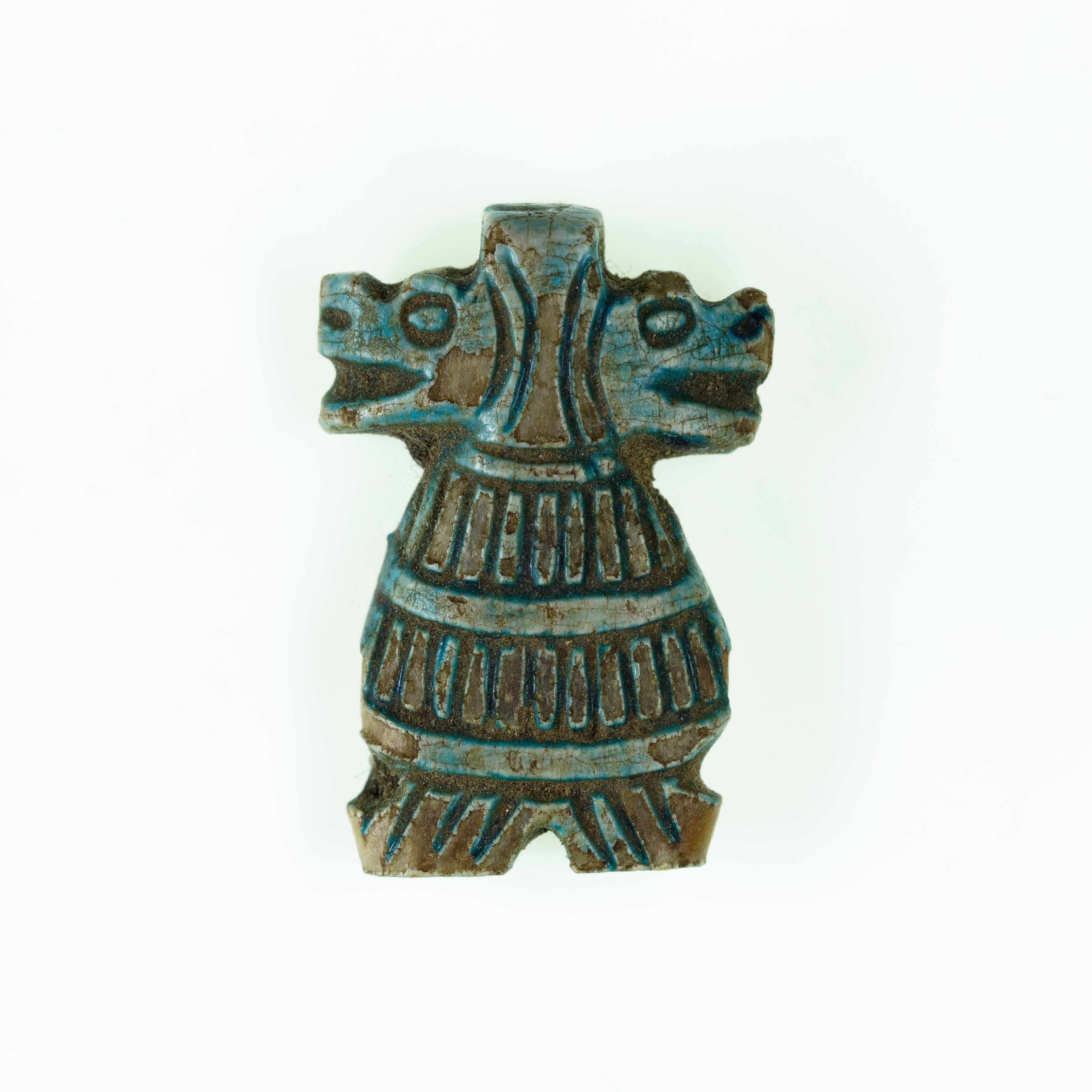
Heritage Analysis: The Taweret Amulet with Double Head
Subject Overview and Cultural Provenance
The artifact under examination is a Taweret amulet with a double head, originating from the Ancient Egyptian civilization, specifically the Late Period (circa 664–332 BCE). Crafted from glazed steatite, a magnesium silicate mineral coated in a vitreous alkaline glaze, this amulet exemplifies the intersection of spiritual symbolism and material artistry. Steatite, known for its softness and ease of carving, was often glazed to mimic the vibrant hues of turquoise or faience, colors associated with rebirth and protection. The double-headed representation of Taweret—a hybrid deity combining hippopotamus, lion, and crocodile attributes—amplifies her apotropaic potency, offering a dual perspective of vigilance against malevolent forces. This amulet was not merely decorative; it was a talismanic object worn or carried to invoke divine safeguarding, particularly for women during childbirth and for children in their vulnerable early years.
Symbolic Power and Spiritual Meaning
The symbolic power of the Taweret amulet lies in its layered iconography. Taweret, whose name means “the Great One,” was a goddess of fertility, childbirth, and domestic protection. The double head—typically one hippopotamus and one lioness—signifies dual guardianship: the hippopotamus represents maternal ferocity and the Nile’s life-giving yet dangerous waters, while the lioness embodies royal strength and predatory vigilance. This duality ensures that the amulet watches over the wearer from all directions, a concept deeply rooted in Egyptian cosmology where balance and opposition (such as Upper and Lower Egypt) were essential for cosmic order. The glazed steatite medium further enhances this spiritual meaning; the glaze’s blue-green hue evokes the primordial waters of Nun, from which creation emerged, and the regenerative power of the sun. In funerary contexts, such amulets were placed on mummies to guide the deceased through the underworld, underscoring their role as protectors against chaos.
Historical Adornment and Material Significance
Historically, the Taweret amulet served as both a personal ornament and a ritual implement. Glazed steatite was a democratized material, accessible to a broader population than gold or lapis lazuli, yet its glaze conferred a sacred luster that mimicked more precious stones. The amulet’s small size—typically 2–4 centimeters—allowed it to be strung on necklaces, bracelets, or girdles, often alongside other protective symbols like the Eye of Horus or the ankh. This practice of layered adornment reflects a sophisticated understanding of material semiotics: the amulet’s tactile presence and visual brilliance reinforced its apotropaic function. For Katherine Fashion Lab, this historical context offers a rich vein of inspiration. The lab can reinterpret the double-headed Taweret amulet as a modular luxury accessory, perhaps as a pendant or clasp that embodies “dual protection” in a contemporary idiom. The use of glazed steatite could be updated with high-fire ceramics or enameled metals, preserving the ancient aesthetic while aligning with modern sustainability and craftsmanship values.
Strategic Implications for 2026 High-End Luxury
To integrate the Taweret amulet into a 2026 high-end luxury strategy, Katherine Fashion Lab must leverage its heritage as a narrative of protective luxury—a concept that resonates with contemporary consumers seeking meaning beyond material excess. The double-headed motif can be positioned as a symbol of dual empowerment: protection of the self and guardianship of legacy. This aligns with the post-pandemic luxury trend where clients prioritize emotional resilience and spiritual well-being. The lab should consider a capsule collection titled “The Great One,” featuring limited-edition pieces that echo the amulet’s form in high-carat gold, blackened silver, or sustainably sourced steatite composites. Each piece could be accompanied by a digital provenance certificate detailing its ancient symbolism and the artisan’s process, appealing to the heritage-driven luxury buyer.
Market Positioning and Brand Narrative
From a strategic branding perspective, the Taweret amulet offers a unique differentiator in a crowded luxury market. While many houses reference Egyptian motifs (e.g., Cartier’s scarab or Bulgari’s Serpenti), the double-headed Taweret is relatively obscure, allowing Katherine Fashion Lab to claim curatorial exclusivity. The lab can develop a narrative around “apotropaic luxury”—adornment that actively protects the wearer’s aura in a chaotic world. This could be marketed through immersive experiences: a private exhibition at a museum or an AR app that visualizes the amulet’s protective energy field. Pricing should reflect the artifact’s rarity and the lab’s artisanal rigor, targeting the ultra-high-net-worth segment that values intellectual and spiritual capital. Collaborations with Egyptologists or contemporary artists reimagining ancient symbols could further solidify the lab’s authority in heritage luxury.
Design Innovation and Material Evolution
For design innovation, the lab should explore how the double head can be rendered in modular forms—perhaps a reversible pendant or a clasp that interchanges between two faces. The glazed steatite medium can be reimagined using advanced ceramic engineering, such as zirconia-based glazes with iridescent finishes, or bio-resin composites that mimic the stone’s texture. This approach honors the ancient material while introducing cutting-edge durability and lightness. The amulet’s protective symbolism can also extend to sustainable luxury practices: each purchase could fund maternal health initiatives or Nile conservation projects, creating a modern echo of Taweret’s role as a guardian of life. This aligns with the 2026 luxury consumer’s demand for purpose-driven consumption.
Conclusion: A Blueprint for Heritage-Driven Luxury
In conclusion, the Taweret amulet with double head is a strategic asset for Katherine Fashion Lab, offering a confluence of symbolic depth, historical resonance, and material beauty. By translating its dual-headed protection into a luxury narrative of empowerment and guardianship, the lab can carve a distinctive niche in the 2026 high-end market. The amulet’s ancient purpose—to shield and nurture—becomes a modern metaphor for luxury that cares for the wearer’s body, mind, and legacy. Through meticulous craftsmanship, ethical sourcing, and immersive storytelling, Katherine Fashion Lab can elevate this artifact from a relic of the past to a beacon of future-oriented luxury. The double-headed Taweret is not just an ornament; it is a talisman for the discerning elite, a timeless emblem of strength and grace that transcends epochs.