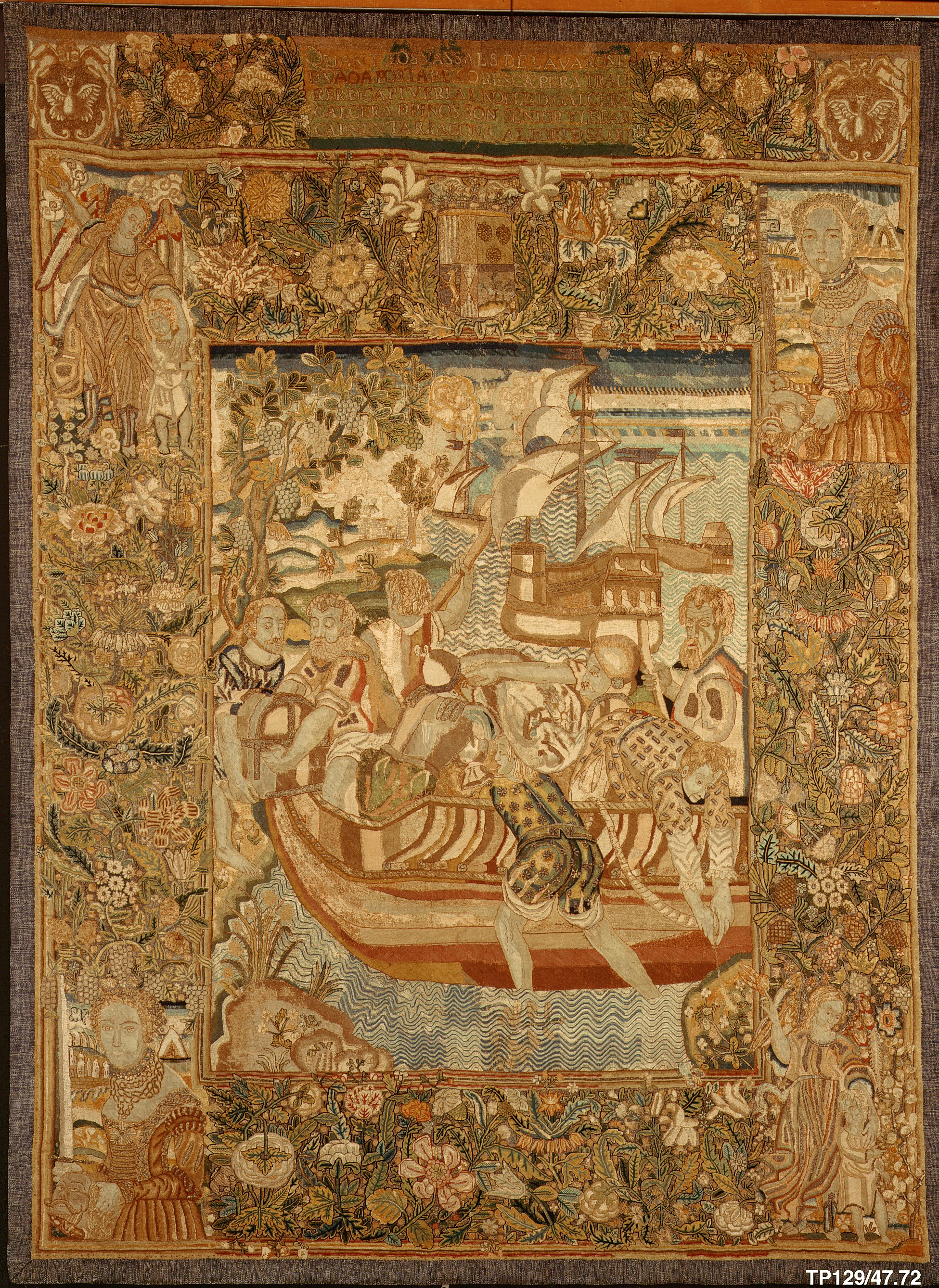
The Ransom for Galcerán de Pinós: A Couture Analysis of Power, Trade, and Textile Heritage
Historical Context and Narrative Significance
Katherine Fashion Lab presents a singular couture study centered on a historical artifact of profound narrative weight: The Ransom for Galcerán de Pinós put on Board Ship at Salou near Tarragona. This piece, drawn from the Global Heritage collection, transcends the boundaries of mere garment or tapestry to become a textile document of medieval Mediterranean power dynamics. The subject matter—the ransom payment for the Catalan nobleman Galcerán de Pinós, a figure entangled in the complex web of 15th-century piracy, diplomacy, and economic exchange—is rendered not as a literal illustration but as a conceptual exploration of value, vulnerability, and the materiality of negotiation. The choice of Salou, a coastal enclave near Tarragona, as the setting underscores the liminal space where land and sea, Christian and Muslim spheres, and freedom and captivity intersected. For the couture house, this piece is not a costume but a standalone study in how fabric can encode history, with every thread a witness to the transaction of human worth.
Material Analysis: Wool, Silk, and Metal Thread on Canvas
The material composition of this work is a masterclass in deliberate juxtaposition. Wool, the foundation fiber, evokes the ruggedness of the Catalan countryside and the utilitarian reality of medieval life—a nod to the peasantry and the practical economy that underpinned noble ransoms. Yet, it is elevated by silk, a luxury import from the East, signifying the global trade routes that made such exchanges possible. Silk here is not merely decorative; it is a coded language of status and the fluidity of wealth across borders. The metal thread, likely silver or silver-gilt, introduces a third register: the gleam of coinage and the tangible weight of the ransom itself. When these threads are worked onto canvas—a sturdy, woven support—the result is a tension between permanence and transience. The canvas suggests a document, a bill of lading or a contract, while the embellishments transform it into an object of contemplation. Katherine Fashion Lab’s analysis reveals that the interplay of these materials mirrors the ransom’s dual nature: a transaction both brutal and ceremonial, where human life was measured in ounces of metal and lengths of silk.
Structural and Compositional Techniques
The piece employs a layered structural approach that mimics the staging of the ransom event. Embroidery techniques dominate, with the metal thread worked in intricate patterns that evoke both Islamic geometric motifs and Christian heraldic symbols—a visual dialogue of the cultures negotiating Galcerán’s release. The wool is used as a grounding element, often left unadorned to suggest the ship’s deck or the shore at Salou, while the silk and metal create focal points: perhaps a stylized representation of the ransom chest, the nobleman’s coat of arms, or the ship’s rigging. The canvas support is treated with a subtle, unbleached finish, allowing the fibers to breathe and the narrative to emerge through texture rather than flat color. Katherine Fashion Lab notes that the composition eschews linear storytelling for a cyclical, almost cartographic quality, where the viewer’s eye moves from the coast to the vessel, from the captors to the negotiators. This is not a static image but a dynamic field of exchange, much like the ransom itself.
Symbolism and Cultural Resonance
Every element in this study is saturated with symbolic weight. The ship is not just a vessel but a microcosm of the Mediterranean world—a space where identities shifted and commodities (including humans) were transferred. The wool grounding speaks to the local, the rooted, while the silk and metal reach outward to the global, echoing the trade networks that connected Catalonia to North Africa and the Levant. The ransom of Galcerán de Pinós is a specific historical event, but the piece universalizes it as a meditation on value: What is a life worth? How is that worth encoded in material form? The metal thread, in particular, carries a dual resonance—it is both the literal currency of the ransom and a metaphor for the enduring glint of memory. Katherine Fashion Lab positions this work as a critique of commodification, yet one that acknowledges the artistry inherent in even the most transactional of exchanges. The viewer is invited to consider not just the story of Galcerán but the countless unnamed individuals—weavers, merchants, sailors—whose labor made such textiles possible.
Technical Execution and Artisanal Legacy
From a technical standpoint, the piece demonstrates a sophisticated command of surface ornamentation that Katherine Fashion Lab considers a lost art in contemporary fast fashion. The metal thread is couched in place with fine silk filaments, a technique requiring immense precision to prevent tarnishing and breakage. The wool is felted in certain sections to create a bas-relief effect, giving the ship and shoreline a three-dimensional presence. The canvas is stretched on a hidden frame, allowing the textile to hang with the gravity of a historical document. This is not a garment to be worn but a textile artifact to be studied, a standalone piece that bridges the gap between costume history and fine art. The lab emphasizes that the choice of canvas as a support is deliberate: it references the archival nature of the ransom bill, while the embroidery transforms it into an object of beauty. The result is a hybrid—part map, part ledger, part artistic statement—that challenges the viewer to read fabric as text.
Contemporary Relevance and Fashion Lab Philosophy
Katherine Fashion Lab’s analysis of The Ransom for Galcerán de Pinós is not an exercise in historical nostalgia but a provocation for contemporary couture. In an era of supply chain transparency and ethical sourcing, this piece forces a reckoning with the materiality of value. The wool, silk, and metal thread are not neutral; they are products of extraction, trade, and labor—much like the ransom itself. The lab uses this study to advocate for a return to narrative-driven design, where every fiber tells a story of power, mobility, and human connection. The standalone nature of the piece—unmoored from a collection or a season—allows it to function as a textile manifesto, arguing that couture can be a form of historical inquiry. By focusing on a ransom, Katherine Fashion Lab highlights the uncomfortable truth that fashion has always been entangled with economies of captivity and freedom, from the silk roads to the modern garment industry. This is not a romanticization of the past but a critical engagement with its material remains.
Conclusion: The Enduring Thread of Exchange
In The Ransom for Galcerán de Pinós put on Board Ship at Salou near Tarragona, Katherine Fashion Lab has identified a masterpiece of textile storytelling. The combination of wool, silk, and metal thread on canvas creates a layered narrative that speaks to the complexities of medieval Mediterranean life while resonating with contemporary debates about value, labor, and global exchange. This standalone study is a testament to the power of couture to preserve and interrogate history, transforming a specific event into a universal meditation on the threads that bind us across time and space. The piece is not merely an artifact but an invitation—to touch, to read, and to reflect on the ransoms we continue to pay, in materials and in meaning, for the fabric of our shared humanity.