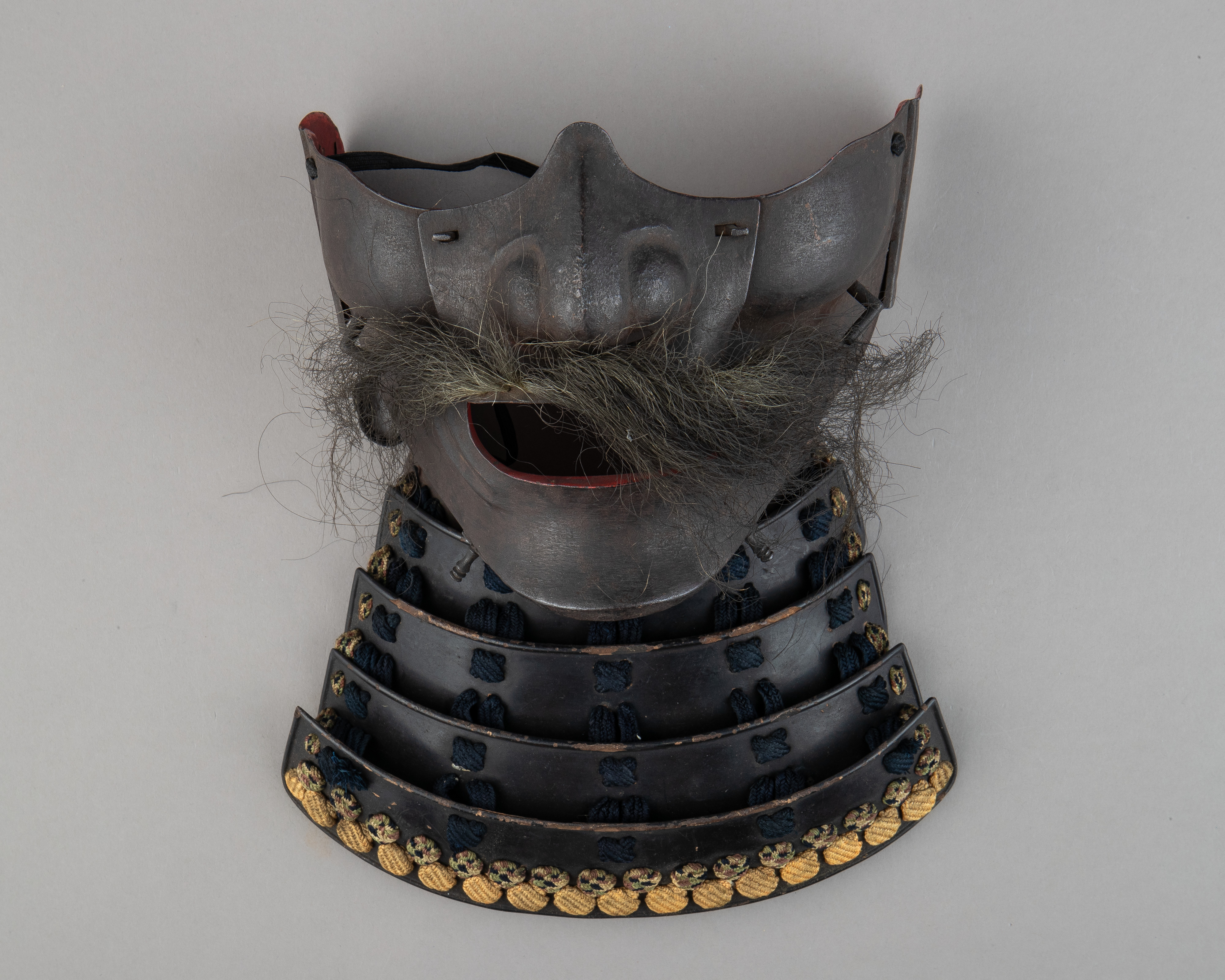
The Armor of the Soul: A Couture Analysis of the Japanese Half Mask (Menpō) with Gorget
In the rarefied world of haute couture, where fabric meets form and identity is stitched into every seam, the Japanese Menpō—a half mask with an integrated gorget—stands as a profound artifact of sartorial and martial mastery. At Katherine Fashion Lab, we dissect this object not merely as a piece of armor, but as a standalone study in couture craftsmanship, where iron, lacquer, silk, and hair converge to articulate a narrative of power, protection, and the deliberate concealment of the self. This analysis explores the Menpō’s construction, its semiotic weight, and its resonance within the lexicon of high fashion, revealing how a warrior’s necessity became an enduring icon of aesthetic discipline.
Material Alchemy: Iron as Textile, Lacquer as Finish
The foundational material of the Menpō is iron, but this is no crude metal. In the hands of Edo-period artisans, iron was transformed into a supple, sculptural medium. The mask’s surface is meticulously hammered and shaped to mirror the contours of the human face, with pronounced cheekbones, a defined jawline, and a subtly flared nose guard. This is not mere utility; it is an act of anthropomorphic precision. The iron is then coated in layers of urushi lacquer, a natural resin that, when cured, yields a glass-like, impervious finish. The lacquer serves dual purposes: it protects against corrosion and infuses the mask with a luminous, almost liquid depth—a technique akin to the haute couture practice of draping and stiffening to create a second skin. The choice of lacquer color, often a deep russet or black, evokes the subtle tonalities of luxury textiles, grounding the mask in a palette of restrained opulence.
The integration of silk cords (shita-obi) and human hair (often crafted into a mustache or beard) introduces a startling juxtaposition. Where iron is rigid and eternal, silk is fluid and tactile; where lacquer is cold, hair is organic and intimate. This material dialogue is central to the Menpō’s couture value. The silk, dyed in deep indigo or crimson, is braided into intricate knots that secure the mask to the kabuto (helmet). These cords are not hidden but celebrated, framing the mask like a couture neckline. The hair, meticulously inserted into the iron’s perforations, adds a hyper-realistic, almost theatrical quality, blurring the line between protection and performance. In modern couture, such a material mix would be heralded as avant-garde—a deliberate collision of hard and soft, permanent and ephemeral.
Structural Anatomy: The Gorget as a Couture Collar
The Menpō is incomplete without its gorget (yodare-kake), a multi-layered, articulated collar that extends from the chin down the neck and shoulders. This component is a marvel of engineering and design. Constructed from overlapping iron plates, each lacquered and laced with silk, the gorget functions as a structural collar, akin to the boned necklines of a Victorian gown or the sculptural shoulders of a Balenciaga silhouette. The plates are riveted in a way that allows for controlled mobility, enabling the wearer to turn their head while maintaining unyielding protection. This balance between rigidity and flexibility is the hallmark of fine tailoring. In couture, a collar must frame the face and define the garment’s silhouette; the gorget does precisely this, creating a V-shaped cascade that draws the eye downward, elongating the neck and emphasizing the mask’s fierce expression.
The articulation of the plates mirrors the techniques of scale armor and, more abstractly, the layered ruffles of a couture gown. Each plate is a separate entity, yet together they form a cohesive, protective whole. This modularity is a lesson in design system thinking: the gorget can be disassembled for cleaning or repair, much like a couture piece is deconstructed for preservation. The silk lacing, known as odoshi, is not merely functional; it is a decorative element that echoes the embroidery and passementerie of high fashion. The tension of the lacing—tight enough to hold, loose enough to move—speaks to the precision of a master corsetier.
Semiotics of the Face: Concealment as Couture Statement
In a world where fashion often seeks to reveal, the Menpō is a radical act of concealment. It obscures the lower half of the face—the mouth, chin, and jaw—leaving only the eyes visible. This partial masking is a powerful semiotic device. It transforms the wearer into an archetype, stripping away individual identity and replacing it with a symbol of collective strength. The mask’s expression is deliberately fearsome: a snarling mouth, bared teeth, and a furrowed brow, often styled after the demonic guardians (oni) of Japanese mythology. This is not a representation of the wearer’s emotions but a projection of intimidation and authority—a couture of the psyche.
From a fashion perspective, the Menpō anticipates the modern phenomenon of the face as a canvas. It predates the surrealist masks of Elsa Schiaparelli, the veils of Yohji Yamamoto, and the digital facades of contemporary streetwear. The mask’s ability to command presence while withholding expression is a lesson in silhouette and restraint. In the atelier, this translates to the art of the hood, the high collar, and the obscured gaze—techniques that create mystery and demand engagement. The Menpō teaches us that what is hidden is often more compelling than what is revealed.
Cultural Resonance: From Battlefield to Runway
The Menpō’s journey from battlefield to museum to fashion inspiration is a testament to its timeless design language. Its echoes can be seen in the armored shoulders of Alexander McQueen’s collections, the lacquer-like finishes of Iris van Herpen’s 3D-printed pieces, and the strategic layering of Comme des Garçons’ deconstructed forms. The mask’s integration of protective function with ornamental beauty challenges the fashion industry’s often superficial relationship with utility. It asks: Can a garment protect the body while also elevating the spirit?
Moreover, the Menpō embodies the Japanese philosophy of mono no aware—the awareness of impermanence. The iron will rust, the silk will fray, the hair will fade. Yet, in its moment of creation, it achieves a perfect synthesis of form and function. This is the ultimate goal of couture: to create objects that transcend their materiality and become vessels of meaning. For Katherine Fashion Lab, the Menpō is not a historical relic but a living blueprint for how fashion can armor the soul, conceal the self, and reveal the warrior within.
Conclusion: The Menpō as a Masterclass in Couture
In closing, the Japanese Half Mask with Gorget is a standalone masterwork that defies easy categorization. It is armor, yes, but it is also sculpture, textile art, and psychological theater. Its construction—iron shaped like flesh, lacquer polished like glass, silk tied like a bow, hair woven like a thread of humanity—demands the same reverence we afford a gown from a Parisian atelier. The Menpō teaches us that protection is a form of adornment, and that the most powerful fashion is that which guards the wearer’s identity while allowing their spirit to command the room. As we continue to explore the boundaries of material and meaning at Katherine Fashion Lab, the Menpō stands as a perennial source of inspiration—a reminder that true couture is not about covering the body, but about revealing the soul through the art of concealment.