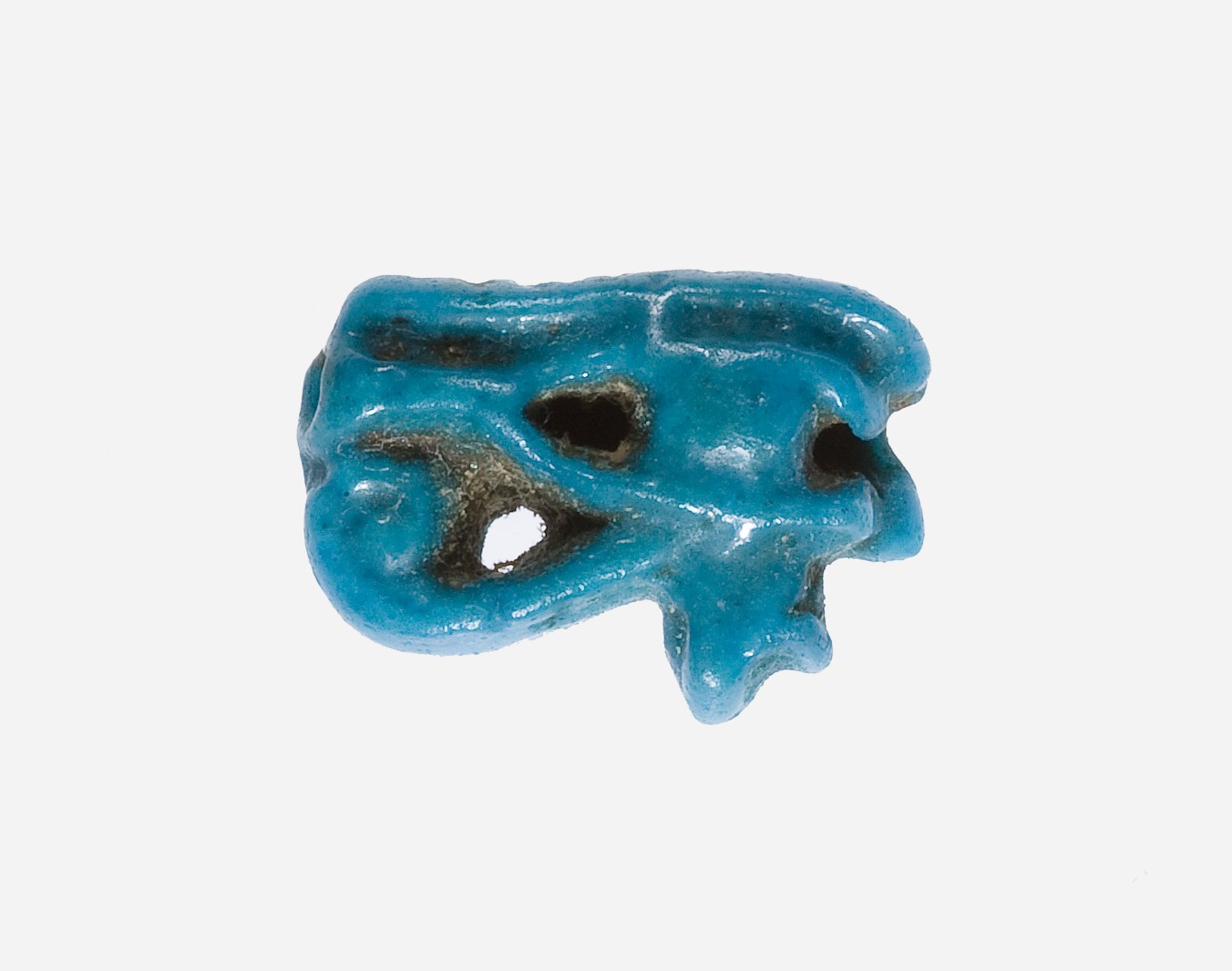
Executive Summary: The Wedjat Eye as a Strategic Heritage Asset
The Wedjat Eye, or Eye of Horus, represents one of the most potent and enduring symbols to emerge from ancient civilization. Fashioned in materials like faience—a glazed non-clay ceramic revered for its luminous, turquoise-like quality—this amulet transcended mere ornamentation to become a cornerstone of spiritual, social, and political identity in ancient Egypt. For Katherine Fashion Lab, a deep-dive analysis of this artifact is not an antiquarian exercise but a critical strategic initiative. This research positions the Wedjat Eye as a foundational archetype for a 2026 high-end luxury strategy, offering a blueprint for embedding authentic symbolic power, historical depth, and spiritual resonance into contemporary design. The amulet’s narrative provides a coherent framework for brand distinction in an oversaturated market, moving beyond aesthetic appropriation to achieve meaningful cultural synthesis.
Historical & Cultural Context: The Anatomy of Protection
Originating in the mythic conflict between the god Horus and his uncle Seth, the Wedjat Eye symbolizes healing, restoration, and wholeness. After Horus lost his eye in battle, the god Thoth magically restored it, an act that transformed the symbol into an embodiment of completeness and protection. This was not passive symbolism; it was an active, functional belief. The amulet’s very design is a mathematical marvel, with its six constituent parts representing fractions that together form the whole unit, metaphorically mapping the senses and the process of perception onto a schema of cosmic order (ma’at).
Faience as the Medium of Divine Light
The choice of faience as a primary medium is itself a statement of profound symbolic intent. More than a cheaper alternative to precious stone, Egyptian faience, with its quartz core and alkaline glaze, was engineered to capture and reflect light. Its brilliant blue-green hues were directly associated with life-giving forces: the Nile’s waters, the lush vegetation of its banks, and the vault of the heavens. Wearing faience was thus an act of carrying a piece of regenerating cosmic power. For the luxury strategist, this underscores a critical principle: materiality must be inseparable from meaning. The medium is not a neutral vessel but an active participant in the narrative, a lesson directly applicable to sourcing and storytelling in luxury materials for 2026.
Core Symbolic Pillars for Modern Translation
Symbolic Power and Spiritual Meaning
The Wedjat Eye operated on multiple levels: a protective talisman against evil, a guarantee of physical wholeness, and a key to spiritual perception. It was ubiquitous, found on jewelry, carved into ship prows, placed within mummy wrappings, and used as a medical notation. This multifunctionality points to a holistic worldview where adornment, wellness, and destiny were intertwined. For a contemporary luxury brand, this expands the definition of "value" beyond economic cost. The modern equivalent is emotional and psychological value—the "wellness" and "protection" consumers seek in a turbulent world. A 2026 strategy can frame products not as mere accessories, but as modern talismans for clarity, resilience, and personal integrity.
Historical Adornment and Social Currency
While deeply spiritual, the Wedjat Eye was also a marker of social and political status. Worn by pharaohs and commoners alike, its meaning was universal, but its execution was tiered. A peasant might have a simple faience amulet, while a royal would possess one inlaid with lapis lazuli and gold. This demonstrates an innate understanding of democratic luxury—a shared symbolic language accessible at multiple entry points. Katherine Fashion Lab can architect a collection strategy that mirrors this: iconic Wedjat-inspired motifs rendered in sterling silver or high-polished resin for diffusion, while the haute couture or fine jewelry line explores the symbol through rare gemstones, innovative composites, and masterful metallurgy, preserving the core symbol while elevating its material expression.
Strategic Integration: A 2026 Luxury Framework
The 2026 luxury consumer is increasingly a "cultural investor," seeking authenticity, narrative depth, and intellectual engagement. The Wedjat Eye provides a robust platform to meet these demands through a strategy of Archetypal Recontextualization.
Narrative-Driven Collections
Move beyond literal replication. Develop collections themed around the core concepts inherent to the Wedjat: "The Restored Gaze" (focusing on perception and clarity), "Mathematical Harmony" (exploring geometric precision and proportion in cuts and patterns), and "Faience Light" (a material innovation lab creating modern luminous textiles and finishes). Each collection tells a chapter of the story, building a rich brand universe.
Material Innovation as Heritage
Establish a "Katherine Faience Lab"—a dedicated R&D division tasked with creating proprietary materials that capture the spirit of ancient faience. This could involve sustainable glazed ceramics for hardware, luminescent polymers woven into evening wear, or partnerships with tech firms developing smart materials that change hue. This positions the brand as both curator and pioneer.
The Modern Talisman Ecosystem
Product development should create a cohesive ecosystem of modern talismans. This includes fine jewelry, naturally, but also extends to meticulously crafted leather goods with amulet-like clasps, eyewear frames that subtly reference the Eye's geometry, and even a line of home objects or digital app "talismans" for mindfulness. The symbol becomes a recognizable brand code across categories, ensuring cohesion and cross-category desirability.
Ethical & Cultural Stewardship
Engagement with heritage symbols in the 2020s necessitates respect and reciprocity. The strategy must include clear, public-facing partnerships with archaeological institutes or museums dedicated to Egyptian heritage, funding conservation or research. This transforms cultural reference from extraction into a dialogue, building brand integrity and aligning with the values of the conscious luxury consumer.
Conclusion: From Ancient Amulet to Iconic Code
The Wedjat Eye amulet offers Katherine Fashion Lab far more than a decorative motif. It provides a complete strategic lexicon: a story of resilience and restoration, a principle of meaningful materiality, a model for tiered yet coherent brand expression, and a timeless connection to the human desire for protection and insight. By deconstructing its historical, spiritual, and social functions, the Lab can reconstruct a powerful modern luxury identity. The goal for 2026 is not to sell a piece of history, but to embed its enduring intelligence into objects of contemporary desire, transforming the Wedjat from an archaeological artifact into the foundational icon of a discerning, narrative-rich, and spiritually attuned luxury house. This is the path to achieving not just market presence, but cultural relevance and lasting symbolic capital.