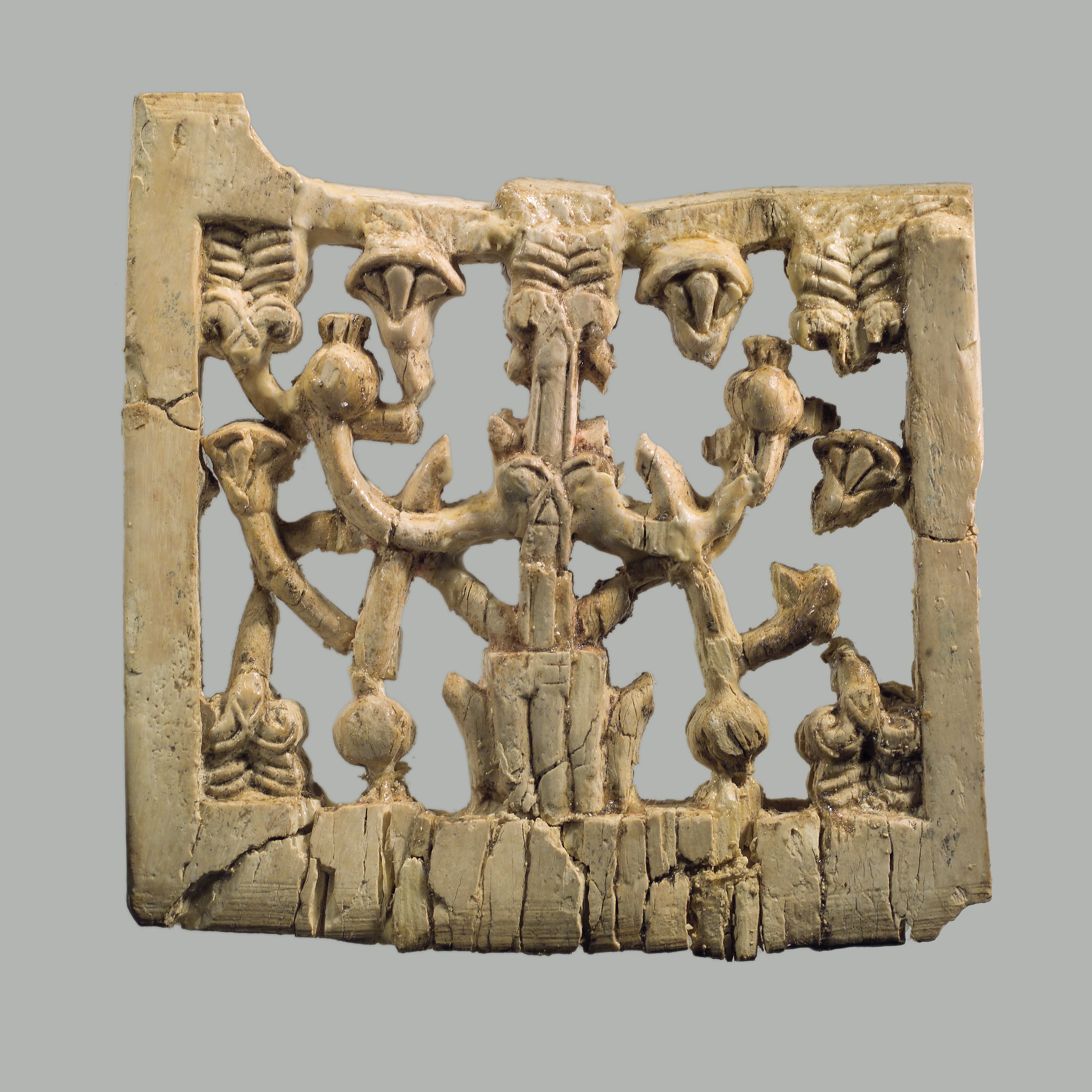
Heritage Analysis: Openwork Ivory Plaque with Papyrus and Pomegranates
Provenance and Material Significance
The openwork plaque, carved from elephant ivory and originating from the Neo-Assyrian period (c. 9th–7th century BCE), represents a pinnacle of ancient Near Eastern craftsmanship. Assyrian artisans, particularly those working in the royal workshops of Nimrud and Khorsabad, mastered the delicate art of openwork carving—a technique that removes background material to create a lace-like, translucent effect. Ivory, sourced from Syrian elephants or traded from Africa and India, was a material of immense value, reserved for elite adornment, furniture inlays, and ritual objects. This plaque’s survival underscores its symbolic weight: it was not merely decorative but a statement of divine favor and imperial reach.
Symbolic Power: Papyrus and Pomegranates in Assyrian Cosmology
The papyrus motif is a striking anomaly in Assyrian iconography, as papyrus (Cyperus papyrus) is native to Egypt and the Nile Delta. Its presence on an Assyrian artifact signals cultural appropriation and political ambition. Assyrian kings, from Tiglath-Pileser III to Ashurbanipal, actively absorbed Egyptian motifs to legitimize their conquest of the Levant and, briefly, Egypt itself. Papyrus here symbolizes rebirth, eternal life, and royal dominion over the fertile, life-giving waters of the Nile. In Assyrian thought, it reinforced the king’s role as the earthly steward of cosmic order—a god-ordained ruler whose power transcended regional boundaries.
The pomegranate is far more rooted in Near Eastern tradition. Revered across Mesopotamia, Anatolia, and the Levant, the pomegranate was a polysemic symbol: fertility, abundance, kingship, and the cycle of death and rebirth. Its ruby-red seeds evoked blood and life force; its crown-like calyx mirrored royal regalia. In Assyrian palace reliefs and cylinder seals, pomegranates often flank sacred trees or deities, reinforcing the king’s role as the mediator between heaven and earth. The fruit’s 365 seeds (in some traditions) also linked it to the solar year, aligning royal power with cosmic cycles.
Historical Adornment: The Openwork Technique as Status Marker
Openwork ivory plaques were not designed for public display in the modern sense. They adorned furniture—thrones, beds, footstools—and ritual chariots within the royal palace and temple complexes. The technique itself required extraordinary skill: carving through a thin ivory sheet (2–4 mm thick) without fracturing the material, then polishing the remaining lattice to a luminous sheen. The resulting play of light and shadow transformed static furniture into a dynamic, almost living presence. For the Assyrian elite, such objects were emblems of sophistication and global trade networks. Ivory, gold, lapis lazuli, and cedar were tribute from vassal states; possessing them demonstrated the empire’s ability to command resources from Egypt to the Persian Gulf.
The specific pairing of papyrus and pomegranates on a single plaque is rare and deliberate. It likely adorned a piece of furniture used in royal investiture or funerary rituals. The papyrus’s aquatic symbolism (rebirth from the primordial waters) combined with the pomegranate’s chthonic associations (death and regeneration) created a powerful talisman for the king’s transition between earthly and divine realms. This was adornment as theopolitical communication—a visual assertion that the king’s power was both earthly and eternal.
Spiritual Meaning: The Plaque as a Microcosm of Assyrian Religion
Assyrian spirituality was deeply syncretic, absorbing and reinterpreting symbols from conquered cultures. The openwork plaque functioned as a sacred microcosm. The papyrus, with its triangular stem and fan-shaped umbel, evoked the primordial mound (Benben) of Egyptian creation myths, while the pomegranate’s spherical form and internal seeds mirrored the cosmic egg of Mesopotamian cosmology. Together, they represented the union of heaven (the sun-blessed papyrus) and earth (the fertile pomegranate)—a duality central to Assyrian kingship.
Furthermore, the openwork itself held spiritual significance. The negative space—the voids cut into the ivory—was not empty but charged with invisible divine presence. In Assyrian art, gaps and perforations were portals for prayers and offerings to reach the gods. The plaque’s placement on a throne or bed meant that the king’s body was perpetually inscribed with protective symbolism, his sleep and rule guarded by the regenerative powers of papyrus and pomegranate. This was not mere decoration; it was a living talisman woven into the fabric of imperial ritual.
2026 High-End Luxury Strategy: Translating the Plaque’s Heritage into Modern Brand Value
For Katherine Fashion Lab, this Assyrian plaque offers a blueprint for transcultural luxury in the 2026 market. The following strategic insights emerge from this heritage analysis:
1. The Power of Contradictory Symbols
The plaque’s genius lies in pairing a foreign symbol (papyrus) with a native one (pomegranate). For a 2026 luxury brand, this translates into cultural fusion as a statement of sophistication. Katherine Fashion Lab can design collections that juxtapose motifs from distinct heritages—for example, combining Japanese kiri (paulownia) leaves with Persian floral arabesques—to signal global fluency and intellectual depth. The key is deliberate, researched juxtaposition, not random eclecticism.
2. Openwork as a Signature Craft
Openwork carving—whether in ivory, metal, or modern materials like resin or laser-cut leather—communicates rarity, patience, and mastery. In an era of fast fashion, openwork demands time and skill, qualities that define ultra-high-end positioning. Katherine Fashion Lab could develop a signature “Assyrian Lattice” technique for handbags, jewelry, or footwear, using negative space to create visual depth and brand-recognizable silhouettes. The marketing narrative would emphasize the spiritual function of voids—as portals to hidden meaning, much like the original plaque.
3. Theopolitical Storytelling
The plaque’s original purpose—to legitimize royal power through divine symbolism—can be reinterpreted for 2026 luxury consumers who seek meaning beyond status. Katherine Fashion Lab can position its collections as “artifacts of personal sovereignty”: each piece imbued with protective or aspirational symbolism (e.g., papyrus for renewal, pomegranate for abundance). This taps into the growing demand for “intentional luxury”—objects that serve as talismans for the wearer’s own journey. Limited-edition pieces with documented heritage narratives (e.g., “Inspired by the Nimrud ivories”) would command premium pricing and collector loyalty.
4. Material Ethics and Heritage Revival
While ivory is now rightly banned, Katherine Fashion Lab can champion heritage materials with ethical sourcing: sustainably harvested tagua nut (vegetable ivory), recycled precious metals, or lab-grown gemstones. The plaque’s legacy becomes a platform for craft preservation: partnering with ateliers in the Middle East or Mediterranean to revive lost openwork techniques, thereby creating a living heritage supply chain. This aligns with 2026 consumer values of transparency, cultural respect, and environmental stewardship.
5. The 2026 Consumer as a “Neo-Assyrian Collector”
The original plaque’s owner was a king who accumulated symbols of conquered lands. The 2026 high-end luxury consumer—often a global entrepreneur, diplomat, or cultural patron—similarly seeks objects that narrate their own world-spanning identity. Katherine Fashion Lab can cater to this by offering “curated heritage capsules”: small, research-backed collections that tell a specific historical story (e.g., “The Assyrian Garden: Papyrus and Pomegranate”). Each piece would come with a digital provenance card (QR-coded) linking to museum archives, archaeological papers, and artisan interviews. This transforms the purchase into an educational artifact, deepening emotional and intellectual attachment.
Conclusion: The Plaque as a Strategic Archetype
The openwork Assyrian plaque with papyrus and pomegranates is far more than a decorative relic. It is a compressed universe of political ambition, spiritual belief, and masterful craft. For Katherine Fashion Lab, it offers a template for luxury that is symbolically dense, ethically reimagined, and globally resonant. By translating the plaque’s core principles—contradictory symbolism, openwork mastery, theopolitical narrative, and provenance stewardship—into a 2026 strategy, the brand can position itself at the intersection of heritage authority and avant-garde innovation. The result is not fashion as commodity, but fashion as curated legacy—a wearable artifact for the discerning sovereign of the modern world.