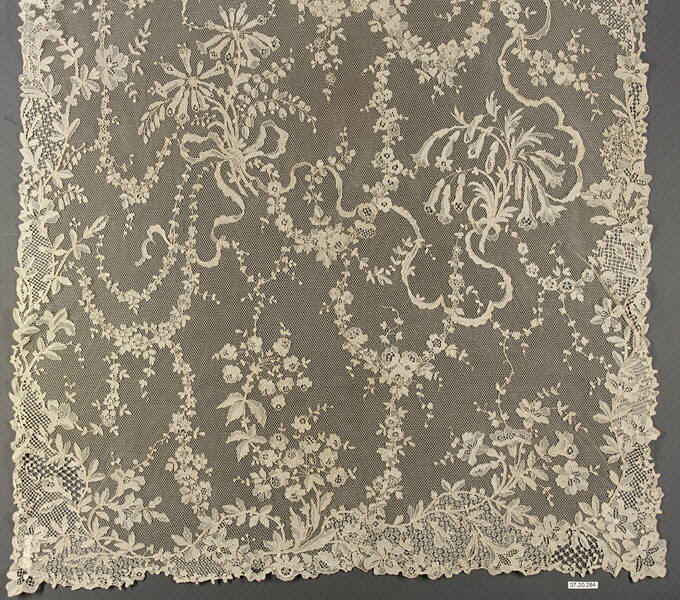
The Scarf as Architectural Silence: A Couture Analysis of Needle Lace and Point d’Alençon
In the rarefied echelons of haute couture, the scarf is often relegated to the periphery—a practical accessory, a fleeting gesture of warmth or modesty. Yet, within the atelier of Katherine Fashion Lab, the scarf is elevated to a standalone object of study, a tactile narrative woven from threads of global heritage. This analysis dissects a singular piece: a scarf crafted from needle lace and point d’Alençon, sourced from traditions spanning continents, yet rendered as a contemporary architectural statement. It is not merely an accessory; it is a microcosm of couture’s highest ambitions—where material mastery, historical reverence, and structural innovation converge.
The Material Lexicon: Needle Lace and Point d’Alençon
Needle lace represents one of the most labor-intensive textile arts in human history. Originating in 16th-century Italy (reticella) and later refined in France, it is constructed entirely by hand using a needle and thread, without a woven base. Each stitch is a deliberate act of creation, building a fabric that is simultaneously fragile and robust. For Katherine Fashion Lab, needle lace is not a nostalgic nod to the past; it is a medium for exploring negative space, light, and tension. The scarf’s needle lace sections are executed in a gossamer-thin silk thread, dyed in a palette of ivory, charcoal, and muted ochre—colors that evoke ancient trade routes from the Silk Road to the Mediterranean.
Point d’Alençon, often called the “queen of lace,” is a specific needle lace technique developed in Alençon, France, in the 17th century. Its hallmark is a raised, cordonnet outline that defines each motif, creating a three-dimensional relief against a sheer ground. In this scarf, point d’Alençon is used sparingly but strategically: it frames the scarf’s periphery and anchors key intersections of the lace pattern. The cordonnet is worked in a matte silk thread, contrasting with the luminous, almost liquid quality of the needle lace. This interplay of texture—rough against smooth, opaque against translucent—imbues the scarf with a kinetic energy, as if it breathes with the wearer’s movement.
Global Heritage: A Cartography of Craft
Katherine Fashion Lab’s design philosophy is rooted in global heritage as a living, evolving dialogue. This scarf is a cartography of craft, referencing techniques and symbols from disparate cultures without flattening them into pastiche. The needle lace patterns draw from Venetian punto in aria, but the motifs—geometric stars, interlocking circles, and stylized flora—echo Islamic geometric art from the Alhambra and Mughal miniature paintings. The point d’Alençon borders, with their scalloped edges, recall the intricate calado lacework of the Philippines, a legacy of Spanish colonial influence. Yet, these references are not overtly decorative; they are structural, embedded into the scarf’s architecture.
The scarf’s dimensions—approximately 90 by 90 centimeters—are a deliberate choice. This square format is a universal canvas for draped textiles, from the Indian dupatta to the French carré. By honoring this shared form, the scarf becomes a bridge between cultures, a silent testament to the human impulse to adorn and communicate through cloth. The color palette, too, is a global lexicon: ivory for purity in many Eastern traditions, charcoal for the ink of Japanese sumi-e, ochre for the earth pigments of Aboriginal Australian art. Each hue is hand-dyed using natural indigo, madder root, and walnut husk, ensuring that the scarf is not only visually resonant but also ecologically conscious.
Structural Innovation: The Scarf as Architecture
What sets this scarf apart from historical lace pieces is its structural innovation. Katherine Fashion Lab employs a technique borrowed from tensile architecture: the lace is not merely sewn but tensioned across an internal framework of micro-mesh silk organza. This invisible substructure allows the needle lace to float away from the body, creating pockets of air and shadow. When draped, the scarf does not collapse into a flat plane; it retains a sculptural volume, as if suspended in mid-air. This is couture as engineering—a dialogue between softness and rigidity.
The point d’Alençon borders act as a compression ring, a term borrowed from dome architecture. Just as a ring distributes stress evenly around a circular opening, the cordonnet edges stabilize the lace, preventing distortion while allowing for fluid draping. The result is a scarf that can be worn in multiple configurations: as a shawl, a head wrap, or a wall hanging. In each iteration, it maintains its structural integrity, a testament to the precision of its construction. The scarf’s weight is negligible—under 50 grams—yet it possesses a heft that speaks to its craftsmanship.
Contextualizing the Standalone Study
This scarf is presented as a standalone study, a term that implies both isolation and depth. In the context of Katherine Fashion Lab’s broader oeuvre, it is a departure from the brand’s focus on full-body silhouettes. Here, the scarf is the complete object—a self-contained universe of technique and meaning. This decision challenges the fashion industry’s tendency to view accessories as secondary. By isolating the scarf, the atelier invites the viewer to scrutinize every stitch, every thread, every shadow. It is an act of radical focus, akin to a still life painting that elevates a single object to monumental significance.
The scarf also occupies a unique position in the couture ecosystem. Unlike bespoke gowns, which are often worn once, this scarf is designed for longevity and versatility. It can be passed down as an heirloom, its needle lace mended and restored over generations. This aligns with the slow fashion movement, but it also reclaims lace from its historical association with femininity and domesticity. The scarf is not delicate in the pejorative sense; it is resilient, a textile armor that protects and empowers the wearer. It is a feminist statement, not through overt symbolism, but through its insistence on technical mastery and material integrity.
The Sensory Experience: Touch, Light, and Time
To experience this scarf is to engage in a sensory dialogue. The needle lace is cool to the touch, with a slight graininess from the hand-stitched loops. The point d’Alençon borders are raised, offering a tactile map of the scarf’s architecture. When held up to light, the lace becomes a screen, casting intricate shadows that shift with the angle of the sun. This is a garment that exists in time: the hours of labor are visible in every knot, and the scarf will age gracefully, its threads softening and its colors mellowing.
Katherine Fashion Lab’s choice to use natural dyes further anchors the scarf in a temporal narrative. Indigo, for instance, is a living dye that oxidizes over time, deepening in hue with each wash. This impermanence is not a flaw but a feature—a reminder that couture is not about static perfection but about the beauty of process. The scarf, therefore, becomes a chronicle of its own making and wearing, a textile diary.
Conclusion: The Scarf as a Manifesto
In the hands of Katherine Fashion Lab, the scarf transcends its accessory status to become a manifesto for couture’s future. It asserts that luxury is not synonymous with excess but with intentionality. It demonstrates that global heritage can be honored without appropriation, through deep research and technical respect. And it proves that even the smallest object—a square of lace—can contain the full breadth of human creativity. This scarf is not just worn; it is studied, cherished, and remembered. It is, in the truest sense, a work of art.