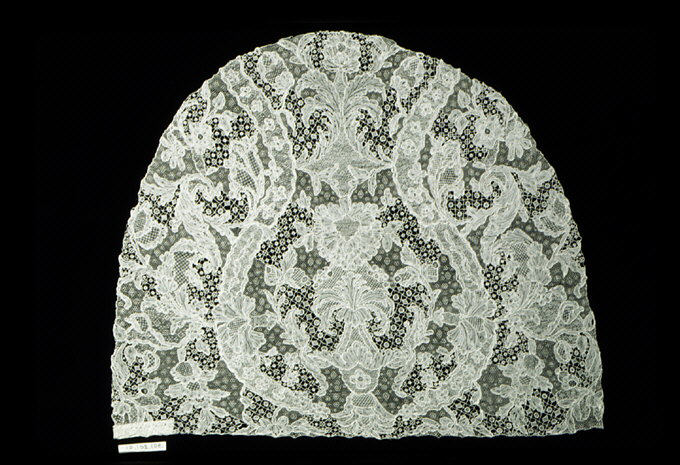
The Cap Crown: A Study in Structural Poetry
In the rarefied domain of haute couture, the cap crown is often relegated to a supporting role—a structural foundation for more ostentatious embellishments. Yet, within the atelier of Katherine Fashion Lab, this unassuming silhouette is elevated to a standalone thesis on the interplay between heritage and innovation. This analysis deconstructs the cap crown as an object of profound technical mastery, where the ethereal medium of needle lace—specifically the point d’Argentan variant—becomes a vehicle for global narrative. Here, the crown is not merely a headpiece; it is an architectural artifact that redefines luxury through precision, tradition, and conceptual rigor.
Heritage as a Design Lexicon
The cap crown’s lineage traces back to medieval European headwear, evolving from utilitarian warmth to aristocratic symbolism. However, Katherine Fashion Lab’s interpretation eschews nostalgic replication. Instead, the studio mines this heritage for its formal vocabulary: the dome’s gentle curvature, the brim’s subtle projection, and the crown’s inherent symmetry. These elements are not copied but abstracted, serving as a geometric scaffold upon which a global tapestry of techniques is woven. The result is a piece that speaks to the universal human impulse to adorn the head—a gesture present in the feathered headdresses of the Americas, the embroidered skullcaps of Central Asia, and the lace coifs of Renaissance Europe. By distilling these diverse traditions into a single silhouette, the cap crown becomes a vessel for cross-cultural dialogue, devoid of appropriation yet rich in referenced wisdom.
Needle Lace: The Alchemy of Thread and Air
At the heart of this creation lies needle lace, a technique that demands both monastic patience and mathematical precision. Unlike bobbin lace, which is mechanically plotted, needle lace is built stitch by stitch, with a single thread and needle forming loops, twists, and bridges that seem to defy gravity. Katherine Fashion Lab’s choice of point d’Argentan—a French lace variant from the 17th century—is deliberate. Its hallmark is the “brides picotées” (picoted bars), where each connecting thread is adorned with tiny, looped knots. This creates a surface that is simultaneously rigid and airy, like frozen frost on a windowpane. For the cap crown, this translates into a dome that appears to hover above the wearer’s head, supported by a gossamer network of structural tension. The lace is not appliquéd onto a fabric base; it is the structure. Each picot acts as a micro-arch, distributing weight and maintaining form without the need for underlying boning. This is engineering disguised as embroidery.
Point d’Argentan: A Study in Contradiction
To fully appreciate the cap crown, one must understand point d’Argentan’s unique properties. Unlike its delicate cousin, point de Venise, Argentan lace is robust, almost architectural. Its ground is a dense, hexagonal mesh, while the motifs—often floral or geometric—are outlined with a raised cordonnet (a thicker thread). For the cap crown, Katherine Fashion Lab reverses this hierarchy: the ground becomes the focal point, while the motifs recede into subtle texture. The hexagonal mesh is scaled up, each cell measuring nearly a centimeter across, creating a honeycomb effect that catches and refracts light. This is a radical departure from tradition, where lace was meant to be seen as a continuous, delicate field. Here, the voids are as important as the threads, turning the crown into a study of negative space. The point d’Argentan’s inherent stiffness is leveraged to create a self-supporting shell, yet the picoted bars soften the silhouette, lending a tactile, almost organic quality. It is a material that whispers of both iron and cobweb.
Construction as Choreography
The making of this cap crown is a performance of meticulous choreography. The process begins with a custom wooden block, turned to the exact dimensions of the wearer’s cranium. Onto this, a pattern of the lace is drawn in water-soluble ink. The needle lace is worked directly on the block, with the thread tensioned so that each stitch conforms to the three-dimensional curve. This is not flat lace later shaped by steaming; it is born in the round. The point d’Argentan is built in sections: the crown’s apex, the side panels, and the brim (if present). Each section is joined by a “point de raccroc” (invisible seam), where threads are woven into the existing structure, leaving no trace of assembly. The picoted bars are added as a final layer, their loops meticulously counted to ensure uniformity. The result is a seamless object—a monocoque of lace that holds its shape without internal scaffolding. The weight is negligible, yet the presence is monumental.
Global Heritage: A Tapestry of Techniques
While point d’Argentan anchors the piece, Katherine Fashion Lab weaves in global references through subtle details. The crown’s silhouette echoes the “kufi” cap of West Africa and the “doppa” of Central Asia, both of which use structural embroidery to create a stiff, rounded form. The lace’s hexagonal grid recalls Islamic geometric patterns, while the picoted edges nod to the “chikan” embroidery of India, where thread loops create shadow work. These influences are not overt; they are embedded in the logic of the design. For instance, the crown’s interior is lined with a whisper-thin silk organza, dyed a deep indigo—a color sacred in West African textiles and Japanese shibori. This lining is invisible from the outside, yet it adds a layer of cultural resonance, a secret dialogue between the wearer and the maker. The piece thus becomes a palimpsest of global craft, where each stitch is a citation from a shared human heritage.
Standalone Study: The Crown as Artifact
Positioning this cap crown as a standalone study removes it from the context of a full ensemble. It is not an accessory; it is a primary object. This allows the observer to engage with its materiality and form without distraction. The crown’s scale is intimate—roughly 20 centimeters in diameter—yet its presence commands a room. When displayed on a minimalist pedestal, it reads as both sculpture and relic. The interplay of light through the hexagonal voids creates shifting shadows on the surface below, animating the piece in real time. This is a deliberate curatorial choice: the crown is not meant to be worn in a conventional sense, but to be contemplated as a microcosm of couture’s potential. It asks the viewer to consider what a garment is when it is liberated from the body. Is it still fashion? Or does it become pure form? The answer lies in the tension between its heritage as a wearable object and its evolution into an autonomous artwork.
Conclusion: The Future of Craft in a Digital Age
Katherine Fashion Lab’s cap crown is a manifesto for the enduring relevance of manual craft in an era of digital simulation. The point d’Argentan needle lace, with its thousand-hour creation time, stands in stark opposition to the instant gratification of 3D printing. Yet the piece is not reactionary; it is progressive in its rigor. By isolating a single silhouette and elevating it through global heritage techniques, the lab demonstrates that luxury is not about excess but about depth—the depth of research, of skill, and of meaning. This cap crown is a quiet revolution, proving that the most powerful statements are often the most restrained. It invites the discerning connoisseur to look closer, to touch, and to marvel at what a single thread, guided by a needle and a vision, can achieve. In doing so, it redefines the cap crown not as a relic of the past, but as a beacon for the future of couture.