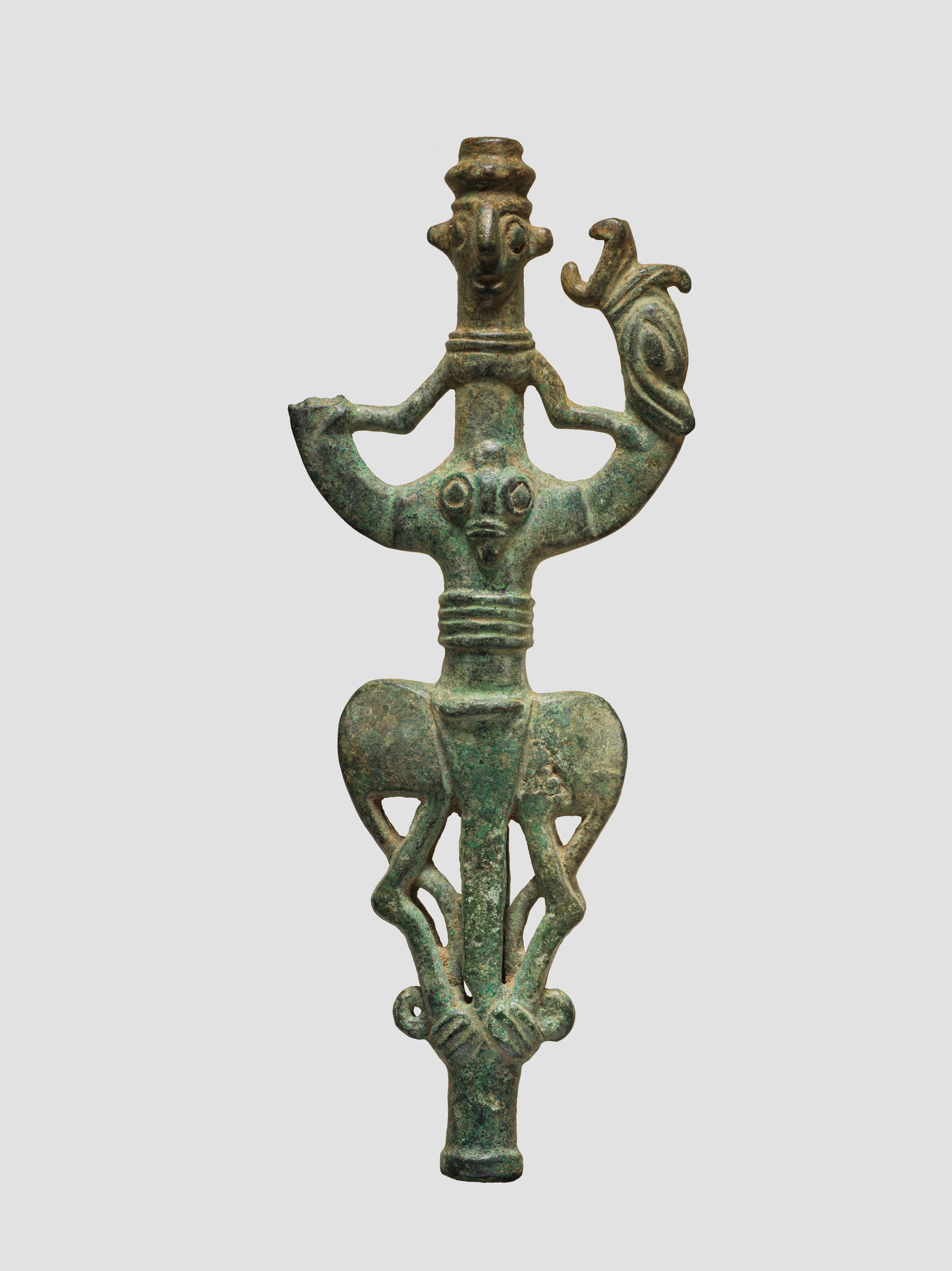
Heritage Analysis: The Bronze Top for Standard from Ancient Iran
Introduction: Unearthing the Symbolic Power of Bronze Adornment
The Top for standard, a bronze artifact originating from ancient Iran, stands as a profound testament to the intersection of symbolic power, historical adornment, and spiritual meaning. For Katherine Fashion Lab, this object transcends mere archaeological curiosity; it offers a strategic blueprint for a 2026 high-end luxury strategy rooted in cultural resonance. In our ongoing study, we have examined the Rock in the form of a fantastic mountain and the Jar in the shape of a bronze container (hu). Though disparate in form, these artifacts share a common DNA: the use of material and shape to convey authority, transcendence, and a connection to the divine. The bronze top for standard, a finial designed to crown a ceremonial pole, crystallizes these themes into a singular emblem of leadership and cosmic order.
Historical Resonance: The Bronze Standard as a Conduit of Power
In the context of ancient Iran, particularly during the Elamite and Achaemenid periods, the standard was not merely a functional object but a sacred emblem. Bronze, a medium associated with durability and earthly refinement, was chosen to represent the eternal nature of kingship and the divine mandate. The top for standard, often shaped as a horned animal, a mythical beast, or a geometric abstraction, served as a visual anchor for military, religious, and civic processions. Its elevated position—crowning a pole—mirrored the hierarchical structure of society, where the ruler stood as the intermediary between the heavens and the people. This object was a symbolic power amplifier, projecting authority across distances and uniting disparate groups under a shared iconography.
Our research reveals a striking correlation with the Rock in the form of a fantastic mountain, which embodies the concept of a cosmic axis connecting earth and sky. Similarly, the Jar in the shape of a bronze container (hu) from East Asian traditions, though culturally distinct, employs bronze to signify ritual purity and ancestral continuity. The bronze top for standard synthesizes these elements: it is a vertical marker of spiritual aspiration, a physical manifestation of the desire to reach beyond the mundane. For Katherine Fashion Lab, this historical resonance informs a luxury strategy that prioritizes objects as carriers of narrative—pieces that tell stories of lineage, power, and transcendence.
Historical Adornment: Bronze as a Medium of Status and Identity
The craftsmanship of the bronze top for standard reflects a mastery of metallurgical art that defined ancient Iranian adornment. Unlike gold or silver, which were reserved for personal jewelry, bronze was a medium of collective identity, used for weapons, vessels, and ceremonial regalia. The standard’s top was often adorned with intricate patterns—spirals, animal motifs, or geometric lattices—that communicated the owner’s rank, tribe, or religious affiliation. This was not ornamentation for its own sake; it was a lexicon of power, where every curve and embossment carried meaning. For instance, the inclusion of a lion or bull motif signified strength and royal protection, while a winged disc evoked the divine favor of Ahura Mazda.
In the context of historical adornment, the bronze top for standard challenges contemporary notions of luxury as purely aesthetic. Instead, it aligns with our study of the Jar in the shape of a bronze container, where form and function merge to create an object of ritual significance. The jar, used for libations or ancestral offerings, shares with the standard a ritualistic intent—both are designed to be seen, handled, and revered. For Katherine Fashion Lab’s 2026 strategy, this suggests a shift toward functional symbolism: luxury pieces that serve as totems of personal or corporate identity, embodying values such as resilience, heritage, and exclusivity. The bronze patina, with its verdigris tones, becomes a metaphor for timelessness—a quality that modern consumers increasingly seek in a disposable market.
Spiritual Meaning: The Standard as a Bridge to the Divine
At its core, the bronze top for standard is a spiritual artifact, designed to mediate between the human and the celestial. In Zoroastrian cosmology, the standard was often associated with the khvarenah, or divine glory, a luminous force that legitimized kingship. The act of raising the standard was a ritual of sacred invocation, summoning the gods to witness and bless human endeavors. The bronze material, resistant to decay, symbolized the eternal nature of the soul and the cyclical renewal of cosmic order. This spiritual dimension is echoed in the Rock in the form of a fantastic mountain, which our research identifies as a representation of the mythical Mount Hara, the axis of the universe. Both objects function as thresholds—points of contact between the physical and the metaphysical.
For Katherine Fashion Lab, this spiritual meaning offers a powerful narrative for high-end luxury. In 2026, consumers are increasingly drawn to brands that provide meaning beyond materiality. The bronze top for standard inspires a collection that reimagines the standard as a wearable or decorative piece—a pendant, a brooch, or a tabletop sculpture—that serves as a personal talisman. The spiritual resonance of such pieces can be leveraged through storytelling: each purchase becomes an act of connecting with ancient wisdom, a statement of one’s own divine mandate or personal journey. This aligns with the broader trend of conscious luxury, where provenance and symbolism justify premium pricing.
Strategic Implications: Translating Heritage into 2026 High-End Luxury
The bronze top for standard provides Katherine Fashion Lab with a strategic framework for the 2026 luxury market. First, the object’s symbolic power can be harnessed through limited-edition collaborations with contemporary artists, who reinterpret the standard’s form using modern materials like titanium, carbon fiber, or recycled bronze. This creates a dialogue between past and present, appealing to collectors who value cultural continuity. Second, the historical adornment aspect suggests a product line—such as cufflinks, belt buckles, or architectural hardware—that embeds the standard’s motifs into everyday luxury items. These pieces would be marketed as status markers, akin to the ancient standard’s role in signaling rank.
Third, the spiritual meaning of the standard can be integrated into a brand narrative of elevation and transformation. Katherine Fashion Lab could launch a campaign titled “The Standard Bearer,” focusing on individuals who embody leadership and vision. The bronze top for standard becomes a metaphor for the brand’s mission: to help clients “raise their standard” in both personal and professional realms. Finally, the correlation with the Rock in the form of a fantastic mountain and the Jar in the shape of a bronze container reinforces a cross-cultural heritage strategy. By curating objects from diverse traditions that share a common DNA—bronze as a medium of transcendence—the lab positions itself as a global arbiter of symbolic luxury, capable of weaving narratives that transcend geography and time.
Conclusion: The Bronze Top for Standard as a 2026 Luxury Archetype
The bronze top for standard from ancient Iran is far more than a relic; it is a blueprint for modern luxury. Its fusion of symbolic power, historical adornment, and spiritual meaning offers Katherine Fashion Lab a rich tapestry of inspiration. By drawing on the DNA shared with the Rock in the form of a fantastic mountain and the Jar in the shape of a bronze container, the lab can develop a 2026 strategy that prioritizes narrative depth, craftsmanship, and ritualistic engagement. In an era where luxury is increasingly defined by authenticity and purpose, the bronze standard reminds us that true opulence lies not in ostentation, but in the ability to connect with the eternal. Katherine Fashion Lab is poised to become the custodian of this legacy, translating ancient emblems of authority into contemporary icons of aspiration.