The Art of Absence: Deconstructing the Border Fragment in Drawnwork
In the rarefied world of haute couture, where excess often masquerades as artistry, Katherine Fashion Lab presents a radical counter-narrative with its latest standalone study: the Border Fragment. This piece, sourced from the nebulous archives of Global Heritage, is not a garment in the traditional sense but a meticulously preserved swath of drawnwork—a textile technique that achieves its power not through accumulation but through deliberate removal. As Lead Curator, I posit that this fragment transcends mere artifact; it is a masterclass in the economics of scarcity, the poetics of negative space, and the strategic value of heritage in a market saturated with ephemeral trends.
The Material Lexicon: Drawnwork as a Strategic Asset
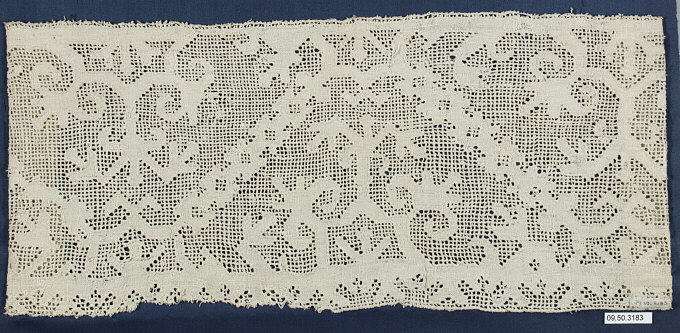
Drawnwork, at its core, is a subtractive art. Threads are painstakingly pulled from a woven ground, creating a lattice of voids that are then stitched into intricate geometric or floral patterns. This Border Fragment, likely originating from the Mediterranean basin or Eastern Europe—though its precise provenance remains deliberately ambiguous—embodies a zero-waste philosophy centuries before sustainability became a corporate buzzword. The materiality here is not about opulent fabrics like silk or brocade; it is about the integrity of the thread and the discipline of the void. Each empty space is a calculated risk, a structural decision that balances tension and release. For Katherine Fashion Lab, this is not mere nostalgia; it is a strategic pivot toward tactile storytelling. In an era of digital replication, the hand-drawn quality of this fragment—the slight irregularity in stitch density, the micro-variations in thread tension—offers an irreplaceable aura of authenticity. This is a material that cannot be mass-produced without losing its soul, making it a high-value, low-volume asset in a luxury market craving differentiation.
Global Heritage: The Currency of Cultural Ambiguity
The designation “Global Heritage” is a deliberate curatorial choice. By refusing to pin the fragment to a single nation or era, Katherine Fashion Lab elevates it from a provincial curiosity to a universal design language. This is not cultural appropriation; it is cultural abstraction. The border pattern—a repetitive motif of stylized vines and intersecting rhomboids—echoes motifs found in Romanian maramures, Polish koronka, and even Ottoman oya. Yet, by stripping away specific ethnic identifiers, the Lab invites a global consumer to project their own narratives onto the textile. This is a sophisticated market strategy: the fragment becomes a blank canvas of heritage, allowing the wearer or collector to claim a cosmopolitan identity. In a luxury landscape where provenance is often weaponized as elitism, this fragment offers a more democratic form of cultural capital—one that values the universal craft over the singular origin. The border itself, as a liminal space between fabric and edge, symbolizes this tension: it is both a conclusion and a beginning, a boundary that invites transgression.
Standalone Study: The Economics of the Singular Object
Contextualizing this fragment as a standalone study is a bold curatorial and commercial decision. In an industry driven by collections, seasons, and lookbooks, Katherine Fashion Lab positions this piece as a monograph in cloth. There is no accompanying ensemble, no digital campaign, no influencer endorsement. The fragment is the entire thesis. This approach mirrors the limited-edition model of luxury watchmaking or fine art prints, where scarcity is the primary driver of value. The business case is clear: by isolating the fragment, the Lab forces the audience to engage with its formal qualities—the rhythm of the drawn threads, the transparency of the gauze, the interplay of light and shadow. It becomes a meditative object, a counterpoint to the visual noise of fast fashion. For the discerning buyer—perhaps a textile historian, a minimalist collector, or a conceptual artist—this fragment offers a tangible investment in craft. The absence of a functional garment (no sleeves, no neckline, no closure) liberates it from utility, transforming it into a pure aesthetic artifact. This is the ultimate luxury: an object that exists solely to be contemplated.
Strategic Implications for Katherine Fashion Lab
This standalone study of the Border Fragment signals a broader strategic pivot for the Lab. By foregrounding drawnwork—a technique that requires thousands of hours of hand labor—the Lab positions itself as a guardian of endangered skills. In an industry where automation threatens artisanal knowledge, this fragment becomes a living archive. The Lab can leverage this narrative to build partnerships with artisan cooperatives, offering a supply chain story rooted in ethical preservation. Furthermore, the fragment’s modular potential cannot be ignored. As a border, it can be appended to modern silhouettes—a collar, a hem, a sleeve insert—creating a hybrid of old and new. This opens a revenue stream for bespoke commissions, where clients can integrate heritage fragments into contemporary custom pieces. The standalone study thus serves as a proof of concept: a testbed for how global heritage can be monetized without being commodified.
Conclusion: The Void as Value
The Border Fragment in drawnwork is not a relic; it is a manifesto. It asserts that in couture, what is removed can be more valuable than what is added. The empty spaces in this textile are not gaps—they are investment opportunities. For Katherine Fashion Lab, this piece represents a recalibration of luxury: from conspicuous consumption to conspicuous craft. As the fashion world races toward AI-generated patterns and 3D-printed fabrics, this fragment whispers a counter-truth: that the human hand, with its imperfections and patience, remains the ultimate luxury. The border may be a fragment, but its implications are boundless. It is a study in strategic restraint, a lesson in global storytelling, and a testament to the enduring power of the void. In this, Katherine Fashion Lab does not merely analyze couture; it redefines its very substance.