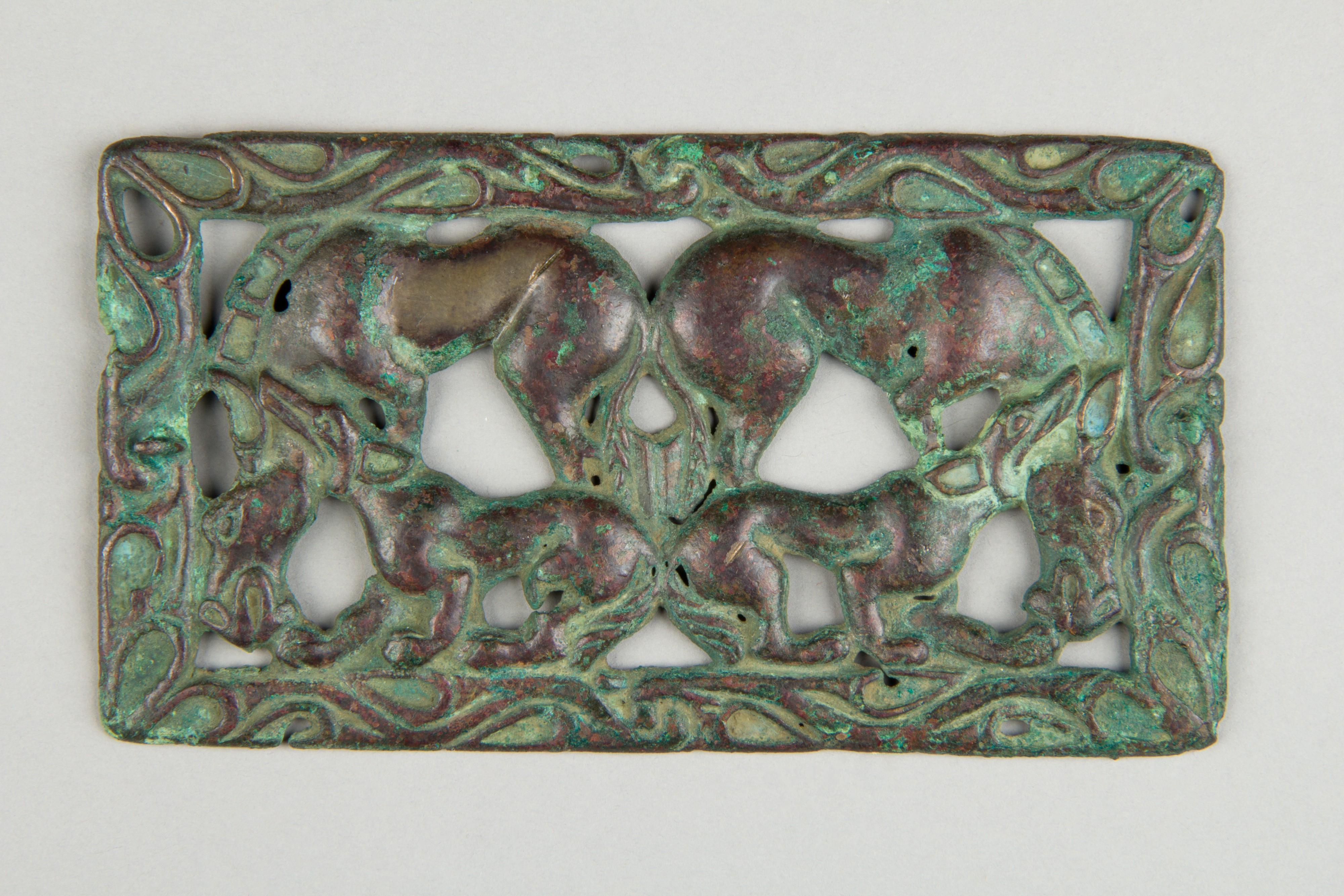
Heritage Analysis: Belt Buckle with Kulans Attacked by Wolves
Introduction: The Artifactual Nexus
The belt buckle depicting kulans attacked by wolves, cast in bronze from Southern Siberia, represents a masterwork of nomadic metallurgy and symbolic storytelling. This artifact, dating to the early Iron Age (circa 6th–4th century BCE), belongs to the Scytho-Siberian tradition, a culture renowned for its animal-style art. Its imagery—a dramatic predation scene—is not merely decorative but encodes deep spiritual and social codes. Within the research context of Katherine Fashion Lab, this buckle resonates with two previously studied objects: Rock in the form of a fantastic mountain and Jar in the shape of bronze container (hu). Though disparate in form and origin, these three artifacts jointly reveal a universal principle: adornment as a vessel for cosmic narrative. The mountain rock embodies geological permanence and transcendence; the hu jar signifies ritual containment and transformation; the belt buckle, as a personal ornament, mediates between the wearer’s body and the wild, untamed forces of nature. This analysis will decode the buckle’s symbolic power, its role in historical adornment, its spiritual meaning, and its strategic implications for a 2026 high-end luxury brand.
Symbolic Power: Predation as Sovereignty
The Kulan and the Wolf: A Dialectic of Domination
The kulan—a wild ass native to the Central Asian steppes—and the wolf form a binary of prey and predator. In Scythian cosmology, such scenes were not about mere violence but about the cyclical order of life, death, and rebirth. The wolf, a totemic animal for many nomadic tribes, symbolized strategic intelligence, pack loyalty, and the ability to conquer vast territories. The kulan, fleet-footed and resilient, represented the untamed spirit of the steppe—a resource to be harnessed or a challenge to be overcome. By wearing this buckle, the owner proclaimed their mastery over both physical and metaphysical domains. The buckle’s placement at the waist—the body’s center of gravity and power—anchored this symbolism to the wearer’s personal authority. In high-end luxury, such a motif can be reimagined as a logo of controlled ambition: the brand as the wolf, the market as the kulan, and the buckle as the emblem of strategic conquest.
Bronze as a Material of Eternity
Bronze, an alloy of copper and tin, was not merely a practical medium but a sacred one. Its durability mirrored the eternal cycle of the steppe—harsh winters followed by renewal. The buckle’s casting process, involving lost-wax techniques, imbued it with a sense of alchemical transformation. For the 2026 luxury consumer, bronze’s patina—a surface that ages gracefully—offers a counterpoint to ephemeral fast fashion. It speaks to heritage as a living process, not a static relic. A luxury brand could adopt bronze finishes or oxidized metals in accessories to signal timelessness and resilience, aligning with the growing demand for sustainable, long-lasting luxury.
Historical Adornment: The Belt as Social Armor
Function and Status in Nomadic Society
In Southern Siberian cultures, belts were more than functional; they were markers of rank, wealth, and tribal affiliation. A bronze buckle of this complexity would have been worn by a warrior-elite, possibly a chieftain or shaman. The predation scene served as a visual résumé, broadcasting the wearer’s hunting prowess and spiritual favor. The belt also held practical items—weapons, pouches, tools—making it a mobile command center. This dual role of utility and symbolism is a key insight for luxury design: modern accessories must marry function with narrative. A 2026 belt collection could incorporate hidden compartments, modular attachments, or QR codes linking to the brand’s heritage story, transforming the buckle into a wearable artifact.
Parallels with the Hu Jar and Mountain Rock
The Jar in the shape of bronze container (hu) from ancient China shares with the buckle a ritualistic containment—the hu held offerings for ancestors, while the buckle contained the wearer’s identity. The Rock in the form of a fantastic mountain, likely a scholar’s object or talisman, represents a microcosm of the universe. Together, these objects reveal a cross-cultural truth: adornment is a cosmogram, a map of the wearer’s world. For Katherine Fashion Lab, this triad suggests a collection that juxtaposes steppe predator motifs with Chinese ritual forms and geological textures—a fusion of East and North, of wild and refined.
Spiritual Meaning: The Shamanic Threshold
Animal Spirits as Guardians
The wolf and kulan are not merely animals but spirit guides. In shamanic traditions of Siberia, animal imagery on personal objects facilitated communication with the otherworld. The buckle, worn at the waist—a liminal zone between upper and lower body—acted as a spiritual gateway. The predation scene could be interpreted as a ritual of transformation: the kulan’s death enabling the wolf’s survival, mirroring the shaman’s journey through death and rebirth. For the modern wearer, such symbolism offers a narrative of personal evolution. A luxury brand can leverage this by framing its products as totems—objects that empower the wearer to navigate life’s transitions with courage and grace.
Resonance with the Fantastic Mountain
The Rock in the form of a fantastic mountain evokes the axis mundi, the world tree or mountain connecting heaven and earth. The belt buckle’s predation scene, set against the vast steppe, similarly anchors the wearer to a cosmic landscape. Both objects are microcosms, compressing vast spiritual geography into portable form. In a 2026 luxury strategy, this suggests creating narrative ecosystems around each product—stories of origin, myth, and transformation that invite the consumer into a deeper relationship with the brand.
2026 High-End Luxury Strategy: From Artifact to Icon
DNA Correlation: The Triadic Collection
The research context linking the buckle, the mountain rock, and the hu jar reveals a DNA of cosmic adornment. For 2026, Katherine Fashion Lab can develop a Triadic Collection that reinterprets these three artifacts. The buckle inspires a line of predation-motif belts in bronze-toned hardware, with wolf and kulan motifs embossed on leather or engraved on metal. The mountain rock informs sculptural jewelry—pendants, rings, and cufflinks—that mimic geological strata. The hu jar translates into ritual-inspired handbags with ceramic or metal closures, echoing ancient vessel forms. This collection would not merely copy but transcend, using modern materials like recycled bronze, lab-grown gems, and vegan leather to align with sustainability trends.
Marketing Narrative: The Wolf’s Strategy
The buckle’s predation scene can be reframed as a brand manifesto: “To lead is to hunt with purpose.” This narrative targets the high-net-worth individual who sees luxury as a tool for self-actualization, not mere display. Campaign imagery could juxtapose the ancient buckle with contemporary power settings—boardrooms, private jets, or wilderness retreats. Limited-edition pieces, each with a unique patina and numbered certificate tracing its design lineage to the Scythian original, would create scarcity and provenance. Collaborations with contemporary artists or archaeologists could further authenticate the collection, bridging past and future.
Consumer Experience: The Shamanic Unboxing
Spiritual meaning translates into experiential luxury. Each belt buckle from the collection could be presented in a box designed as a miniature steppe landscape, with a QR code linking to a digital narrative about the artifact’s history and symbolism. The unboxing becomes a ritual, akin to the shamanic journey. Pop-up events in galleries or natural history museums could offer immersive experiences—soundscapes of wolf howls, tactile samples of bronze patina, and expert talks on nomadic culture. This elevates the product from commodity to cultural artifact, commanding premium pricing and loyalty.
Conclusion: The Enduring Power of the Predation Motif
The belt buckle with kulans attacked by wolves is more than a historical curiosity; it is a blueprint for luxury that speaks to the human desire for power, meaning, and beauty. Its symbolic predation, historical function, and spiritual depth offer a rich vocabulary for a 2026 brand strategy that values heritage without nostalgia. By correlating its DNA with the mountain rock and hu jar, Katherine Fashion Lab can create a coherent, cross-cultural narrative that positions its products as modern totems—objects that empower, transform, and endure. In an era of fleeting trends, this buckle reminds us that true luxury is eternal, like the wolf’s hunt across the steppe.