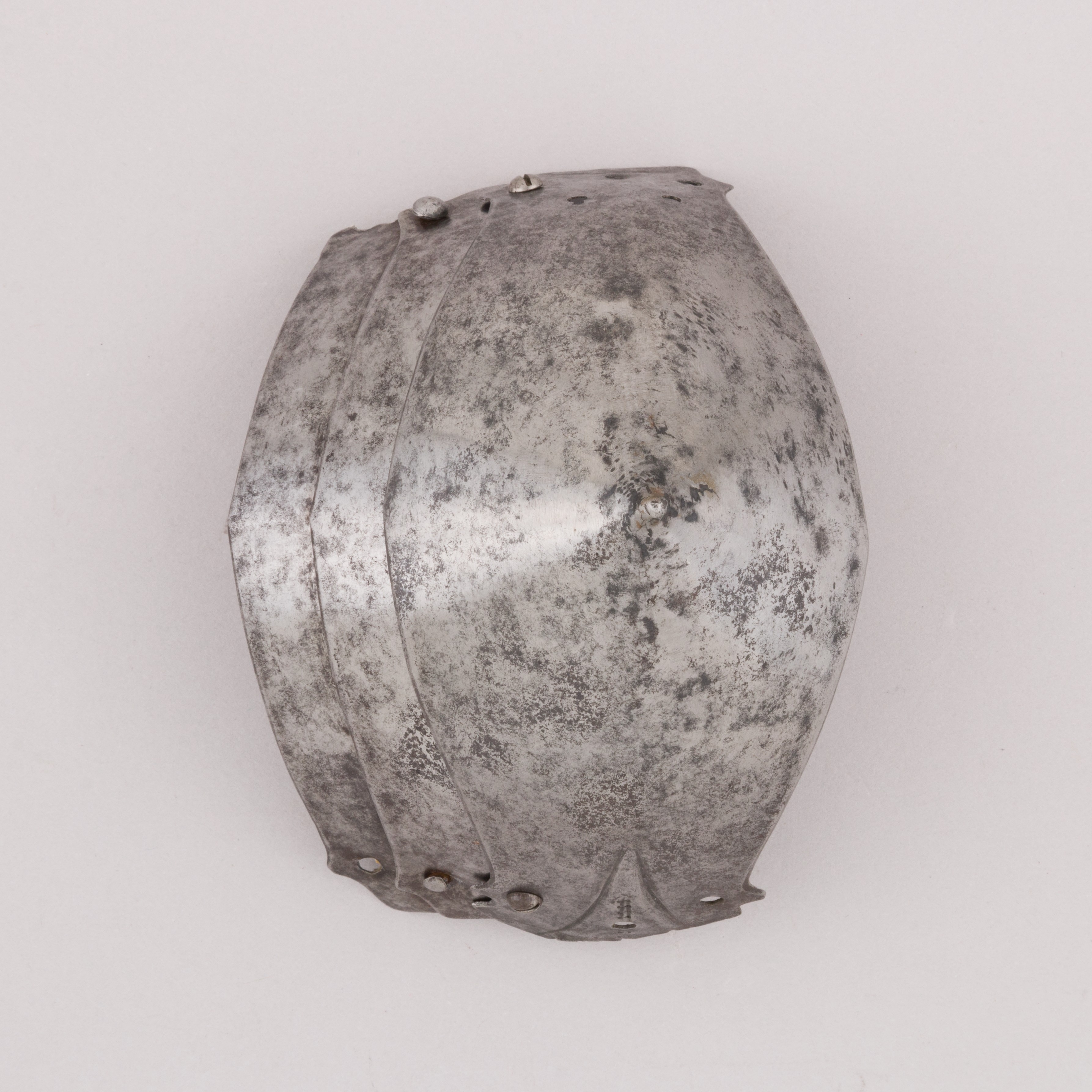
An Analysis of the Italian Couter: Steel, Structure, and Symbolism in Renaissance Armor
Historical Context and the Rise of Specialized Armor
The study of medieval and Renaissance armor is often dominated by the grand narratives of full plate harnesses, jousting suits, and the iconic helmets of knights. Yet, within this vast field of metallurgical artistry, the individual components—the articulated joints, the segmented gauntlets, and the protective plates—reveal a profound depth of engineering and aesthetic sensibility. Among these, the Italian couter, or elbow defense, stands as a testament to the intersection of function, fashion, and forensic design. Originating in the 14th and 15th centuries, the Italian school of armorers, particularly those in Milan and Brescia, elevated the craft to a level of precision that influenced warfare and courtly display across Europe. This analysis focuses on a standalone steel couter, examining its material, form, and the cultural logic that shaped its creation.
The couter did not emerge in isolation; it was a response to the evolving dynamics of combat. As swords became more precise and polearms more devastating, the need for articulated protection at the elbow—a critical pivot point for both offense and defense—became paramount. Unlike earlier mail or padded defenses, the steel couter offered rigid, impact-resistant coverage while allowing the arm to bend, strike, and parry. In the Italian context, this piece was often part of a broader harness, yet its standalone study reveals a microcosm of the armorer’s art: a balance between mobility and invulnerability.
Material Mastery: Steel as a Canvas
The primary material of this couter is steel, but the term belies the complexity of its metallurgical preparation. Italian armorers of the period employed a sophisticated process of forging, quenching, and tempering to achieve a hardness that could deflect a blade without becoming brittle. The steel was often sourced from the Alpine regions, where iron ore was smelted with charcoal to produce a low-carbon base, then carburized to increase strength. For a couter, the armorer would hammer the metal into a curved shell, using repeated heating and cooling cycles to shape the compound curves that mirror the human elbow’s anatomy.
What distinguishes Italian steelwork from its German or English counterparts is the emphasis on surface finish. This couter exhibits a polished, almost mirror-like luster, achieved through meticulous grinding and burnishing. The reflective quality was not merely decorative; it served a tactical purpose. A polished surface could cause glancing blows to slide off, reducing the transfer of kinetic energy to the joint beneath. Moreover, the bright steel acted as a visual deterrent, signaling the wearer’s wealth and status. In the context of the Italian Renaissance, where armor was as much a statement of civic pride as of martial readiness, the steel couter became a canvas for artistic expression—often etched, gilded, or embossed with motifs ranging from classical mythology to heraldic symbols.
Structural Anatomy: Form and Function Interwoven
Examining the couter’s structure reveals a sophisticated understanding of human biomechanics. The piece is composed of two primary sections: the cop, or the main dome that covers the point of the elbow, and the lames, articulated plates that extend upward and downward to overlap with the upper arm and forearm defenses. The cop is typically forged in a single piece, with a pronounced central ridge that deflects blows away from the joint. This ridge is not merely a decorative spine; it is a structural reinforcement that prevents the metal from collapsing under impact.
The articulation is achieved through a system of rivets and sliding rivets, allowing the lames to move in concert with the arm’s flexion and extension. In this standalone couter, the lames are secured by internal leather straps, which have long since perished but are evidenced by the rivet holes along the inner edge. The gusset—the gap between the cop and the lames—is carefully calibrated to permit a full range of motion without exposing the vulnerable inner elbow. The Italian design often features a symmetrical flare on the outer wing, which provides additional protection to the triceps area, a common target in mounted combat. This asymmetry in shape, with a larger outer wing and a smaller inner one, reflects a strategic prioritization of defense against the most common attack vectors.
Standalone Study: The Couter as an Independent Artifact
When examined in isolation, the couter transcends its role as a mere component. It becomes a standalone artifact that speaks to the broader principles of Renaissance design. The ergonomics are immediately apparent: the interior curvature is not a perfect hemisphere but an organic shape that cradles the olecranon process—the bony point of the elbow—with precision. The thickness of the steel varies, being thicker at the cop’s apex and thinner at the edges, a technique known as dishing that reduces weight while maintaining strength. This is not a mass-produced piece; the hand-hammered dimples and slight asymmetries indicate the direct involvement of a master armorer, who adjusted the metal’s thickness based on the intended wearer’s measurements.
The patina of this couter tells a story of use and preservation. Areas of dark oxidation suggest exposure to moisture and sweat, while the polished highlights on the cop’s peak indicate repeated contact with a shield or weapon. The absence of extensive battle damage—no deep cuts or fractures—implies that this piece may have been used for ceremonial purposes or as a spare component in a noble’s arsenal. Alternatively, the pristine condition could reflect the high-quality steel’s ability to resist deformation. The rivets, forged from a softer iron alloy, are intact, suggesting careful maintenance and periodic replacement of leather straps.
Cultural and Symbolic Dimensions
Beyond its martial utility, the Italian couter carries significant cultural weight. In the context of the condottieri—the mercenary captains who dominated Italian warfare—armor was a symbol of personal prowess and contractual loyalty. A well-crafted couter, visible even when the arm was at rest, signaled the wearer’s investment in their own survival and status. The choice of steel over cheaper materials like brigandine or mail was a deliberate assertion of wealth. Furthermore, the Italian preference for smooth, unadorned surfaces (as opposed to the fluted Maximilian styles of Germany) reflected a humanist aesthetic that valued clarity, proportion, and the natural beauty of the material itself.
The couter also embodies a philosophical tension between protection and vulnerability. The elbow, as a joint, is both a strength and a weakness—it enables the arm to strike with force, but a blow to the exposed inner hinge can incapacitate. The armorer’s solution was to create a mobile fortress, a piece of armor that moved with the body yet stood firm against assault. This duality resonates with the Renaissance ideal of the uomo universale, the universal man who balances action with contemplation, strength with grace. In wearing this couter, the knight was not merely defending a limb; he was embodying a worldview where technology, art, and human skill converged.
Conclusion: The Legacy of Italian Armor Craftsmanship
This standalone study of an Italian steel couter reveals that even the most specialized piece of armor is a microcosm of a larger cultural and technological ecosystem. From the sourcing of Alpine steel to the precise articulation of its lames, every detail reflects a commitment to excellence that defined the Italian armorer’s workshop. The couter is not just a defensive implement; it is a record of human ingenuity, a response to the demands of combat, and a canvas for aesthetic expression. For the modern curator or historian, examining such an object in isolation allows for a deeper appreciation of the craft, unencumbered by the narrative of the full harness. In the steel of this couter, we see the fusion of art and war, of function and form, that continues to define our understanding of the Renaissance world.