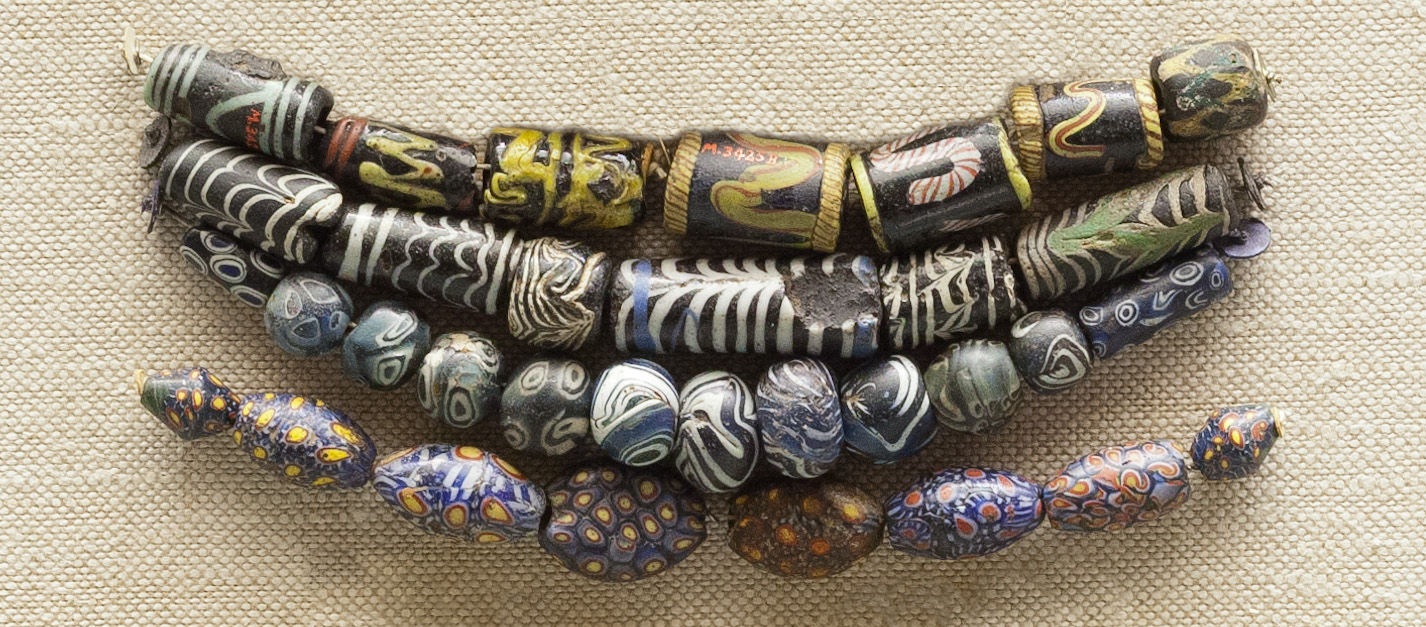
Heritage Analysis: The String of 8 Glass Beads
This strategic standalone research paper, prepared for Katherine Fashion Lab, examines the profound heritage of an ancient artifact: a string of eight glass beads. This analysis will deconstruct its symbolic power, historical context of adornment, and spiritual meaning, culminating in a forward-looking luxury strategy for the 2026 high-end market. The objective is to transform this humble object into a cornerstone of narrative-driven luxury, leveraging its depth to create exclusivity and cultural resonance.
Symbolic Power: The Octad as a Universal Archetype
The number eight, represented by this specific arrangement of beads, carries immense symbolic weight across ancient civilizations. In Mesopotamian cosmology, eight was the number of the primeval gods, the Anunnaki, who shaped human destiny. In Egyptian mythology, the Ogdoad represented the eight primordial deities of creation, embodying the chaotic yet generative forces of the universe. Similarly, in early Chinese philosophy, the Eight Trigrams (Bagua) of the I Ching are fundamental principles of reality, representing the interplay of yin and yang. This universal reverence elevates the string of eight beads from mere decoration to a talisman of cosmic order, balance, and infinite potential.
For Katherine Fashion Lab, this symbolic power translates directly into a brand asset. The number eight becomes a signature motif—a subtle but potent code for completeness, regeneration, and prosperity. In high-end luxury, where meaning is paramount, such a symbol offers a sophisticated narrative that resonates with discerning consumers seeking depth beyond aesthetic appeal. The bead itself, as a discrete unit, signifies individual moments or virtues; strung together, they represent a cohesive journey, a curated life, or a protected soul. This duality—the singular and the collective—is a powerful metaphor for the luxury consumer’s desire for both personal identity and belonging to an exclusive community.
Historical Adornment: Glass as a Marker of Status and Trade
The medium of glass is critical to this analysis. In the ancient world, glass was not a commodity but a luxury material, as precious as semi-precious stones. The earliest glass beads, dating to the third millennium BCE in Mesopotamia and Egypt, were created through a labor-intensive process of core-forming and winding. Their production was a closely guarded secret, often controlled by royal or temple workshops. To wear a string of glass beads was to broadcast wealth, technological access, and proximity to power. They were not merely ornaments; they were portable wealth, currency in long-distance trade networks spanning the Mediterranean, the Silk Road, and sub-Saharan Africa.
This historical context is invaluable for a 2026 luxury strategy. The glass bead’s narrative of scarcity, craftsmanship, and global exchange aligns perfectly with contemporary luxury values. The modern consumer is increasingly drawn to “slow luxury”—items that tell a story of artisanal mastery and ethical provenance. Katherine Fashion Lab can position its string of eight beads as a direct heir to this tradition, emphasizing the ancient techniques of glassmaking (e.g., millefiori, gold-foil encasing) and the rarity of the material. The beads become a metaphor for the brand’s own global sourcing and commitment to preserving endangered crafts, creating a tangible link between the wearer and millennia of human ingenuity.
Spiritual Meaning: The Bead as a Meditative and Protective Tool
Beyond status, ancient glass beads held profound spiritual functions. In many cultures, beads were used as amulets to ward off evil (the evil eye, in particular), to attract fertility, or to ensure safe passage in the afterlife. The specific number eight was often associated with infinity and the cyclical nature of life, death, and rebirth. The act of stringing beads, and the tactile sensation of moving them through one’s fingers, was a form of early meditation—a precursor to the rosary or the Buddhist mala. Each bead could represent a prayer, a wish, or a moment of reflection, transforming the object into a portable sanctuary.
For the 2026 luxury market, this spiritual dimension is a powerful differentiator. The contemporary high-end consumer is seeking not just products, but rituals and experiences that foster well-being. Katherine Fashion Lab can frame the string of eight glass beads as a “modern talisman” for mindfulness. The brand can develop a ritual around the beads—a breathing exercise for each bead, a set of eight affirmations, or a guided meditation—packaged as an exclusive, limited-edition offering. This transforms the product from an accessory into a tool for self-care and spiritual grounding, appealing to the growing demand for “conscious luxury.” The beads become a daily reminder of intention, balance, and personal power, a subtle yet profound counterpoint to the chaos of modern life.
2026 High-End Luxury Strategy: From Artifact to Archetype
Integrating these layers of meaning, Katherine Fashion Lab’s 2026 strategy for the String of 8 Glass Beads must be executed with precision and restraint. The following framework is recommended:
Product Positioning: The beads will be offered as a “Heritage Capsule”—not a mass-produced collection, but a series of 888 individually numbered sets. Each set will be accompanied by a hand-bound booklet detailing the specific ancient civilization’s cosmology and the bead’s symbolic journey. The glass will be sourced from a single, historic Venetian or Egyptian atelier, using original techniques. The price point will be set at ultra-high-net-worth levels, emphasizing scarcity and connoisseurship.
Narrative Architecture: The brand will launch a “The Eightfold Path” campaign, drawing on the universal symbolism of the octad. The campaign will not focus on the product’s appearance but on its meaning. Short, cinematic films will depict the beads’ journey through time: from a Mesopotamian temple, to a Silk Road caravan, to a modern meditation room. The tagline: “Eight Beads. One Infinite Story.” This narrative elevates the product beyond fashion into the realm of cultural artifact.
Experiential Retail: The beads will not be sold in traditional boutiques. Instead, Katherine Fashion Lab will host invitation-only “Ritual Salons” in key global capitals (Paris, Tokyo, New York, Dubai). At these salons, a “Keeper of the Beads” (a trained heritage curator) will guide clients through a 30-minute ritual of intention-setting, using the string of beads as a focal point. The client will then be presented with their numbered set, sealed in a hand-carved wooden box. This experience creates an emotional bond far deeper than a standard transaction.
Strategic Alliances: To reinforce authenticity, Katherine Fashion Lab will partner with leading museums (e.g., The British Museum, The Louvre) and academic institutions specializing in ancient glass. A portion of proceeds will fund the preservation of ancient glassmaking techniques, further solidifying the brand’s commitment to heritage. This also provides a powerful public relations narrative, positioning the brand as a custodian of culture, not just a purveyor of goods.
Digital Exclusivity: The beads will be promoted through a private, members-only digital platform. Each owner will receive a unique digital “key” that unlocks exclusive content: video meditations, historical lectures, and a forum to share their own “eight intentions.” This creates a community of like-minded individuals, fostering brand loyalty and long-term engagement.
Conclusion: The Bead as a Strategic Asset
The String of 8 Glass Beads is not a simple relic. It is a concentrated repository of human belief, trade, and artistry. For Katherine Fashion Lab, it represents a strategic opportunity to transcend the transient nature of fashion and anchor the brand in timeless, universal values. By weaving together its symbolic, historical, and spiritual dimensions, the brand can offer the 2026 high-end consumer something increasingly rare: an object of profound meaning, crafted with intention, and possessed as a key to a deeper story. This is not luxury as commodity; this is luxury as legacy.