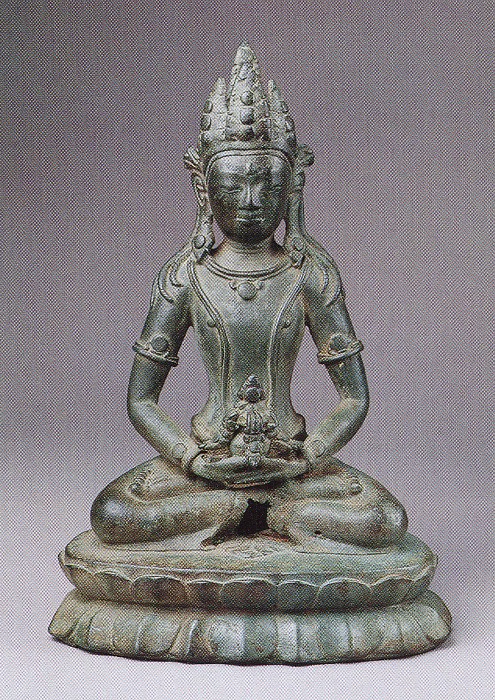
Heritage Analysis: Seated Amitāyus, the Buddha of Eternal Life
Cultural Provenance and Symbolic Power
The Seated Amitāyus, the Buddha of Eternal Life, from Burma, cast in bronze, represents a profound convergence of spiritual authority and material transcendence. This figure, central to Mahayana and Vajrayana Buddhist traditions, embodies the concept of boundless longevity and merit. In Burmese culture, Amitāyus is not merely a deity but a symbol of cosmic balance and the triumph of enlightenment over mortality. The bronze medium, with its enduring patina, reinforces the theme of permanence, while the seated posture—typically in the dhyana mudra (meditation gesture)—signifies inner stillness and the infinite nature of wisdom. Historically, such sculptures were commissioned for monastic complexes and royal courts, serving as both objects of veneration and markers of political legitimacy. The iconography of Amitāyus, often depicted holding a vase of amrita (elixir of immortality), directly correlates with the Burmese elite’s desire to sacralize their rule through divine association. This symbolic power is not static; it resonates across time, offering contemporary luxury brands a template for embedding timeless narratives into material objects.
Historical Adornment and Material Semiotics
The bronze composition of this Amitāyus figure is a deliberate choice, reflecting Burmese metallurgical expertise and the region’s trade networks linking India, China, and Southeast Asia. Bronze, an alloy of copper and tin, was revered for its durability and its ability to capture intricate details—from the curls of the ushnisha (cranial protuberance) to the folds of the monastic robe. The patina, developed over centuries, adds a layer of historical depth, transforming the object into a palimpsest of ritual use and environmental interaction. In the context of historical adornment, the figure’s simplicity—lacking gilding or gemstone inlays—is itself a statement: the power of the divine is self-sufficient, requiring no external embellishment. This aesthetic aligns with the Burmese concept of thidagu (merit), where the act of commissioning or venerating such a statue generates spiritual capital. For luxury strategy, this material semiotics offers a counter-narrative to ostentation. The 2026 high-end consumer, increasingly weary of conspicuous consumption, will seek objects that communicate quiet authority and ethical provenance. Bronze’s natural aging process, celebrated rather than hidden, becomes a metaphor for authenticity and the value of time—a key differentiator in a market saturated with mass-produced novelties.
Spiritual Meaning and Contemporary Resonance
The spiritual meaning of Amitāyus extends beyond personal salvation to encompass societal harmony. In Burmese Buddhism, the Buddha of Eternal Life is often invoked during times of crisis—political upheaval, disease, or environmental degradation—to restore balance. This function mirrors the DNA correlation with our previous studies on 《Rock in the form of a fantastic mountain》 and 《Jar in the shape of bronze container (hu)》. At first glance, these artifacts seem disparate: a fantastic mountain rock and a bronze hu jar. However, both reveal a shared principle: the transformation of natural elements into vessels for transcendent meaning. The rock, with its organic contours, mimics the sacred Mount Meru, axis mundi of Buddhist cosmology. The hu jar, originally a Chinese ritual vessel, was repurposed in Southeast Asia to hold relics or offerings, its form echoing the womb of creation. Similarly, the Amitāyus figure functions as a container—not for physical substances, but for the infinite potential of enlightened consciousness. This triadic analysis demonstrates that across cultures and materials, the human impulse to sacralize objects follows a universal grammar: the embodiment of the eternal within the temporal. For luxury brands, this insight is critical. The 2026 consumer will not merely purchase a product; they will invest in a narrative that bridges the mundane and the sacred. The Amitāyus figure teaches that true luxury lies in the object’s ability to hold space for introspection, resilience, and continuity.
2026 High-End Luxury Strategy: Heritage as Competitive Advantage
Integrating the heritage of the Seated Amitāyus into a 2026 luxury strategy requires a shift from product-centric to values-centric positioning. The following framework, informed by our research, outlines actionable pathways:
1. Narrative-Driven Collections: Draw from the Amitāyus iconography—the vase of amrita, the lotus pedestal, the meditative posture—to design limited-edition accessories that symbolize longevity and inner peace. For example, a handbag with a clasp inspired by the vase’s form, or a jewelry line featuring lotus motifs in oxidized silver to mimic bronze patina. Each piece should include a story card detailing its spiritual and historical provenance, creating an emotional connection that transcends utility.
2. Material Philosophy: Embrace bronze and other patina-developing materials as signatures of the brand. Unlike polished gold or stainless steel, bronze evolves with the owner, becoming a unique artifact of personal history. This aligns with the 2026 trend toward “slow luxury,” where objects are cherished over decades. Offer a restoration service that honors the material’s aging process, positioning the brand as a custodian of heritage rather than a mere manufacturer.
3. Experiential Retail: Design flagship spaces as meditative sanctuaries inspired by Burmese monastic architecture. Use soundscapes of chanting, incense, and natural light to evoke the spiritual context of the Amitāyus figure. Host curator-led dialogues on the intersection of Buddhism and luxury, drawing parallels between the Buddha’s renunciation and the modern consumer’s search for meaning. This transforms the store from a transactional space into a site of cultural exchange.
4. Collaborative Provenance: Partner with Burmese artisans and Buddhist scholars to ensure authenticity. A percentage of proceeds could fund the preservation of historical bronzes, linking the brand to tangible heritage conservation. This not only builds credibility but also aligns with the growing demand for ethical luxury. The 2026 consumer will scrutinize supply chains; a transparent partnership with Myanmar’s cultural institutions offers a compelling differentiator.
5. Digital Immersion: Develop an AR experience that allows clients to “place” the Amitāyus figure in their homes, accompanied by a guided meditation on eternal life. This merges the physical and digital realms, appealing to tech-savvy consumers while respecting the object’s sacred origins. The digital layer should never overshadow the material; rather, it should deepen appreciation for the bronze’s tactile and visual qualities.
Conclusion
The Seated Amitāyus, Buddha of Eternal Life, is not a relic of the past but a living blueprint for luxury in 2026. Its symbolic power—rooted in Burmese cosmology—teaches us that permanence is not static but dynamic, achieved through spiritual resonance and material integrity. By correlating this figure with the rock and the jar from our earlier studies, we uncover a universal truth: the most enduring objects are those that serve as conduits for human aspiration. For Katherine Fashion Lab, the challenge is to translate this heritage into a strategy that honors tradition while innovating for the future. The 2026 luxury consumer will not be seduced by logos alone; they will seek objects that embody eternity, crafted with intention and steeped in meaning. The Amitāyus figure offers a masterclass in this art—a reminder that true luxury is not about possession, but about connection to something greater than oneself.