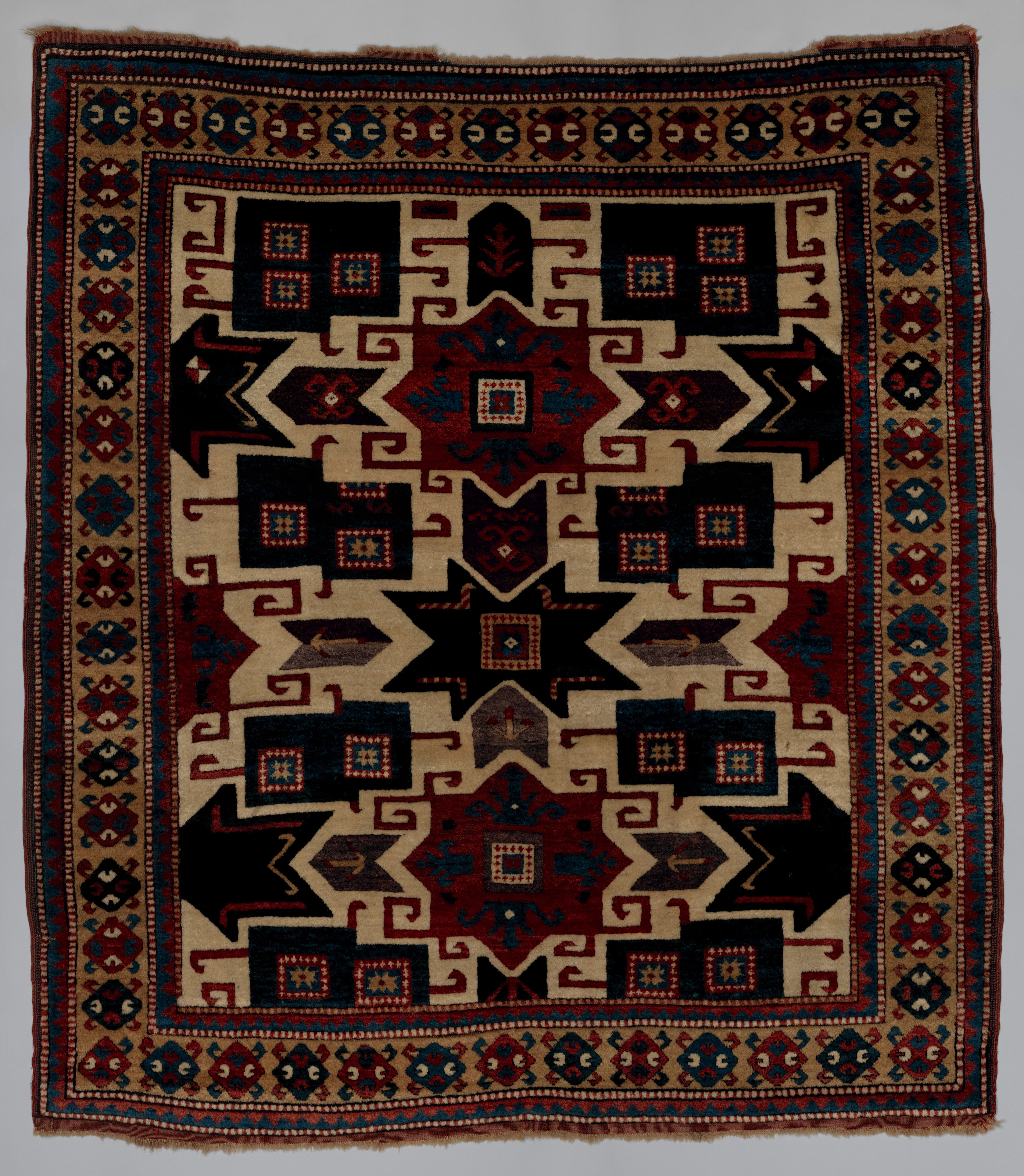
The Star Kazak Carpet: A Tapestry of Heritage Woven for the Modern Connoisseur
In the rarefied air of haute couture, where fabric becomes narrative and thread becomes legacy, Katherine Fashion Lab presents a singular artifact of global heritage: the Star Kazak Carpet. This is not merely a textile; it is a cartography of cultural memory, a testament to the enduring dialogue between nomadic tradition and contemporary luxury. As a standalone study, this piece demands an analysis that transcends the decorative, positioning itself within the lexicon of design history, material science, and the economics of scarcity. The Star Kazak, with its symmetrical knots and raw wool composition, emerges as a masterclass in how heritage can be curated for the discerning modern eye.
Materiality and the Language of Wool
The foundation of any couture analysis lies in the raw materials, and here, the Star Kazak speaks with uncompromising authenticity. The carpet is constructed entirely from wool—serving as the warp, the weft, and the pile. This tripartite use of a single fiber is a hallmark of the Kazak tradition, a strategic choice rooted in both necessity and artistry. Wool, sourced from highland sheep, offers a unique confluence of properties: natural lanolin imparts water resistance and a subtle sheen, while the fiber’s crimp provides elasticity and resilience. For the connoisseur, this translates into a textile that ages with grace, developing a patina that deepens its visual and tactile allure over decades.
The symmetrically knotted pile is the technical signature of this piece. Each knot, tied by hand around two warp threads, creates a dense, durable surface that is both plush and structurally rigorous. This technique, known as the Turkish or Ghiordes knot, is distinct from the asymmetrical Persian knot, offering a sharper definition of pattern and a more uniform pile height. In the Star Kazak, this symmetry is not merely functional; it is a philosophical statement. It embodies a worldview of balance—between the nomadic and the settled, the geometric and the organic. The knots per square inch, while variable in antique pieces, are typically high enough to allow for intricate medallion designs, yet low enough to preserve the carpet’s rugged, tactile character. This is a fabric that demands to be touched, a sensory experience that digital reproduction can never replicate.
Decoding the Star Motif: Geometry as Global Lexicon
The star motif, from which this carpet derives its name, is a universal symbol of guidance, divinity, and cosmic order. However, in the Kazak tradition, the star is rendered with a distinct geometric precision that reflects the region’s synthesis of Turkic, Caucasian, and Persian influences. The Star Kazak typically features an eight-pointed star, often enclosed within a diamond or octagonal medallion, set against a field of repeating geometric hooks, crosses, and stylized floral forms. This is not a naturalistic representation; it is an abstracted language of power and protection.
From a curatorial perspective, the star serves as a focal point that anchors the composition. Its symmetry creates a visual rhythm that guides the eye inward, while the surrounding negative space—often in deep indigo or madder red—provides a dramatic contrast. The color palette of the Star Kazak is deliberately restrained, relying on natural dyes derived from madder root (producing rich reds), indigo (for blues), and weld or onion skins (for yellows). This chromatic discipline is a hallmark of global heritage textiles, where color is not arbitrary but steeped in local ecology and symbolism. For the modern collector, these hues offer a sophisticated counterpoint to the synthetic uniformity of mass-produced design. They are colors that breathe, shift, and reveal new depths under changing light.
Cultural Provenance and the Economics of Heritage
To analyze the Star Kazak as a standalone study is to confront the economics of heritage. Originating from the Caucasus region, specifically from the Kazak tribal groups spanning modern-day Armenia, Azerbaijan, and Georgia, these carpets were historically woven by nomadic and semi-nomadic communities. Each piece was a repository of clan identity, woven by women who encoded their lineage, beliefs, and aspirations into the very structure of the fabric. The global heritage of this piece lies in its ability to transcend its geographic origins, becoming a symbol of cross-cultural exchange along the Silk Road and later, a coveted object in Western and Eastern decorative arts.
The valuation of a Star Kazak carpet is determined by a confluence of factors: age, condition, dye quality, knot density, and the rarity of the star motif. Antique examples from the 19th century, particularly those with well-preserved borders and vibrant natural dyes, command premium prices at auction houses and among private collectors. This economic reality positions the Star Kazak not as a mere floor covering, but as an alternative asset class—a tangible investment in cultural capital. For Katherine Fashion Lab, the curation of such a piece involves a rigorous authentication process, including fiber analysis, dye chromatography, and provenance documentation. This scholarly rigor ensures that the carpet’s story is not lost to time, but rather, is preserved and presented with the same integrity as a haute couture gown.
Design Principles: Symmetry, Scale, and the Modern Interior
The Star Kazak’s design principles are a study in controlled asymmetry within a symmetrical framework. The central star medallion is typically flanked by smaller repeating motifs—often hooks or stylized animal forms—that create a sense of movement and energy. The borders, usually composed of multiple bands, serve as a visual frame, containing the central field while echoing its geometric vocabulary. This structural logic is inherently architectural, making the carpet an ideal anchor for a modern interior.
From a scale perspective, the Star Kazak is versatile. Smaller pieces (approximately 4x6 feet) function as powerful accent pieces, defining a seating area or entryway with a bold statement. Larger formats (8x10 feet or more) can transform a room, establishing a chromatic and textural foundation upon which other elements—furniture, art, lighting—are composed. The key to integrating such a piece into a contemporary setting lies in contrast. The carpet’s dense, handcrafted texture and deep, natural dyes provide a counterpoint to sleek, minimalist furniture and polished surfaces. It is a dialogue between the raw and the refined, the ancestral and the avant-garde.
A Standalone Study: The Carpet as Artifact and Art
In positioning the Star Kazak as a standalone study, Katherine Fashion Lab elevates it beyond the realm of functional decor. This carpet is an artifact of human ingenuity—a document of a pre-industrial world where time, skill, and cultural meaning were woven together by hand. It is also an art object, whose abstract geometry and rich color field anticipate the principles of modernism. The symmetry of the knots, the rhythm of the star motifs, and the depth of the wool pile all contribute to a sensory experience that is both intellectual and visceral.
For the collector, the Star Kazak represents a convergence of heritage, craftsmanship, and investment potential. It is a piece that demands to be studied—its knots counted, its dyes analyzed, its provenance traced. Yet it also invites a more intuitive appreciation: the way light plays across its surface, the tactile pleasure of its pile, the quiet authority it brings to a room. In this analysis, we see that the Star Kazak is not a relic of a bygone era, but a living text, one that continues to speak to the human desire for beauty, order, and connection across time and geography. It is a testament to the power of global heritage, curated for the future by the discerning eye of Katherine Fashion Lab.