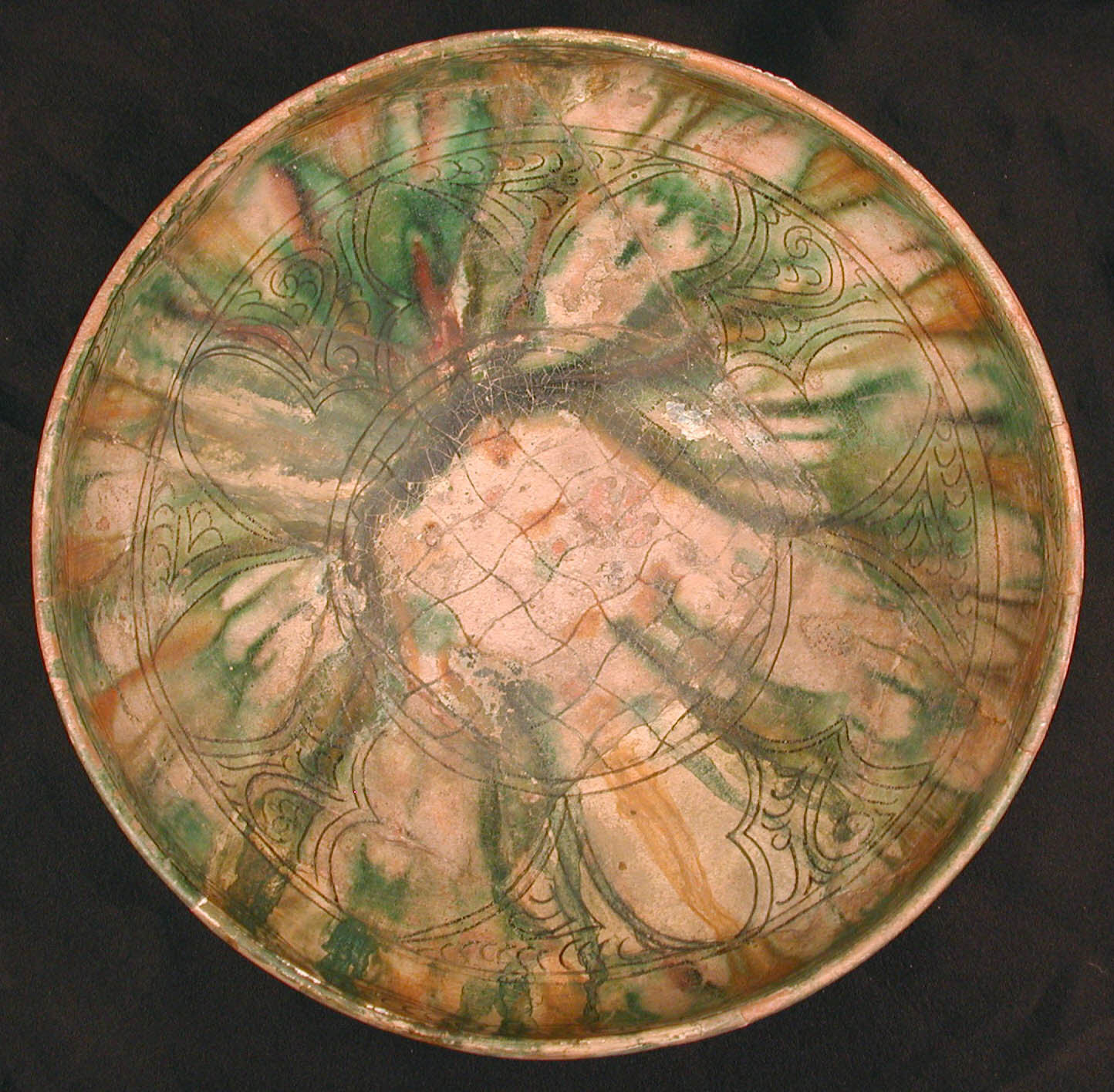
The Sgraffito Bowl: A Study in Material Narrative and Global Heritage
In the rarefied sphere of couture, where fabric is often the primary medium of expression, the analysis of a ceramic object might seem an anomaly. Yet, for the discerning eye of Katherine Fashion Lab, the bowl transcends its utilitarian origins to become a profound text on form, texture, and cultural memory. This standalone study examines a singular artifact: a bowl crafted from earthenware, adorned with white slip, incised and splashed with polychrome glazes under a transparent glaze—a technique known globally as sgraffito. Its origin, defined as “Global Heritage,” signals not a single geographic birthplace but a confluence of traditions, a palimpsest of techniques that traveled across continents and centuries. This piece is not merely a vessel; it is a microcosm of the human impulse to decorate, to signify, and to preserve.
Deconstructing the Material Lexicon
The foundational material of the bowl is earthenware, a clay body fired at relatively low temperatures. In the hierarchy of ceramics, earthenware is often considered humble, porous, and accessible. Yet, this very accessibility is its strength. It speaks to a democratic artisanal tradition, one that does not rely on the rare resources required for porcelain or stoneware. The choice of earthenware for this piece anchors it in a lineage of everyday objects elevated through artistry. The white slip—a liquid suspension of clay—is applied as a primary coat, creating a pristine canvas. This slip is not merely a background; it is a deliberate act of preparation, a blank page upon which the narrative will be inscribed.
The technique of incising through the slip to reveal the darker clay body beneath is the defining gesture of sgraffito. This is a subtractive process, a form of drawing with a tool rather than a brush. Each incision is a permanent mark, a commitment that cannot be undone. In couture terms, this is akin to a structural cut—a slash in silk or a precise seam that defines the silhouette. The incised lines are not random; they are deliberate, rhythmic, and often geometric or floral, echoing patterns found in Islamic, Italian Renaissance, and even East Asian ceramic traditions. The act of carving into the surface creates a tactile topography, a play of light and shadow that changes with the viewer’s angle.
The polychrome glazes—splashes of green, amber, and ochre—are then applied. These are not meticulously painted within the lines but are “splashed,” suggesting a controlled spontaneity. This technique introduces an element of unpredictability, a dialogue between the artisan’s intention and the alchemy of the kiln. The glazes pool in the incised grooves, darkening the lines and creating a stained-glass effect. The final transparent glaze seals the composition, unifying the disparate elements into a glossy, luminous whole. This layering—slip, incision, color, seal—mirrors the complexity of haute couture construction, where each step is both a technical requirement and an aesthetic choice.
Global Heritage as a Design Philosophy
The designation “Global Heritage” for this bowl is not a vague attribution but a specific curatorial stance. It acknowledges that the sgraffito technique is not the property of a single culture. Historical evidence traces its use from 9th-century Islamic pottery in Nishapur and Samarkand, where it was used to create intricate epigraphic and vegetal designs. It traveled to Byzantine and Italian medieval ceramics, notably in the graffita wares of Tuscany and Umbria. It reappears in the slipware of 17th-century England and Germany, and later in the folk pottery of Latin America and the American South. This bowl, therefore, is a global composite—a synthesis of these migrations.
In the context of Katherine Fashion Lab, this concept of global heritage challenges the traditional Western-centric narrative of fashion history. It posits that design excellence is not linear but rhizomatic, with roots and branches across continents. The bowl’s form—a simple, hemispherical bowl—is universal. It is a shape that predates civilization itself, found in the earliest Neolithic settlements. Yet, its decoration is a testament to cross-cultural exchange. The incised spirals might recall Celtic knotwork, while the splashed glazes evoke Tang dynasty sancai (three-color) wares. This is not appropriation but transcultural resonance—a recognition that certain aesthetic impulses are shared across time and space.
Structural and Chromatic Analysis
From a structural perspective, the bowl’s profile is a study in balance. The foot is small and unglazed, grounding the piece while allowing the eye to travel upward to the expansive, curving walls. The rim is slightly everted, a subtle detail that softens the transition from interior to exterior. The incisions follow the curvature, creating a sense of rotation and movement. This is not a static object; it invites the hand to hold it, the fingers to trace the grooves. In fashion, this is analogous to the drape of a garment—the way fabric falls and moves with the body. The bowl’s interior, often the most intimate space, is where the polychrome splashes are most vivid, suggesting that the most precious artistry is reserved for the inside.
Chromatically, the palette is restrained yet rich. The off-white slip provides a neutral ground, allowing the incised lines to read as dark brown or black. The glazes—a verdant green, a warm amber, and a muted ochre—are earth tones, derived from metal oxides like copper, iron, and manganese. These colors are not primary but secondary, suggesting age, patina, and organic growth. They evoke the landscape of a medieval monastery garden or the glazed tiles of a Persian mosque. The transparent glaze adds a gloss that is neither matte nor high-shine but a soft, reflective sheen. This chromatic strategy is one of understated opulence, a hallmark of Katherine Fashion Lab’s aesthetic philosophy: luxury that whispers rather than shouts.
Implications for Contemporary Couture
What, then, does this bowl teach us about couture? First, it underscores the importance of surface as narrative. In an era of digital prints and synthetic fabrics, the bowl reminds us of the power of handmade marks—the incision, the brushstroke, the splash. These are traces of the human hand, and they carry an authenticity that machine-made perfection cannot replicate. Second, the bowl exemplifies material honesty. The earthenware does not pretend to be porcelain; the slip does not mask the clay. Each material is used for its inherent properties, and the technique reveals rather than conceals the process. This is a lesson for fashion: to celebrate the texture of linen, the grain of leather, the weave of silk, rather than coating them in artificial finishes.
Finally, the bowl’s global heritage challenges designers to think beyond cultural boundaries. A sgraffito pattern from 12th-century Iran can find resonance in a 21st-century coat, not as a direct copy but as a reinterpretation of line and color. The bowl is a standalone study, but its implications are vast. It is a call to slow design, to the value of craft, and to the enduring beauty of objects that carry the weight of history. In the hands of Katherine Fashion Lab, this humble bowl becomes a touchstone for a new kind of luxury—one rooted in global dialogue, material intelligence, and the indelible mark of the maker.