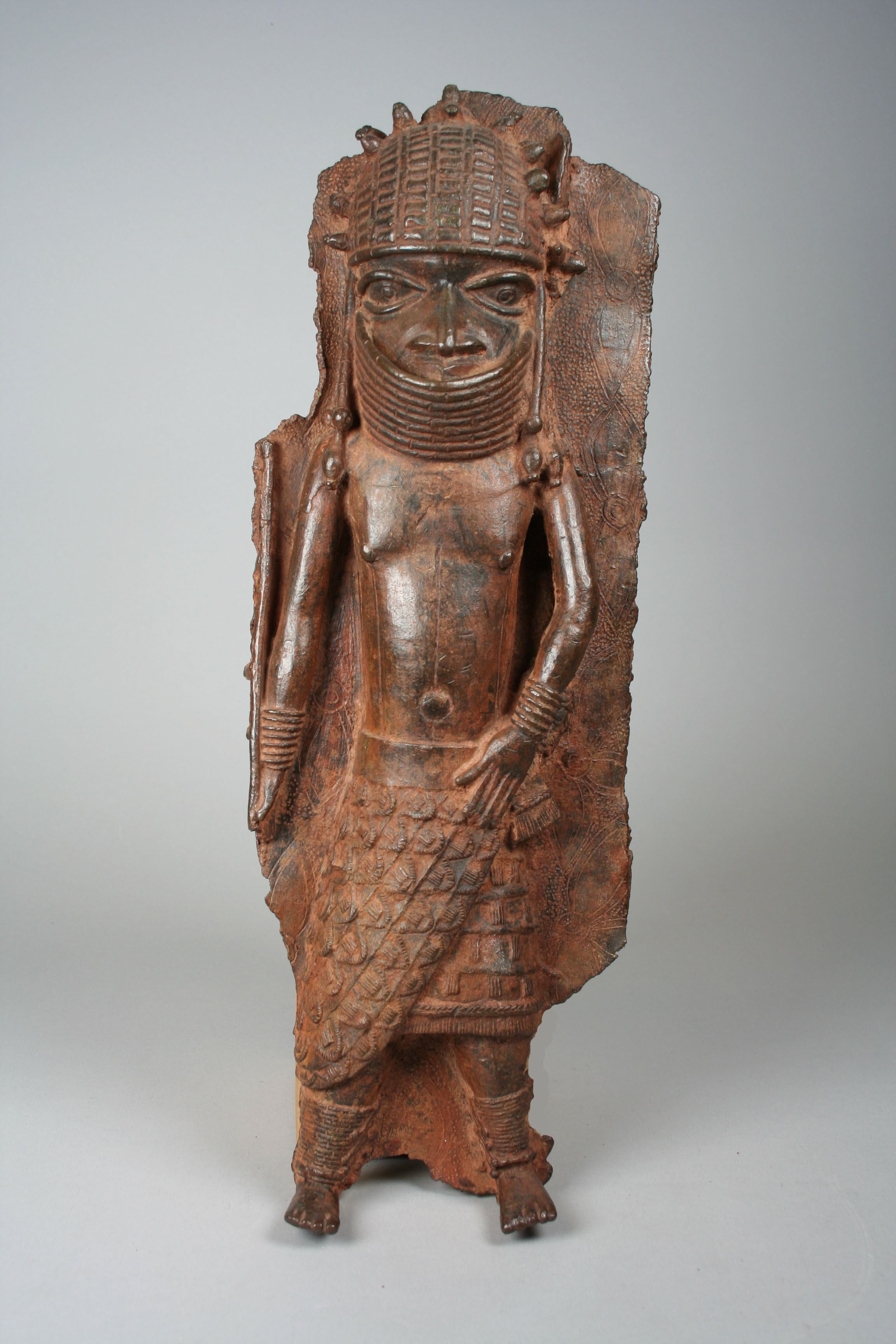
Heritage Analysis: Plaque Fragment with Warrior Chief (Edo Peoples, Brass)
Symbolic Power: The Warrior Chief as a Locus of Authority
The Plaque Fragment with Warrior Chief, originating from the Edo peoples of the historic Kingdom of Benin (present-day Nigeria), is a masterful expression of political and martial authority. Crafted in brass, a medium reserved for the Oba’s court, this fragment depicts a warrior chief in a posture of readiness, often holding a ceremonial sword or staff. Within Edo cosmology, the warrior chief was not merely a military leader but a spiritual guardian of the kingdom, embodying the divine mandate of the Oba. The brass medium itself, known as “the metal of the gods,” was believed to possess protective properties, linking the chief to ancestral forces and the sun deity, Osanobua. The iconography—elaborate headdresses, coral beads, and scarification patterns—signals rank and lineage. For Katherine Fashion Lab, this artifact offers a lexicon of hierarchical symbolism: the use of rigid postures, repetitive motifs, and metallic finishes can be translated into high-end garments that project authority, such as structured blazers with brass-toned embroidery or tailored coats featuring warrior-inspired epaulets. The fragment’s fragmented state itself speaks to the enduring power of incomplete narratives, a concept that can be leveraged in luxury design through asymmetrical cuts or deconstructed silhouettes that hint at a deeper heritage.
Historical Adornment: Brass as a Marker of Status and Craft
The historical adornment of the Edo warrior chief is inseparable from the materiality of brass. In Benin, brass was not native but acquired through trade with Portuguese merchants and later through regional networks, making it a rare and prestigious commodity. The plaque fragment, likely part of a larger series adorning the Oba’s palace, was produced using the lost-wax casting technique—a process that required immense skill and ritual purification. The warrior chief’s regalia, including intricate necklaces, armlets, and anklets, was designed to catch light and reflect the Oba’s glory. These adornments were not decorative but functional symbols of protection, wealth, and divine favor. For a 2026 luxury strategy, Katherine Fashion Lab can draw on this tradition by incorporating brass hardware—from zippers to clasps—as signature elements, positioning them as modern-day talismans. The concept of “adornment as armor” can be reimagined through metallic-threaded fabrics, chainmail-inspired weaves, or resin-embedded brass accents on accessories. The fragment’s weathered patina, a result of centuries of ritual handling and environmental exposure, offers a design cue for aged finishes in leather goods and jewelry, appealing to the high-end consumer’s desire for authenticity and narrative depth.
Spiritual Meaning: The Fragment as a Conduit for Ancestral Energy
In Edo belief, the plaque fragment was not an inert object but a living repository of spiritual energy. The warrior chief depicted on the plaque was considered an intermediary between the living and the dead, his image serving as a focal point for rituals honoring ancestors and invoking protection. The brass medium, when ritually cleansed, was thought to absorb and radiate ase (life force), a concept central to many West African cosmologies. The fragment’s incomplete form amplifies its spiritual potency, as it suggests a connection to a larger, unseen whole—a metaphor for the unseen forces that govern fate. For Katherine Fashion Lab, this spiritual dimension can be integrated into a 2026 luxury strategy through ritualized design processes. For instance, limited-edition collections could be “blessed” through symbolic ceremonies, or garments could feature hidden pockets or interior motifs that reference protective symbols. The concept of fragmentation as empowerment can be applied to modular designs—detachable collars, reversible jackets, or convertible handbags—that allow the wearer to reconfigure their look, mirroring the plaque’s role as a part of a greater whole. This approach aligns with the growing consumer interest in mindful luxury, where objects are valued for their spiritual resonance rather than mere aesthetics.
2026 High-End Luxury Strategy: Translating Heritage into Market Leadership
To position Katherine Fashion Lab as a leader in heritage-inspired luxury by 2026, the Plaque Fragment with Warrior Chief must be leveraged as a strategic asset. The following framework outlines actionable steps:
1. Material Storytelling as Brand DNA: Brass should become a signature material, not just as an accent but as a core component of the brand’s identity. Develop a proprietary “Benin Brass” finish for hardware, buttons, and jewelry, marketed through narratives of craftsmanship, rarity, and spiritual protection. Collaborate with contemporary brass artisans to produce limited-run pieces that echo the lost-wax technique, emphasizing the human touch and the material’s patina evolution over time.
2. Iconographic Codes for Power Dressing: The warrior chief’s posture and regalia can inform a “Power Armor” collection for 2026, featuring tailored separates with structural lines, exaggerated shoulders, and brass-embellished collars. Use the fragment’s scarification patterns as a repeating motif in jacquard weaves or laser-cut leather, creating a visual language that communicates authority without overt branding. This aligns with the high-end consumer’s desire for subtle status markers.
3. Ritualized Consumer Experience: Introduce a “Guardian” membership program, where clients receive exclusive access to collections inspired by ancestral protection. Each purchase could include a digital heritage passport—an NFT-like certificate that traces the design’s inspiration back to the Edo plaque, complete with audio narratives from curators. In-store, create immersive spaces using brass-toned installations and scents of frankincense and myrrh, evoking the ritualistic context of the original artifact.
4. Sustainability via Fragmentation: The fragment’s incomplete nature offers a blueprint for circular fashion. Launch a “Fragment Collection” of modular pieces—detachable sleeves, interchangeable panels, and reversible designs—that encourage longevity and personalization. Market these as “heirloom fragments” that can be passed down, mirroring the plaque’s role as a generational artifact. Partner with restoration experts to offer repair services, positioning the brand as a steward of heritage rather than a fast-fashion entity.
5. Cultural Stewardship and Ethical Partnerships: To avoid appropriation, establish a Benin Heritage Fund that supports Edo artisans and museums. Collaborate directly with Nigerian craftspeople to co-create capsule collections, ensuring that a percentage of profits funds the preservation of Benin bronzes. This builds trust with discerning consumers who prioritize ethical provenance, and positions Katherine Fashion Lab as a cultural ambassador rather than a cultural extractor.
In conclusion, the Plaque Fragment with Warrior Chief is not merely an artifact but a strategic blueprint for Katherine Fashion Lab’s 2026 luxury strategy. By weaving its symbolic power, historical adornment, and spiritual meaning into material choices, design codes, and consumer experiences, the brand can achieve market leadership while honoring the legacy of the Edo peoples. The fragment’s resilience and incompleteness become metaphors for a luxury brand that is both rooted in history and evolving toward the future—a timeless proposition for the discerning high-end client.