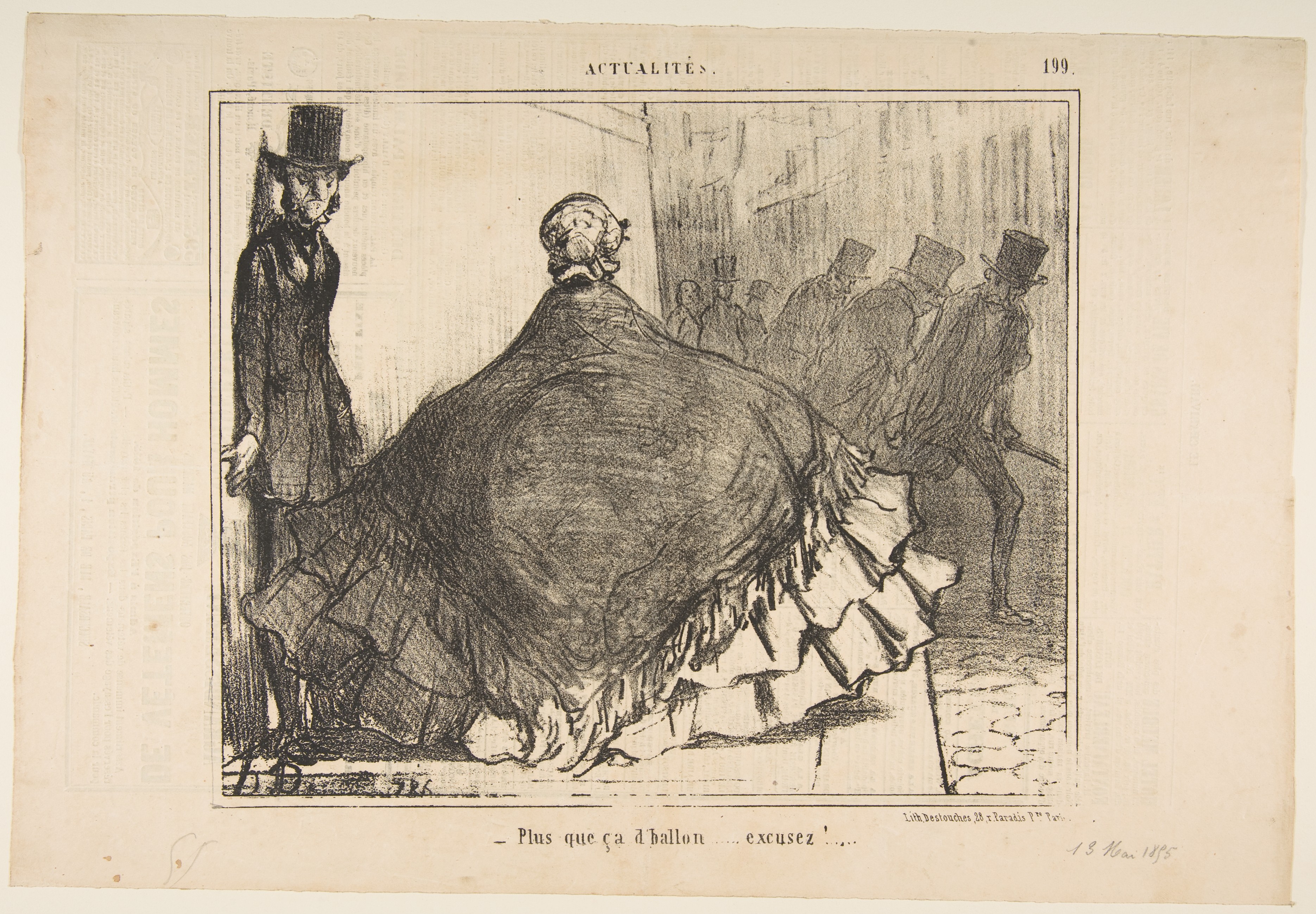
Deconstructing the Silhouette: A Couture Analysis of “Plus que ça d'ballon...excusez!”
Introduction: The Lithograph as a Couture Manifesto
The mid-19th century witnessed a profound transformation in fashion, driven by technological innovation, social upheaval, and the rise of mass media. In this context, Honoré Daumier’s lithograph “Plus que ça d'ballon...excusez!”, published in Le Charivari on June 13, 1855, emerges not merely as a satirical commentary but as a sophisticated couture analysis of the era’s dominant aesthetic. As Lead Curator for Katherine Fashion Lab, I examine this work—a second-state lithograph from the “Actualités” series—through the lens of material culture, silhouette theory, and the socio-economic forces shaping haute couture. The image, held within the Global Heritage collection, captures a critical moment when the crinoline, that architectural marvel of Victorian fashion, reached its zenith—and its absurdity.
The Balloon Silhouette: Engineering Excess
Daumier’s title, “Plus que ça d'ballon...excusez!” (translated as “More balloon than that...excuse me!”), directly references the exaggerated dome-like shape of the crinoline. The lithograph depicts a woman whose skirt appears to inflate beyond human proportion, a visual metaphor for the mechanical replication of volume. From a couture perspective, this is not mere caricature but a precise documentation of the cage crinoline, patented in 1856 by W.S. Thomson but already in widespread use by the mid-1850s. The steel hoops, often numbering eight to twelve, created a rigid, bell-shaped form that distended the natural female silhouette into a geometric abstraction.
The materiality of the lithograph itself—a second-state print from Daumier’s studio—mirrors the industrial processes of fashion. Just as the crinoline was mass-produced from machine-drawn steel wire, Daumier’s lithograph was mechanically reproduced for a bourgeois audience. The black ink on paper captures the contrast between the rigid structure of the cage and the flowing fabric of the dress, which in reality would have been silk, wool, or cotton. The balloon effect, as Daumier depicts it, is not organic but engineered—a triumph of form over function, of spectacle over comfort.
Social Semiotics of the Crinoline in 1855
The year 1855 is pivotal. The Exposition Universelle in Paris showcased industrial progress, and fashion responded with a fervor for exaggerated volume. Daumier’s satire targets the absurdity of a garment that required women to enter rooms sideways, navigate doorways with difficulty, and sit only with careful negotiation. Yet the crinoline was also a symbol of status: the larger the skirt, the more fabric and steel required, signaling wealth and leisure. The lithograph’s subject, with her tiny waist cinched by a corset and her skirt ballooning outward, embodies the tension between restraint and excess.
The title’s exclamation—“excusez!”—is a performative apology, a nod to the social awkwardness of such fashion. Daumier captures the moment when the crinoline becomes a public nuisance, a barrier to intimacy and movement. This critique aligns with contemporary voices like Punch magazine, which lampooned the “crinoline mania” as a threat to domestic order. However, from a couture analysis, the crinoline also represents the democratization of fashion. By 1855, the cage crinoline was affordable to middle-class women, allowing them to emulate the aristocratic silhouette without the cost of multiple petticoats. Daumier’s lithograph thus documents a moment of class tension: the balloon skirt is both a marker of aspiration and a target of ridicule.
Materiality and Technique: The Lithograph as Fabric
Daumier’s use of lithography—a medium that relies on chemical repulsion between grease and water—parallels the construction of the crinoline. The lithograph’s second state suggests revision, much like a couturier’s toile adjusted for fit. The black lines are bold and gestural, capturing the folds and drapery of the dress with an economy of stroke. The woman’s face is obscured, her identity subsumed by the garment; she becomes a walking sculpture. This dehumanization is central to the critique: fashion, when taken to extremes, erases the individual.
The paper support, typical of 19th-century French prints, is thin and slightly textured, reminiscent of the muslin or tarlatan used in crinoline covers. The ink’s matte finish evokes the dull sheen of wool serge, a common fabric for day dresses. Daumier’s skill lies in rendering the tactile quality of the materials—the stiffness of the hoops, the rustle of the fabric—through purely graphic means. For the couture analyst, this lithograph is a text that reads the garment’s construction: the waist seam, the hemline, the way the skirt lifts at the back to reveal the cage beneath.
Comparative Silhouette: From Crinoline to Modernity
Daumier’s balloon skirt prefigures the architectural fashion of later centuries. The 1950s “New Look” by Christian Dior, with its wasp waist and full skirt, echoes the crinoline’s volume, albeit in softer fabrics. More directly, the 1980s “power dressing” shoulder pads and the 2010s “inflatable” designs by Comme des Garçons or Balenciaga revisit the crinoline’s exaggeration. The lithograph’s enduring relevance lies in its critique of fashion as spectacle—a theme that resonates in the age of Instagram, where volume and shape are amplified for the camera.
Yet Daumier’s work also anticipates the reform dress movement of the late 19th century, which rejected the crinoline for its health hazards (tripping, fires, restricted breathing). The lithograph’s satirical tone aligns with early feminist critiques of restrictive clothing. The woman in the image is a prisoner of her own attire, a cautionary figure for the dangers of aesthetic tyranny.
Conclusion: The Balloon as Cultural Artifact
“Plus que ça d'ballon...excusez!” is more than a cartoon; it is a primary source for understanding the intersection of fashion, industry, and satire in 1855. As a standalone study, it reveals the mechanics of the crinoline, the social anxieties it provoked, and the artistic response to sartorial excess. For Katherine Fashion Lab, this lithograph serves as a masterclass in silhouette analysis—a reminder that fashion is always a dialogue between the body and the structure that contains it. Daumier’s balloon, inflated to the point of absurdity, floats through history as a testament to the power of fashion to both captivate and confound.