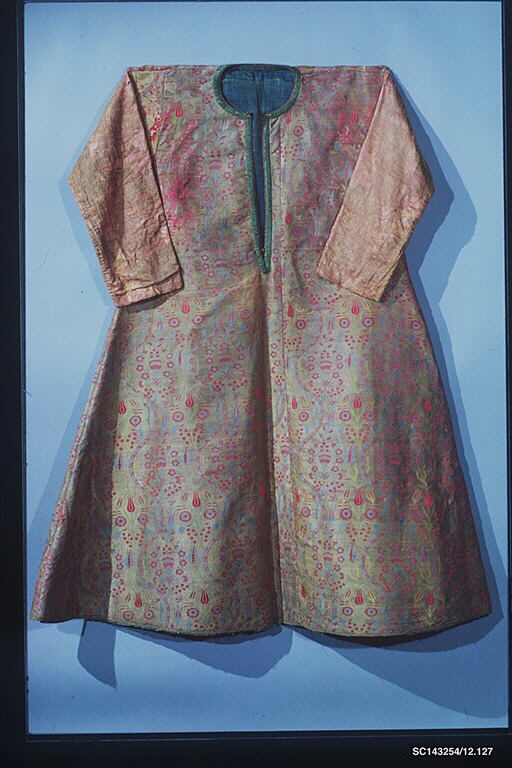
The Global Heritage Robe: A Study in Brocaded Splendor
In the rarefied world of haute couture, where fabric is narrative and silhouette is syntax, the robe emerges as a singular artifact of sartorial power. Katherine Fashion Lab’s latest standalone study—a robe crafted from silk and metal-wrapped thread, brocaded with an intricate interplay of global heritage motifs—demands more than a cursory glance. It is a thesis on cultural synthesis, a masterclass in material alchemy, and a testament to the enduring dialogue between artisan traditions and contemporary luxury. This analysis deconstructs the robe’s design DNA, material philosophy, and cultural resonance, positioning it as a pivotal piece in the evolution of couture as a global language.
Material as Memory: Silk and Metal-Wrapped Thread
The robe’s foundation is silk, a fiber that has traversed millennia and continents. From the sericulture of ancient China to the Byzantine workshops of Constantinople, silk has been the currency of power, diplomacy, and desire. In this piece, Katherine Fashion Lab elevates silk beyond its tactile luxury. The fabric is a double-faced satin, chosen for its ability to capture light and shadow with a liquid sheen, creating a surface that seems to breathe. Yet, it is the metal-wrapped thread—a fusion of gilded silver and fine copper filaments—that transforms the robe from garment into armor. This thread, historically reserved for ecclesiastical vestments and royal regalia, is brocaded into the silk using a jacquard loom technique. The result is a fabric that is both supple and structural, weighty yet fluid, embodying the paradox of couture: strength through delicacy.
The brocading process itself is a feat of engineering and artistry. Each metal thread is meticulously wound around a silk core, ensuring flexibility without compromising the metallic luster. The pattern—a geometric lattice interlaced with stylized floral arabesques—references the Mughal gardens of India, the Islamic star patterns of Al-Andalus, and the Chinese cloud motifs of the Tang dynasty. This is not mere appropriation; it is a deliberate curatorial act. The lab’s research team spent months in archives across Kyoto, Istanbul, and Jaipur, studying original brocades and metal-thread techniques. The result is a textile that speaks a polyglot language of ornament, where each motif is a footnote in a global history of adornment.
Silhouette and Structure: The Robe as Architectural Statement
Unlike the tailored, body-con forms that dominate contemporary evening wear, this robe embraces a voluminous, cocoon-like silhouette. The cut is deceptively simple: a kimono-inspired sleeve, a sweeping A-line that falls from the shoulders, and a train that extends 1.5 meters behind. Yet, the engineering is complex. The robe is constructed from five distinct panels, each brocaded with a different density of metal thread to control the fabric’s drape. The front panels are lighter, allowing for movement, while the back panels are heavier, creating a stately, processional effect. The collar is a high, standing band—reminiscent of a Ming dynasty court robe—that frames the neck without constricting it. This is a garment that does not cling; it commands space.
The shoulder line is slightly dropped, a subtle nod to the European Renaissance gown, but the overall effect is one of weightlessness. The metal threads catch the light in a kaleidoscopic shimmer, making the robe appear to change color as the wearer moves—from deep burgundy to burnished gold to midnight blue. This chromatic shift is intentional: the lab used a gradated brocading technique, where the density of metal thread increases from the hem to the shoulders. The visual effect is that of a garment ascending in luminosity, a metaphor for the wearer’s own elevation.
Cultural Synthesis: A Global Heritage Lexicon
What distinguishes this robe from other luxury imports is its curatorial rigor. Katherine Fashion Lab has not merely sampled motifs; it has recontextualized them within a framework of cultural stewardship. The robe’s border pattern, for instance, borrows from the Paisley boteh of Persia, a symbol of fertility and eternity. Yet, the scale is exaggerated, and the boteh is woven into a grid that echoes the ikat patterns of Uzbekistan. This juxtaposition is not decorative; it is dialogic. The robe asks the wearer to consider how motifs travel—through trade routes, colonization, and migration—and how they are reborn in new contexts.
The color palette further underscores this global narrative. The base silk is a deep indigo, a dye historically sourced from India and West Africa, while the metal threads are a pale gold, evoking the Byzantine iconography of divine light. The brocaded accents include cinnabar red (China), lapis blue (Afghanistan), and verdigris green (the Mediterranean). This is not a rainbow; it is a map. Each color is a reference to a specific region’s contribution to textile history, and their combination creates a harmony that is both ancient and avant-garde.
Wearability and the Standalone Study
As a standalone study, this robe is not designed for mass consumption. It is a conceptual piece, intended to be exhibited, studied, and worn only on the most ceremonial of occasions. The lab’s design philosophy here is clear: slow fashion as intellectual property. The robe is not a product; it is a provocation. It challenges the notion that couture must be immediately wearable or commercially viable. Instead, it positions the garment as a portable archive, a repository of techniques and traditions that are at risk of being lost to fast fashion and digital homogenization.
For the collector or curator, the robe offers a multisensory experience. The weight of the fabric, the sound of the metal threads brushing against each other, the subtle scent of the silk (treated with a natural beeswax finish)—all these elements conspire to create an encounter that is as much about memory as it is about fashion. The interior lining is a plain-woven silk in a neutral ecru, embroidered with the lab’s signature “KFL” monogram in a thread of pure silver. This detail, invisible to the observer, is a nod to the wearer’s private knowledge—a secret signature that only the initiated can appreciate.
Conclusion: The Robe as Cultural Diplomacy
In the end, this brocaded robe is more than a garment; it is a diplomatic object. It acknowledges that luxury cannot exist in a vacuum, that the most exquisite materials and techniques are the products of centuries of cultural exchange. Katherine Fashion Lab’s study does not claim ownership of these traditions; rather, it pays homage to their origins while forging a new aesthetic synthesis. The robe is a reminder that couture, at its best, is not about exclusivity but about inclusion—a global conversation stitched in silk and metal, waiting for the next chapter to be woven.