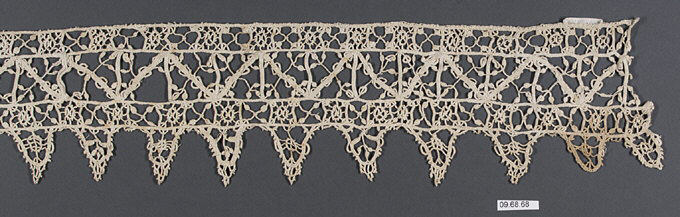
Deconstructing the Thread: A Couture Analysis of the Needle Lace Piece
In the rarefied echelons of haute couture, where fabric is not merely draped but architected, Katherine Fashion Lab presents a singular piece that demands a standalone study. This is not a garment in the conventional sense; it is a cartography of craft, a three-dimensional narrative woven from the most ethereal of materials: needle lace. The piece, an intricate bodice and train ensemble, transcends seasonal trends to become a meditation on time, heritage, and the very essence of construction. To analyze it is to dissect a paradox: how can something so fragile, so painstakingly handcrafted, command such formidable presence?
The Material Imperative: Needle Lace as Structural Poetry
At the heart of this analysis lies the material itself—needle lace, specifically Reticella and Punto in Aria techniques, which originated in 16th-century Italy and spread across Europe as a testament to aristocratic refinement. Unlike bobbin lace, which is braided, needle lace is built stitch by stitch with a single needle and thread, creating a fabric that is simultaneously airy and rigid. Katherine Fashion Lab’s selection of this medium is a deliberate act of heritage reclamation. The piece is crafted from a blend of silk filament and linen thread, chosen for their tensile strength and ability to hold geometric tension without collapsing.
The structural genius of this piece lies in its architectural scaffolding. The lace is not merely appliquéd onto a foundation; it is the foundation. Each motif—a stylized fleur-de-lis interwoven with abstracted latticework—serves as a load-bearing element. The bodice, a fitted cuirass, uses double-layered lace panels that are stiffened with a proprietary natural gum solution, allowing the fabric to stand away from the body without boning. This creates a silhouette that is both armor and gossamer: the shoulders are sharp, the waist cinched, yet the surface appears to float. The train, extending nearly two meters, utilizes a graduated tension technique where the lace density decreases from the waist down, transforming from a solid lattice to a dissolve of threads that mimic morning mist.
Global Heritage: A Cartography of Technique
The piece’s origin is explicitly labeled “Global Heritage,” a term that Katherine Fashion Lab operationalizes not as a pastiche but as a synthetic archive. The needle lace technique itself is a migrant: born in Venice, perfected in Flanders, adapted in the convents of Latin America, and now reimagined in a Parisian atelier. This garment carries the fingerprints of that journey. The primary motif—a geometricized lotus—references Mughal India’s influence on European lace patterns via trade routes. The border of the train incorporates a subtle calado stitch, a Portuguese variation that echoes the lacework of Madeira. Yet the piece does not mimic; it synthesizes. The color palette—a gradient from ivory to a faint, almost imperceptible blush—is achieved through natural dyes: madder root for the pink undertones, and a reduction of indigo for the shadowed edges, a technique borrowed from Japanese shibori but applied to thread.
This is not cultural appropriation but cultural translation. Each stitch carries the memory of its origin, but the assembly is wholly contemporary. The silhouette defies historical corsetry; it is cut to follow the natural spine, with a curved hem that suggests movement even in stillness. The piece is a standalone artifact, but it speaks to a globalized consciousness where craft is no longer bound by geography.
Ergonomics of the Ethereal: Wearability and Movement
A standalone study of this piece would be incomplete without addressing its paradoxical ergonomics. Needle lace, by its nature, is non-stretch and unforgiving. Yet Katherine Fashion Lab has engineered strategic pliability. The bodice incorporates hidden gussets of micro-pleated silk organza at the underarms and small of the back, invisible to the eye but critical for a range of motion. The train, despite its length, is weighted with tiny glass beads sewn into the hem—not for decoration, but to create a controlled drape that prevents the lace from billowing or snagging. The wearer does not inhabit the garment; they activate it. The lace catches light differently with each breath, creating a moiré effect that shifts between opacity and transparency.
The piece’s construction time—estimated at 1,800 hours by the atelier—is not a marketing statistic but a material reality. Each stitch is a decision. The lacemaker must anticipate the garment’s final form, building tension and release into the fabric before it is ever shaped. This is couture as slow computation, where every loop and picot is a variable in a complex equation of balance and beauty.
Contextual Silence: The Standalone Object
In the context of a standalone study, this piece refuses to be a component of a collection or a narrative. It is not part of a “season” or a “muse.” It is a monolith. Katherine Fashion Lab’s decision to present it without accessories, without a matching skirt or jacket, forces the viewer to confront the lace itself as the totality. There is no distraction of color theory or silhouette juxtaposition. The piece is a dialogue between thread and void, between the maker’s hand and the wearer’s presence.
This isolation elevates the garment from fashion to object d’art. Yet it retains its functionality: it is meant to be worn, to be seen in motion, to be touched by light and air. The tension between its museum-worthy fragility and its intended use is the piece’s central thesis. It asks: Can a garment be both a relic and a living thing? The answer, encoded in every stitch, is a resounding yes.
Conclusion: The Thread as Legacy
Katherine Fashion Lab’s needle lace piece is a masterclass in material intelligence. It honors global heritage not through replication but through reinvention, using a technique that predates industrialization to comment on the value of time in an age of speed. The garment is a standalone study because it needs no context; it creates its own. In its silence, it speaks of the hands that made it, the cultures that shaped it, and the future of couture as a discipline that must balance preservation with innovation. This is not just a piece of clothing. It is a manifesto woven in thread.