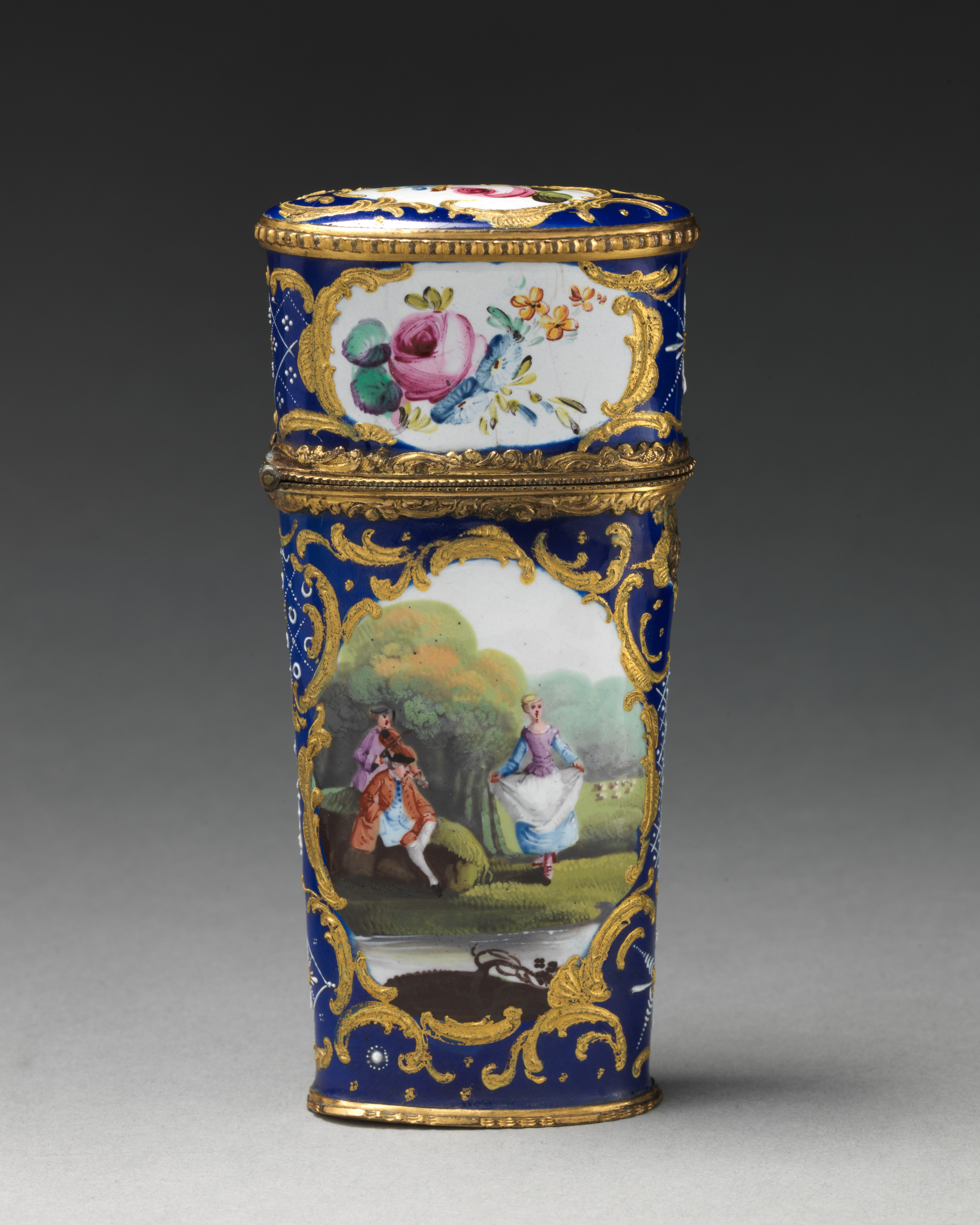
The Étui Recontextualized: A Study in Contained Opulence
Within the lexicon of fashion, the étui occupies a rarefied space. Historically, a small, often exquisitely crafted case designed to hold personal implements—sewing needles, writing quills, cosmetics—it is an object defined by its dual purpose: to protect and to proclaim. For Katherine Fashion Lab, the étui is not a relic but a profound conceptual framework. This standalone study deconstructs the étui's global heritage, reimagining it through the unexpected alchemy of copper and enamel. The analysis posits that the modern couture interpretation of the étui transcends its functional origins to become a metonym for the body itself—a vessel of identity, memory, and protected narrative.
Deconstructing Heritage: The Étui as a Global Narrative
The étui’s origin is not monolithic but a tapestry of global solutions to a universal human need: the portability of the intimate. From the intricate Mughal kalamdans (pen cases) inlaid with ivory and precious stones, to the Chinese scholar's boxes for seals and ink, to the 18th-century European enameled snuffboxes and needle cases carried by the aristocracy, the object is universally recognized. Its value was never in scale, but in concentrated artistry and symbolic weight. It spoke of literacy, leisure, status, and the meticulous care of the self. Katherine Fashion Lab seizes upon this heritage not as a stylistic archive, but as a strategic principle: couture, like the historical étui, must offer a protected, highly personal universe of meaning, engineered with uncompromising craftsmanship. The Lab’s conceptual shift is to expand the scale from an object carried on the body to a construction worn as the body, where the wearer becomes both the curator and the contents.
Material Dialectic: The Strategic Alliance of Copper and Enamel
The choice of copper and enamel is a deliberate, high-stakes material strategy that drives the entire conceptual narrative. Copper, one of humanity’s oldest manipulated metals, is imbued with connotations of conductivity, currency, and antiquity. It is malleable yet durable, a conductor of energy and a canvas for patina. In its raw state, it is humble; worked, it can achieve a sublime, warm luminosity. Enamel, the fusion of powdered glass to metal at high heat, represents the transformative moment—the application of controlled, vibrant, vitreous order onto a metallic base.
This combination creates a powerful dialectic between the foundational and the decorative, the resilient and the fragile, the organic and the perfected. A structural bodice in hammered copper suggests armor, a protective shell for the torso, echoing the étui’s primary function. Over this, cloisonné enamel work in patterns drawn from global traditions—perhaps the swirling paan khania motifs of Bengal or the geometric precision of Byzantine reliquaries—becomes the narrative, the "contents" made visible on the exterior. The enamel is the protected treasure, yet it is displayed on the very surface of the protective vessel. This inversion is critical: it proposes that in modern couture, the protected self is not hidden but is the central, celebrated artifact.
Couture as Contained Architecture: Form and Function Reversed
Katherine Fashion Lab’s application of this study moves into the realm of architectural drapery and constructed silhouette. Imagine a gown where the bodice functions as the primary "case," engineered from a copper mesh that moves with respiratory rhythm, its edges finished with a bezel-like setting. From this structured core, skirts or trains in lustrous silk or fused glass-fiber fabrics cascade, suggesting the flowing, precious contents released. Alternatively, a tailored coat-dress in stiffened, enamel-painted copper silk faille stands closed as a monolithic form, only to reveal, upon movement, an interior meticulously lined with a reverse narrative in enamel-toned velvet and copper thread embroidery—the intimate secret of the garment.
The fastenings become a focal point of the étude: complex clasps inspired by Persian box locks or Chinese puzzle balls, rendered in gilded copper and enamel, which transform the act of dressing into a ritual of opening and securing one’s curated self. The weight of the materials is not dismissed but strategically leveraged, creating a garment that demands a deliberate, ceremonial posture, echoing the gravitas of historical ceremonial wear. This is couture that performs its own heritage, where every seam and joint speaks of containment and revelation.
The Modern Wearer: Curator of the Self
Ultimately, this standalone study on the étui culminates in a redefinition of the client relationship. The wearer of a Katherine Fashion Lab creation born from this concept is no passive consumer. She is the active curator and the living contents. The garment, as an étui, provides the architectural framework, the protected space. But its true value is activated only by the individual who inhabits it. The warm, reflective glow of copper near the skin interacts uniquely with each wearer’s complexion. The narrative suggested by the enamel patterns becomes part of her own story.
This analysis concludes that the future of meaningful couture lies in such deep conceptual mining. By taking a globally recognized heritage object like the étui and subjecting it to a rigorous material and philosophical investigation, the Lab moves beyond trend. It creates wearable theory—garments that are standalone studies in protection, identity, and the artistry of containment. The copper and enamel étui, in its final form, is not merely an article of clothing. It is a proposition: that in an exposed world, the highest luxury is a beautifully wrought sanctuary, one you carry with you, and one that, by its very design, declares what it is you hold most dear.