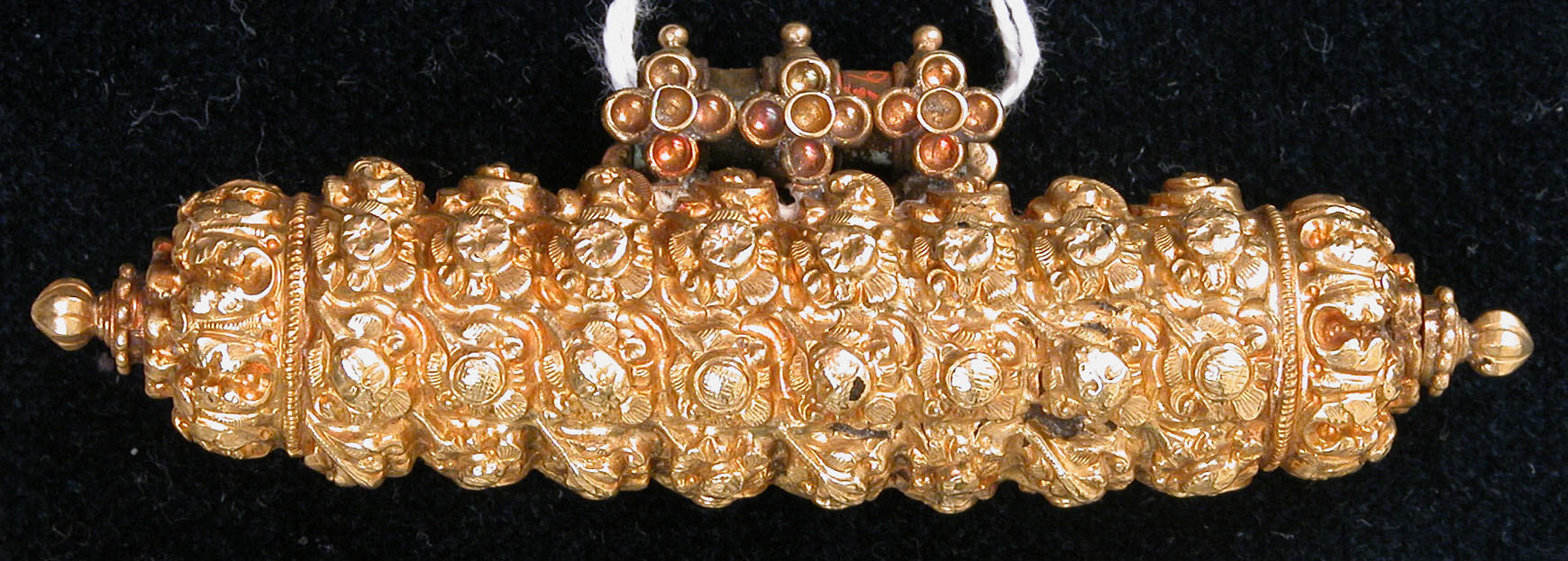
Heritage Analysis: The Gold Amulet Case and Its Resonance for 2026 Luxury Strategy
The amulet case, a small yet potent artifact from ancient civilizations, serves as a profound testament to humanity’s enduring quest for protection, identity, and transcendence. Crafted from gold, this object transcends mere ornamentation, embodying a nexus of symbolic power, historical adornment, and spiritual meaning. For Katherine Fashion Lab, this analysis explores how the amulet case’s heritage can inform a high-end luxury strategy for 2026, drawing on historical resonance and a DNA correlation with the dualistic narrative of the Mirror with Split-Leaf—where one side gleams with gold-inlaid palmettes on a silver mirror, and the other narrates life through relief carvings on a cold stone sarcophagus. This duality mirrors the amulet case’s own function: a vessel of inner protection and outer display.
Symbolic Power: The Amulet Case as a Microcosm of Divine and Mortal Authority
In ancient civilizations, from Egypt to Mesopotamia, the amulet case was not merely a container but a charged object imbued with cosmic significance. Gold, as the medium, was revered as the flesh of the gods—imperishable, radiant, and symbolizing eternal life. The amulet case often housed sacred texts, herbs, or relics, transforming it into a portable sanctuary. Its symbolic power lay in its ability to mediate between the wearer and the supernatural, offering protection against malevolent forces and attracting benevolent energies. For example, in ancient Egyptian funerary practices, gold amulet cases were placed on mummies to safeguard the soul’s journey, while in Hellenistic traditions, they were worn by elites to assert divine favor and social status.
This symbolic duality—protection and prestige—aligns with the Mirror with Split-Leaf’s juxtaposition of reflective light and funerary narrative. The amulet case, like the mirror’s gold-inlaid palmettes, projects an outward radiance of wealth and power. Simultaneously, like the stone sarcophagus’s reliefs, it holds an inner story of mortality and transcendence. For Katherine Fashion Lab, this suggests that luxury in 2026 must embrace dual narratives: the visible and the hidden, the material and the spiritual. The amulet case teaches that true luxury is not just about opulence but about meaningful protection—a brand promise that shields the wearer’s identity and values in a volatile world.
Historical Adornment: The Amulet Case as a Body Ornament and Status Marker
Historically, the amulet case was worn close to the body—suspended from necklaces, belts, or armbands—making it an intimate form of adornment. Its placement on the chest or hip emphasized its role as a guardian of the heart or vital organs. The use of gold elevated it from a common talisman to a marker of elite status, as only the wealthy could afford such materials. In ancient Rome, gold amulet cases (known as bullae) were given to boys as rites of passage, signifying their transition into citizenship and masculine virtue. Similarly, in pre-Columbian Andean cultures, gold amulet cases were buried with high-status individuals, ensuring their protection in the afterlife.
This tradition of intimate adornment offers a blueprint for 2026 luxury strategy. Modern consumers seek pieces that feel personal and transformative, not just decorative. Katherine Fashion Lab can leverage this by designing amulet-case-inspired jewelry that functions as both a fashion statement and a talisman—perhaps with customizable compartments for personal mementos or digital tokens. The historical precedent of gold as a medium for status also underscores the importance of material authenticity. In an era of synthetic luxury, using responsibly sourced gold and artisanal craftsmanship reinforces the brand’s commitment to heritage and exclusivity.
Spiritual Meaning: The Amulet Case as a Vessel for Transcendence
The spiritual dimension of the amulet case is perhaps its most profound legacy. Across cultures, it served as a microcosm of the universe, containing elements believed to align the wearer with cosmic order. In ancient China, jade and gold amulet cases held talismanic inscriptions to harmonize qi (life force). In medieval Europe, reliquary amulet cases housed saintly relics, bridging the earthly and the divine. The gold itself was thought to channel solar energy, purifying the wearer and warding off decay.
This spiritual function resonates with the Mirror with Split-Leaf’s narrative of life and death. The amulet case, like the mirror’s reflective side, represents the light of consciousness; like the sarcophagus’s reliefs, it holds the memory of the soul. For Katherine Fashion Lab, this suggests a luxury strategy rooted in existential storytelling. In 2026, high-end consumers are increasingly drawn to brands that offer not just products but philosophies—objects that address anxieties about mortality, identity, and purpose. The amulet case can inspire a collection that invites wearers to “carry their own narrative,” with designs that incorporate hidden symbols, engravings, or QR codes linking to personal digital legacies.
2026 High-End Luxury Strategy: Integrating Heritage and Innovation
Drawing from this heritage analysis, Katherine Fashion Lab can position the amulet case as a cornerstone of a 2026 luxury strategy that merges historical resonance with contemporary relevance. The following strategic pillars emerge:
- Dualistic Design Language: Echoing the Mirror with Split-Leaf, amulet case pieces should feature contrasting surfaces—one side polished and ornate (reflecting social status), the other textured and intimate (reflecting personal meaning). For example, an exterior of gold-inlaid filigree with an interior compartment lined in velvet or etched with a personal mantra.
- Protective Luxury: Market the amulet case as a talisman for modern anxieties—protecting against digital overload, stress, or identity erosion. This can be supported by collaborations with spiritual advisors or mindfulness experts, creating a narrative of holistic well-being.
- Customization and Ritual: Offer bespoke services where clients select gold finishes, gemstone inlays, and “charges” (e.g., herbs, crystals, or digital tokens). This transforms the purchase into a ritual, aligning with the historical practice of consecrating amulets for specific purposes.
- Material Storytelling: Emphasize gold’s heritage as a “divine metal,” using ethically sourced and traceable materials. A digital passport (e.g., blockchain) can track the gold’s journey from mine to masterpiece, reinforcing transparency and exclusivity.
- Experiential Marketing: Host exhibitions in partnership with museums or archaeologists, showcasing ancient amulet cases alongside the brand’s contemporary interpretations. This educates consumers and positions Katherine Fashion Lab as a curator of cultural heritage.
In conclusion, the gold amulet case from ancient civilizations offers a rich tapestry of symbolic, historical, and spiritual insights. Its duality—as a protector and a status symbol, a vessel for the divine and the mortal—mirrors the Mirror with Split-Leaf’s interplay of light and darkness. For Katherine Fashion Lab, this heritage provides a strategic foundation for 2026: a luxury that is not just seen but felt, not just owned but inhabited. By embracing the amulet case’s legacy, the brand can create objects that resonate deeply with a discerning clientele seeking meaning, protection, and timeless beauty.