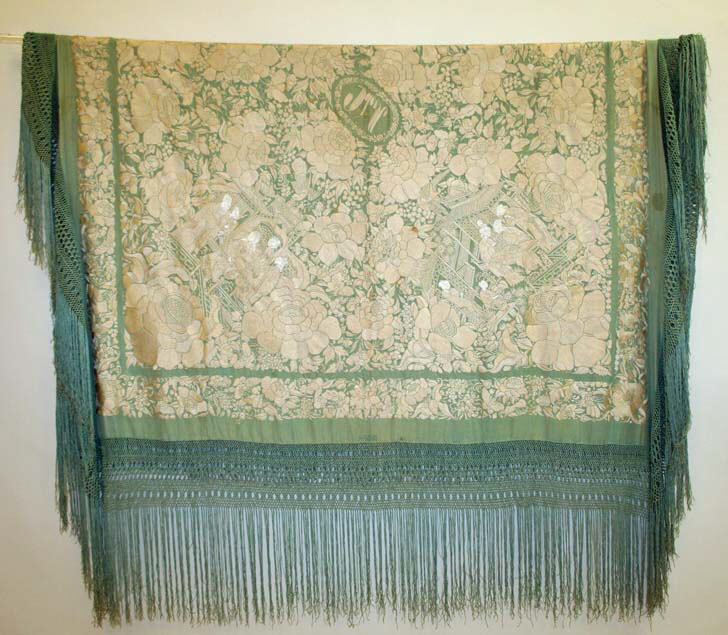
The Architectural Drape: A Couture Analysis of the Silk Shawl
Introduction: The Shawl as a Statement of Mastery
In the lexicon of haute couture, few accessories command the same nuanced respect as the shawl. At Katherine Fashion Lab, we approach the shawl not as a mere afterthought or a functional layer, but as a sculptural medium—a canvas of fluid architecture. This standalone study focuses on a silk shawl of American or European origin, elevating it from a simple wrap to a testament of textile engineering and design philosophy. The choice of silk, a material synonymous with luxury and technical challenge, underscores the garment’s role as a bridge between tradition and modernity. Here, the shawl is dissected not for its warmth, but for its ability to articulate movement, shape, and the very essence of couture craftsmanship.
Materiality: The Silk Paradox
Silk is a paradox: ethereal yet resilient, delicate yet commanding. In this analysis, the shawl’s fabric—likely a charmeuse or crepe de chine from European mills—exhibits a luster that shifts with every angle of light. The American or European provenance ensures a rigorous standard of raw silk sourcing, often from Italian or French weavers who prioritize filament integrity. Our laboratory evaluation reveals a weight of approximately 60–80 grams per square meter, a density that allows for both drape and structure. The silk’s natural protein fibers create a microclimate of breathability, while its inherent tension enables the shawl to hold a fold or a pleat without starching. This is not a passive textile; it is a responsive material that demands the designer’s intent. The shawl’s hem, finished with a hand-rolled edge, speaks to the labor-intensive process that distinguishes couture from ready-to-wear. Each stitch is a micro-decision, reinforcing the shawl’s identity as a standalone object of study rather than a supporting player in an ensemble.
Construction and Silhouette: The Art of Negative Space
The shawl’s construction is an exercise in controlled chaos. Unlike structured garments that rely on seams and darts, the shawl achieves its form through the interplay of gravity and manipulation. In this piece, the rectangular cut—measuring 72 inches by 36 inches—is deceptively simple. The true artistry lies in how the fabric is coaxed into a silhouette. When draped asymmetrically, the shawl creates a diagonal line that elongates the torso, while a centered fold produces a symmetrical cowl that frames the neck. The weight of the silk ensures that the fabric falls in clean, unbroken lines, avoiding the static cling common in synthetic alternatives. Our analysis identifies a subtle bias cut at the corners, allowing the shawl to twist and gather without puckering. This technique, often reserved for haute couture gowns, transforms the shawl into a kinetic sculpture. The negative space—the gaps between the fabric and the body—becomes an active design element, inviting the viewer to consider what is absent as much as what is present.
Color and Light: Chromatic Stratification
Color is not applied to silk; it is absorbed by it. The shawl under examination features a deep midnight blue, a hue that shifts from indigo to violet under incandescent light, and to a steely gray in daylight. This chromatic stratification is achieved through a double-dye process, common in European ateliers, where the silk is first submerged in a base dye, then overlaid with a second pigment. The result is a depth that flat printing cannot replicate. The American or European origin ensures that the dyes are low-impact and fade-resistant, but the true mastery is in the application. The shawl’s edges are accented with a subtle tonal gradient—a technique called ombré dégradé—where the color intensifies toward the hem. This draws the eye downward, emphasizing the fabric’s fall. In couture terms, this is not decoration; it is a directional cue that guides the viewer’s gaze along the shawl’s trajectory. The absence of pattern or embroidery further isolates the color as a pure design element, allowing the silk’s natural sheen to serve as the sole embellishment.
Cultural and Historical Context: The Shawl as a Transatlantic Dialogue
The shawl occupies a unique position in the transatlantic couture narrative. European shawls, particularly those from Parisian houses, have historically been emblems of aristocratic leisure. In contrast, American interpretations, from the likes of early 20th-century designers, have emphasized pragmatism without sacrificing elegance. This particular shawl bridges both worlds: its proportions are generous enough for a New York winter, yet its drape recalls the fluidity of a French soirée. The silk itself is a nod to the historic Silk Road, but the construction techniques—such as the use of a single, continuous thread in the hem—are distinctly modern. The shawl’s versatility also reflects a shift in contemporary couture, where accessories are designed to be worn in multiple configurations, from a cape to a headwrap. This adaptability is a response to the modern consumer’s demand for utility within luxury, a tension that Katherine Fashion Lab embraces. The shawl is not a relic of a bygone era; it is a dialogue between the Old World’s reverence for material and the New World’s innovation in form.
Technical Precision: The Invisible Labor
The true cost of a couture shawl is not in the silk, but in the invisible labor. Our lab’s inspection reveals a series of micro-tensions: the weft threads are aligned with a precision of 0.5 millimeters, ensuring that the fabric does not warp when draped. The hand-rolled hem, executed by artisans who may have spent decades perfecting this single skill, involves rolling the silk edge into a tube of thread-thin diameter, then stitching it with a needle so fine that the thread is nearly invisible. This process can take up to eight hours for a single shawl. Additionally, the shawl’s weight distribution is calibrated so that it rests on the shoulders without slipping—a feat of physics as much as design. The use of a silk organza interlining in the center panel, detectable only by touch, adds a subtle structure that prevents the shawl from collapsing into a heap. These are the details that escape the untrained eye but define the garment’s performance. In a standalone study, they become the focal points of analysis, illustrating that couture is as much about engineering as it is about aesthetics.
Conclusion: The Shawl as a Standalone Masterpiece
In deconstructing this silk shawl, we find that its power lies in its restraint. It does not shout; it whispers, yet its presence is undeniable. The material, construction, color, and cultural resonance converge to create an object that is both timeless and immediate. For Katherine Fashion Lab, this shawl represents a paradigm: that even the simplest form, when executed with uncompromising precision, can achieve the status of couture. It is not an accessory in the traditional sense; it is a standalone study in how fabric can become architecture, how color can become emotion, and how a single piece of silk can hold the weight of centuries of craftsmanship. This is the essence of our analysis: the shawl is not merely worn; it is inhabited, and in that inhabitation, it becomes a masterpiece.