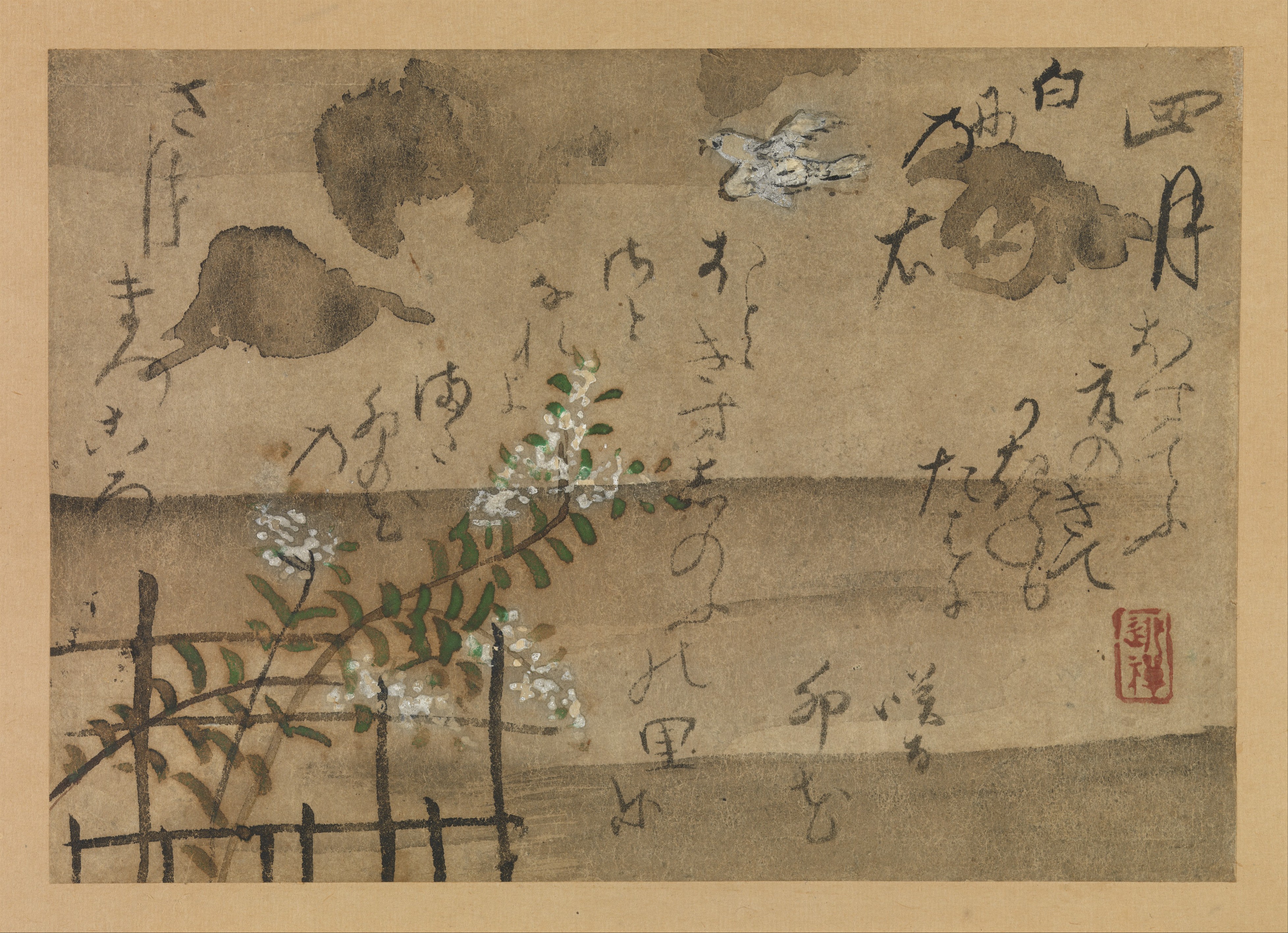
Deconstructing Temporality: “Fourth Month” as Couture Inspiration
The intersection of classical Japanese aesthetics and high fashion has long yielded profound creative syntheses, yet few sources possess the layered symbolism of Fujiwara no Teika’s Birds and Flowers of the Twelve Months. As Lead Curator at Katherine Fashion Lab, I have undertaken a meticulous analysis of the “Fourth Month” hanging scroll—a standalone study in ink and color on paper—to extract its latent couture potential. This work, rooted in the Heian period’s refined sensibility, is not merely a seasonal depiction but a sophisticated meditation on transience, restraint, and the poetic tension between nature and artifice. For the modern couturier, it offers a lexicon of form, color, and narrative that demands both reverence and radical reinterpretation.
Seasonal Semiotics: The Fourth Month as a Liminal Space
In Teika’s oeuvre, the “Fourth Month” occupies a unique temporal threshold: it bridges the exuberant bloom of spring and the humid intensity of early summer. The scroll likely depicts the satsuki (五月) season, characterized by irises, azaleas, and the cuckoo’s first call—motifs that signify renewal, melancholy, and the fleeting nature of beauty. For the fashion analyst, this liminality translates into a design philosophy of controlled impermanence. The couture collection must evoke the sensation of a moment caught between states: fabrics that shift in opacity, silhouettes that suggest both bloom and wilt, and colors that hover between verdant green and rain-soaked gray.
Teika’s poetic technique, known as hon’i (essential nature), prioritizes the essence of a subject over its literal representation. In “Fourth Month,” this manifests through subtle brushwork—a single iris petal rendered with such economy that it implies an entire garden. The couture parallel lies in minimalist construction with maximalist intent: a gown whose asymmetric draping suggests a breeze, or a jacket whose single embroidered stem of azalea carries the weight of an entire season. The scroll’s use of blank space (yohaku) becomes a design tool, urging the fashion house to embrace negative space as a narrative element.
Materiality and Technique: Ink, Color, and the Art of Unfolding
The scroll’s materiality—ink and color on paper—presents a tactile challenge for haute couture. Ink, in Japanese art, is not a mere medium but a philosophical statement: its permanence contrasts with the ephemeral paper, echoing the Buddhist concept of mujō (impermanence). For Katherine Fashion Lab, this demands an exploration of dye techniques that mimic ink wash (sumi-e), such as shibori resist-dyeing or sashiko embroidery that traces brush-like strokes. The color palette, limited to mineral pigments—indigo, vermilion, orpiment, and malachite—must be reinterpreted through modern dye technologies that achieve the same depth without the toxicity of historical materials.
A critical detail in Teika’s “Fourth Month” is the integration of calligraphic line with floral form. The brushstrokes defining a bird’s wing or a flower stem are not decorative but structural; they dictate the visual rhythm. In couture, this translates into architectural seams that double as graphic elements. Imagine a gown where the seams tracing the spine mimic the curve of a bamboo stalk, or a cape whose hemline follows the arc of a crane’s flight path. The scroll’s haboku (broken ink) technique—where ink is applied in splashed, seemingly chaotic patterns—inspires a fabric treatment of deliberate irregularity: laser-cut organza petals that appear to scatter like fallen blossoms.
Narrative Layers: The Scroll as a Standalone Study
Unlike a full set of twelve scrolls, the “Fourth Month” as a standalone study demands a different interpretive lens. It is not part of a series but a self-contained microcosm, a concentrated burst of seasonal meaning. For the fashion collection, this suggests a capsule approach: fewer pieces, each carrying the full weight of the scroll’s symbolism. A single evening gown might encapsulate the entire month—its silhouette referencing the scroll’s vertical format, its train echoing the paper’s unrolled edge, and its embroidery narrating the cuckoo’s song through metallic thread.
The scroll’s compositional asymmetry is another key element. Teika often placed the focal subject—a bird or flower—off-center, creating a dynamic tension that pulls the viewer’s eye diagonally. In couture, this inspires asymmetric necklines, single-sleeve constructions, or trains that trail to one side. The balance is not symmetrical but poetic, achieved through color weight and texture contrast. For instance, a deep indigo bodice might anchor a lighter, ink-washed skirt, while a single vermilion flower at the shoulder acts as the visual pivot.
Symbolic Motifs: Birds, Flowers, and the Language of Transience
Teika’s birds and flowers are not random; they are codified symbols within Japanese court poetry. The cuckoo (hototogisu) in the Fourth Month signals both summer’s arrival and the poet’s longing—a dualism of presence and absence. The iris (ayame) represents victory and protection but also the melancholy of a rain-soaked landscape. For couture, these motifs must be abstracted rather than replicated. A cuckoo might be rendered as a single feather-shaped cutout in a sleeve, or as a pattern of tiny embroidered notes that visually “sing” across the fabric. The iris becomes a structural element: a pleated fan that mimics its petals, or a collar that echoes its sword-like leaves.
The scroll’s use of gold and silver (in the original color palette) is minimal but strategic, often reserved for the sun or moon. In couture, this translates to accent placement: a single gold thread woven into the hem, or a silver clasp that catches light like a dewdrop. The goal is not opulence but restrained luminescence, reflecting the Heian aesthetic of iki (refined simplicity).
From Scroll to Runway: A Curatorial Vision
To translate “Fourth Month” into a runway collection, Katherine Fashion Lab must honor the scroll’s dual identity as art and artifact. The garments should not mimic the scroll but embody its principles: the tension between control and spontaneity, the dialogue between line and form, and the celebration of the ephemeral. Each piece should function as a wearable haiku—a condensed, evocative statement that invites contemplation.
Consider a finale gown inspired by the scroll’s verticality: a column of raw silk, hand-painted with ink-wash gradients from deep charcoal to pale gray, with a single embroidered iris climbing from the hem to the waist. The train, unrolled like paper, features calligraphic strokes that spell out a Teika poem in a modern, abstracted script. The model’s movement would mimic the scroll’s unfurling—a performance of time and space. This is not costume but couture as cultural translation, where every stitch, dye, and cut is a homage to Teika’s genius and the enduring power of seasonal beauty.
In conclusion, the “Fourth Month” offers a masterclass in narrative compression and material poetry. For Katherine Fashion Lab, it is a call to elevate fashion from mere adornment to a medium of temporal and spiritual expression—a practice that, like Teika’s brush, captures the infinite within the finite.