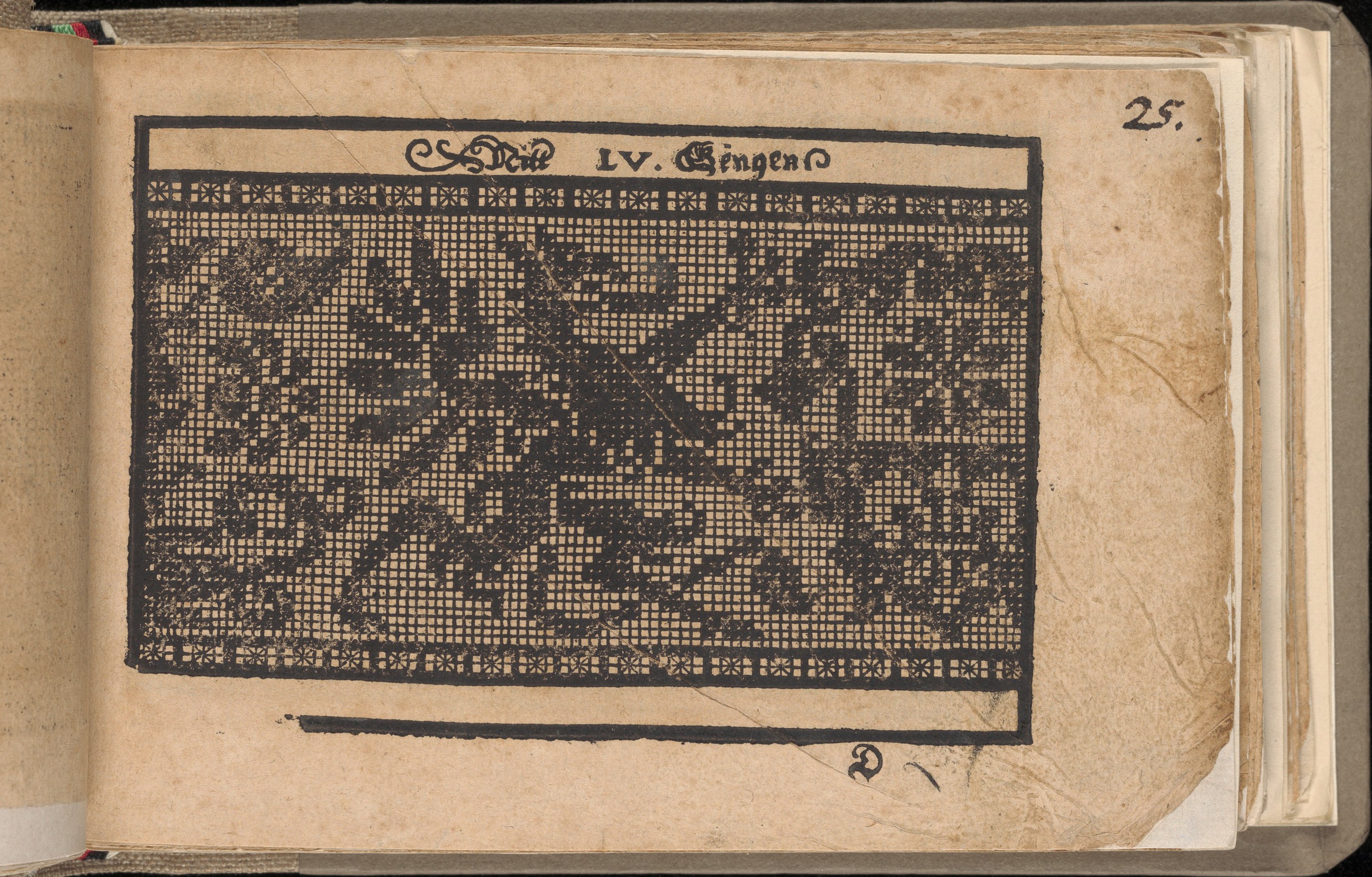
The Geometry of Gesture: A Couture Analysis of Schön’s Modelbuch, Page 25r
Introduction: The Unseen Blueprint of Fashion’s Modernity
In the annals of fashion history, the printed pattern book occupies a paradoxical space: it is both a tool of dissemination and a relic of craftsmanship. Schön’s Newes Modelbuch (1560–1570), specifically Page 25r, offers a profound lens through which to examine the intersection of materiality, cultural transmission, and design philosophy. As a woodcut artifact from the German Renaissance, this page transcends its utilitarian origins to become a standalone study in the geometry of gesture—a silent conversation between the artisan’s hand and the wearer’s body. For Katherine Fashion Lab, this analysis unearths the structural DNA that continues to inform contemporary couture: the tension between ornament and silhouette, the rhythm of repetition, and the silent authority of the unadorned line.
The Woodcut as a Couture Document
At first glance, a woodcut from a 16th-century pattern book may seem anachronistic to the world of haute couture. Yet, the materiality of the woodcut—its stark black lines against cream paper—mirrors the foundational principles of pattern-making in fashion. Each incision in the wood block is a decision; each negative space a breath. Page 25r features a series of figures, likely women, arranged in a frieze-like composition. Their garments are not merely depicted but deconstructed into linear diagrams—the folds of a skirt, the drape of a sleeve, the angle of a collar. This is not illustration; it is instruction. For the couturier, this page functions as a primitive technical flat, a precursor to the modern toiles and muslins that define the atelier.
Deconstructing the Silhouette: The Architecture of the Body
The figures on Page 25r embody a verticality that commands space. Their elongated torsos, narrow waists, and voluminous skirts create a visual rhythm that is both disciplined and lyrical. The woodcut’s reliance on line weight—thick for structural seams, thin for decorative motifs—reveals a sophisticated understanding of how fabric interacts with the human form. The bodice is rigid, almost architectural, suggesting the use of boning or stiffened linen. The sleeves, puffed at the shoulder and tapering to the wrist, echo the sculptural volume that later defined the Baroque and even the 20th-century Dior “New Look.”
What is striking is the absence of excess. Unlike the elaborate embroideries of later centuries, this modelbuch prioritizes clarity. The garments are composed of modular elements: a fitted bodice, a flared skirt, a structured sleeve. Each component is a discrete unit, yet they coalesce into a unified whole. This modularity is a hallmark of couture construction, where pieces are cut, shaped, and assembled with precision. For the contemporary designer, Page 25r offers a lesson in restraint as luxury—the idea that the most profound statements are made through economy of line, not accumulation of detail.
Cultural Transference: The Global Heritage of the Modelbuch
The Newes Modelbuch is a document of global heritage not because it depicts exotic cultures, but because it embodies the transnational flow of design during the early modern period. Schön, active in the German-speaking regions, drew inspiration from Italian, French, and Flemish sources. The woodcuts themselves were distributed across Europe, serving as templates for dressmakers, embroiderers, and tailors. Page 25r, therefore, is a node in a network—a visual currency that transcended borders.
This global dimension is critical for Katherine Fashion Lab’s ethos. The modelbuch’s patterns were not static; they were adapted and reinterpreted by local hands. A garment made in Augsburg would differ from one in Antwerp or Florence, yet the underlying geometry remained constant. This is the essence of cultural sustainability: the recognition that design is a dialogue, not a monologue. The woodcut’s lines are a universal language, speaking to the shared human need for adornment, structure, and identity.
The Rhythm of Repetition: Ornament as System
Page 25r is notable for its repetitive motifs—the parallel lines of a pleated skirt, the scalloped edge of a hem, the diagonal slashes of a sleeve. These are not arbitrary decorations; they are systematic applications of pattern. In couture, repetition creates rhythm. The eye moves across the garment, guided by the recurrence of a line or shape. Schön’s woodcuts exploit this principle with mathematical precision. The pleats are not soft; they are sharp, almost metallic in their regularity. This suggests a fabric that holds its shape—perhaps a stiff wool or a silk taffeta—and a construction technique that prioritizes structure over drape.
For the modern designer, this repetition is a tool of branding. A signature motif—a specific pleat width, a particular collar shape—becomes a visual signature. Page 25r demonstrates that ornament is not mere embellishment; it is a system of communication. The scalloped hem on the figure’s outer garment speaks to a hierarchy of detail: the most intricate work is reserved for the edges, where the eye naturally rests. This is a lesson in strategic luxury: invest in the moments that matter, and let the rest recede into silence.
The Standalone Study: Decontextualizing the Modelbuch
To treat Page 25r as a standalone study is to strip it of its original context—the book, the binding, the intended audience—and re-present it as an object of pure design. This decontextualization is a radical act, but one that reveals the timelessness of the form. Without the surrounding pages, the figures become archetypes. They are not women of a specific era; they are embodiments of proportion. The woodcut’s black lines no longer depict a dress; they become a diagram of desire—the desire to clothe the body in a way that elevates it above the mundane.
In the context of Katherine Fashion Lab, this standalone study invites a re-reading of the modelbuch as a precursor to the mood board. The woodcut is a compressed vision, a distillation of form. It asks the designer to fill in the gaps: What fabric is this? How does it move? Who wears it? The answers are not provided; they are inferred. This is the creative tension that defines couture—the balance between what is shown and what is imagined.
Conclusion: The Enduring Line
Schön’s Newes Modelbuch, Page 25r, is more than a historical artifact. It is a masterclass in the grammar of fashion. The woodcut’s lines are not merely decorative; they are structural, rhythmic, and cultural. For Katherine Fashion Lab, this analysis reaffirms the primacy of the line—the foundational element from which all couture is built. Whether in 16th-century Germany or a 21st-century atelier, the geometry of gesture remains constant. The body is the canvas, and the pattern is the brushstroke. Page 25r reminds us that the most enduring fashion is not about novelty, but about clarity of intention. In a world of noise, the woodcut’s silence is the ultimate luxury.