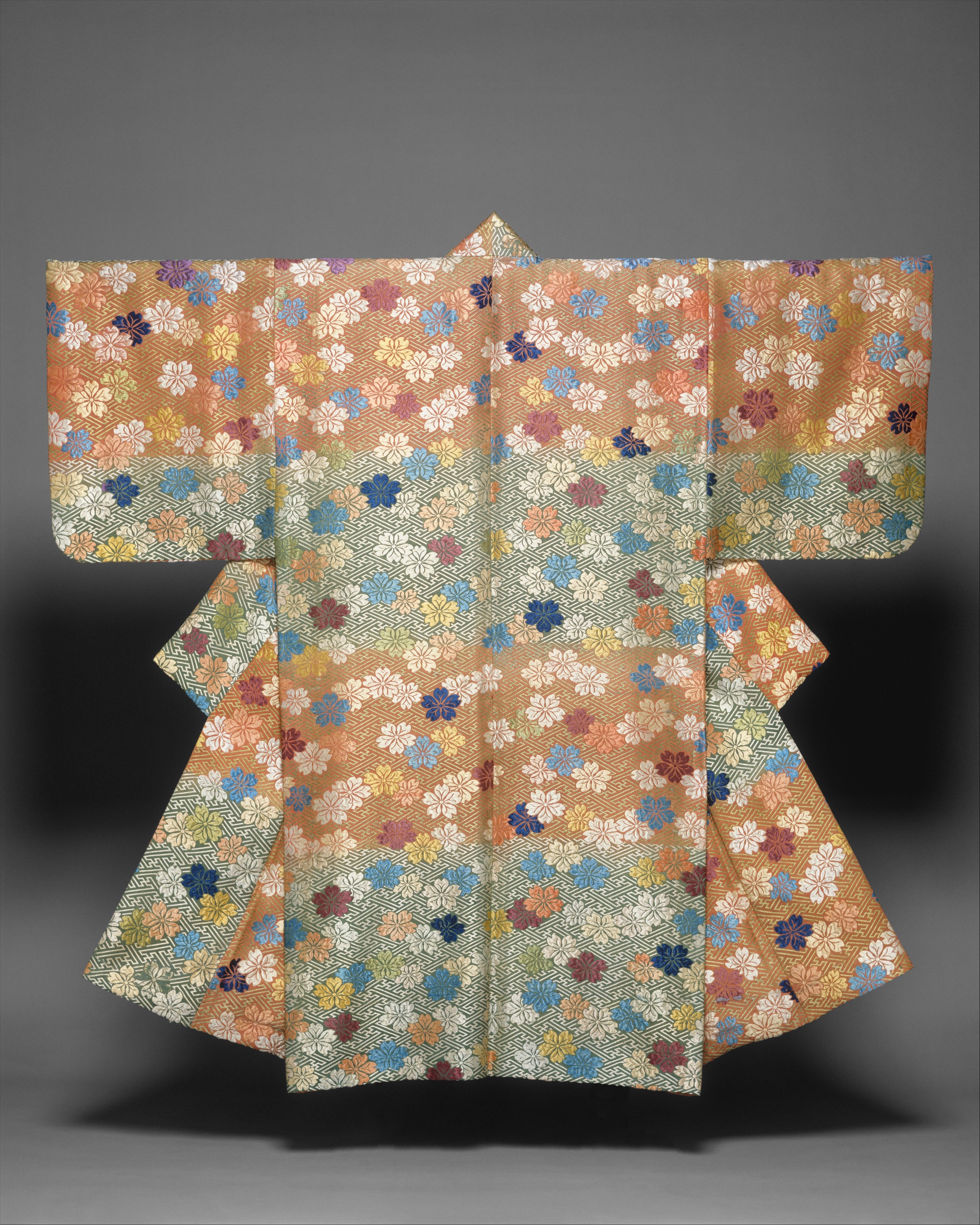
Deconstructing the Karaori: A Couture Analysis of Noh’s Cherry Blossom Fretwork
In the hallowed tradition of Japanese Noh theatre, the Karaori—a term meaning “Chinese weaving”—represents the zenith of textile artistry, a garment that transcends mere costume to become a narrative vessel. This particular piece, a brocaded twill silk robe adorned with cherry blossoms and intricate fretwork, offers a profound study in the intersection of haute couture technique, symbolic storytelling, and material transcendence. For Katherine Fashion Lab, this analysis seeks to decode the garment’s structural, aesthetic, and cultural DNA, drawing parallels to contemporary luxury design principles while respecting its origins as a standalone artifact of unparalleled craftsmanship.
Material Alchemy: Silk, Twill, and Brocade
The foundation of this Karaori lies in its silk brocaded twill, a weave that marries durability with a lustrous, almost liquid surface. The twill structure—characterized by its diagonal ribbing—provides a subtle, directional sheen that catches light differently depending on the wearer’s movement. This is not a static fabric; it is a kinetic canvas. The brocading technique, where supplementary weft threads are woven into the base twill to create raised patterns, introduces a tactile topography. In couture terms, this is akin to embroidery reimagined as weave, where the cherry blossoms and fretwork emerge not as applied decoration but as integral components of the fabric’s very architecture. The silk itself, sourced from Japan’s sericultural traditions, offers a weight that drapes with controlled fluidity, allowing the garment to hold its form while yielding to the actor’s gestures—a critical balance for Noh’s deliberately slow, stylized movements.
Symbolic Lexicon: Cherry Blossoms and Fretwork
The cherry blossom (sakura) is a motif laden with transience and beauty, emblematic of the ephemeral nature of life—a core theme in Noh drama. Here, the blossoms are rendered in a palette of muted pinks and whites, their petals layered to suggest depth and volume. Each flower is a study in gradated shading (bokashi), a technique borrowed from Japanese painting, where colors shift from deep magenta at the center to pale blush at the edges. This creates an illusion of three-dimensionality, as if the blossoms are caught in a gentle breeze. The fretwork (mon), a geometric pattern of interlocking lines and angles, serves as both structural framework and symbolic anchor. In Japanese design, fretwork often represents continuity, eternity, and the infinite—a counterpoint to the cherry blossom’s fleetingness. The juxtaposition is deliberate: the organic, soft curves of the flowers against the rigid, mathematical precision of the fretwork creates a visual tension that mirrors the emotional conflicts of Noh’s protagonists. For Katherine Fashion Lab, this duality offers a lesson in oppositional design, where contrasting elements are not merely juxtaposed but harmonized through masterful execution.
Construction and Silhouette: The Art of Controlled Volume
The Karaori’s silhouette is deceptively simple: a long, kimono-like robe with wide sleeves and a straight, floor-length hem. Yet, its construction is a feat of pattern engineering. The garment is cut from bolts of fabric that are typically 36 to 42 centimeters wide, requiring precise alignment of the woven patterns across seams. The cherry blossoms and fretwork are orchestrated to flow uninterrupted from the shoulders to the hem, with the fretwork often framing the blossoms along the sleeves and back. This asymmetric balance is a hallmark of Noh costume design, where the left and right sides of the robe may feature slightly different arrangements, reflecting the actor’s shifting role between human and spirit. The sleeves, deep and voluminous, are weighted at the hem with small lead pellets—a detail that, in couture terms, functions like a dress weight, ensuring the fabric falls with dramatic, deliberate gravity. The collar, stiffened with multiple layers of silk, rises slightly at the nape, creating a frame for the actor’s face and neck, which are often the only visible parts of the body.
Color and Texture: A Study in Restraint
Unlike the vibrant, saturated hues of many ceremonial garments, this Karaori employs a subdued, tonal palette—gold, ivory, pale pink, and deep indigo—that speaks to its theatrical context. Under Noh stage lighting, which historically relied on candlelight or lanterns, such colors would have appeared as shifting, ethereal tones, the gold catching the flame’s flicker while the indigo receded into shadow. The texture is equally nuanced: the brocaded areas—the blossoms and fretwork—are raised and slightly stiff, while the twill ground remains soft and pliable. This tactile contrast is not merely aesthetic; it informs the garment’s acoustic properties. The rustle of silk against silk, the subtle friction of raised patterns against the base weave, creates a soft, percussive sound that accompanies the actor’s movements, adding an auditory layer to the performance. In modern couture, this integration of sound, texture, and movement is a rare and sought-after quality, akin to the sensory storytelling of a Rick Owens or Iris van Herpen collection.
Cultural Resonance: The Karaori as Timeless Couture
To analyze this Karaori through a couture lens is to recognize its timelessness. It is not a costume bound to a single era but a living artifact that continues to inform contemporary design. The cherry blossom and fretwork motif, for instance, echoes in the work of designers like Yohji Yamamoto, who often juxtaposes organic floral patterns with geometric cuts. The garment’s construction—its reliance on hand-weaving, its rejection of symmetry, its integration of weight and drape—challenges the fast-fashion paradigm of mass production. For Katherine Fashion Lab, this piece embodies the ultimate luxury: the labor of countless hours, the mastery of ancient techniques, and the narrative depth that transforms cloth into character. It stands as a testament to the fact that true couture is not about novelty but about the elevation of craft to art, a principle that resonates across centuries and cultures.
In conclusion, this Karaori is more than a garment; it is a philosophical statement woven in silk. Its cherry blossoms remind us of beauty’s fragility, its fretwork of order’s permanence, and its brocaded twill of the dialogue between tradition and innovation. As a standalone study, it offers Katherine Fashion Lab a blueprint for creating designs that are not merely worn but experienced—pieces that carry the weight of history, the precision of technique, and the soul of their wearer. This is the essence of couture, distilled into 800 words and a single, extraordinary robe.