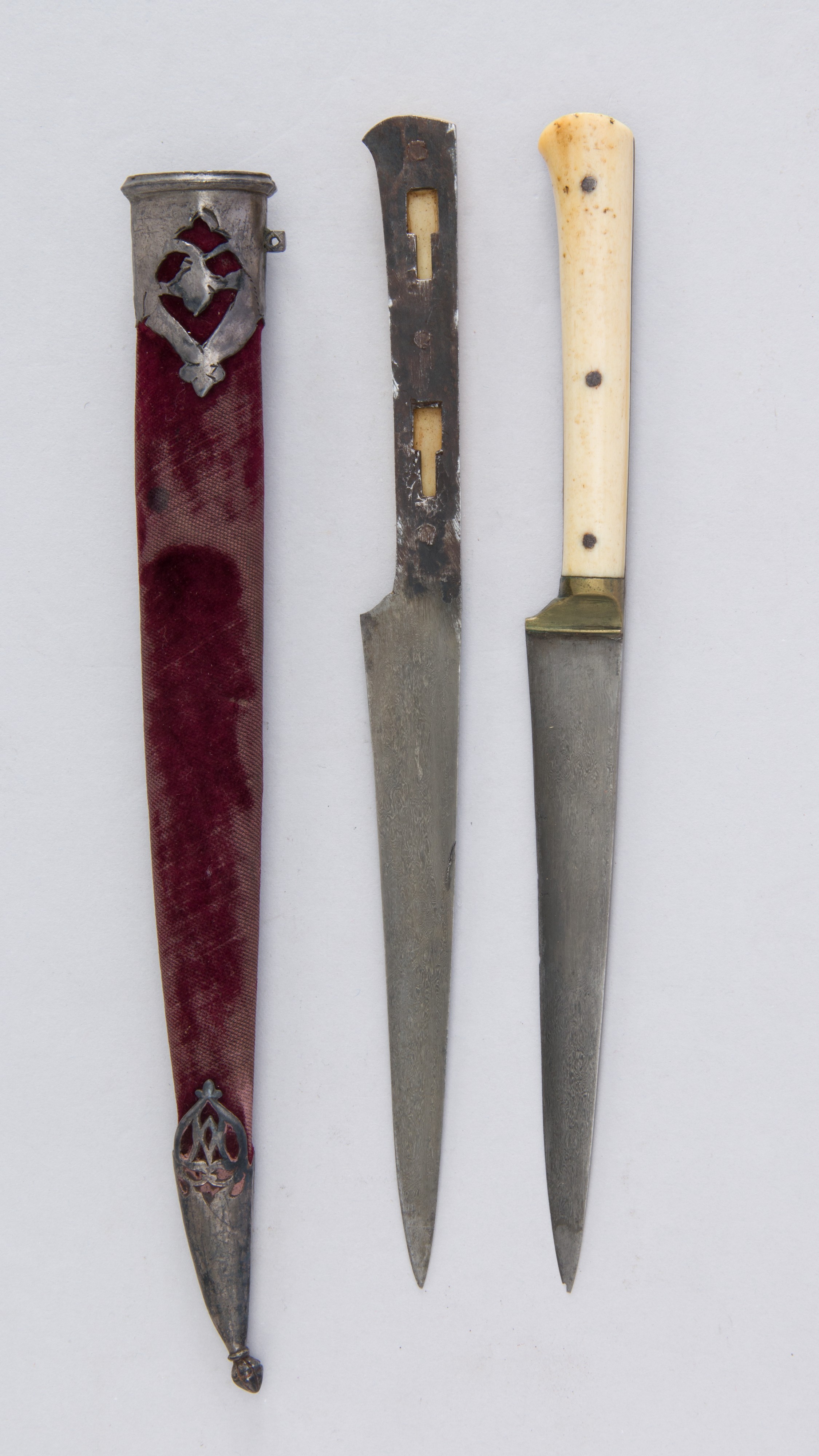
The Duel of Elegance: A Couture Analysis of an Indian Pair of Knives with Sheath
In the rarefied world of high couture, where fabric and form often dominate discourse, the inclusion of weaponry as a subject of aesthetic study challenges conventional boundaries. Yet, the Pair of Knives with Sheath from India, crafted from steel, silver, ivory, velvet, and wood, transcends its utilitarian origins to become a profound statement of cultural artistry and symbolic power. As Lead Curator of Katherine Fashion Lab, I present this standalone analysis, deconstructing the object not as a tool of conflict, but as a masterpiece of material dialogue, narrative design, and socio-aesthetic resonance. This piece embodies a fusion of martial heritage and opulent craftsmanship, offering a lens through which we can examine the interplay of form, function, and fashion in a non-Western context.
Material Alchemy: The Syntax of Steel, Silver, and Ivory
The genius of this ensemble lies in its deliberate material hierarchy. The steel blades, forged with precision, represent the core of the object’s identity—strength, utility, and the unyielding spirit of the warrior. In Indian metallurgical tradition, steel was not merely a resource but a medium of spiritual and physical resilience, often imbued with ritual significance. The silver fittings, likely engraved or chased with intricate motifs, serve as a counterpoint to the steel’s austerity. Silver, a metal associated with lunar purity and wealth in Indian culture, elevates the knives from mere tools to objects of ceremonial prestige. The contrast between the cold, functional steel and the warm, reflective silver creates a visual tension that is both dynamic and harmonious.
The ivory handles introduce a tactile and chromatic softness, a deliberate juxtaposition to the metallic hardness. Ivory, sourced from elephant tusks, was historically a marker of royal patronage and artisanal mastery. Its smooth, organic grain invites touch, transforming the grip into an intimate experience. In a couture context, ivory can be read as a precursor to modern luxury materials like mother-of-pearl or polished resin—a celebration of natural rarity. However, we must acknowledge the ethical complexities of such materials in contemporary discourse; here, the analysis focuses on its historical and aesthetic role as a symbol of status and craftsmanship.
The velvet sheath, typically in deep crimson or royal blue, encases the knives with a sensuous, textile embrace. Velvet, a fabric of opulence and theatricality, bridges the gap between weaponry and fashion. Its plush surface absorbs light, creating shadows that accentuate the contours of the sheath, while the wooden core provides structural integrity. This combination of hard and soft, rigid and pliable, mirrors the duality of the object itself: a tool of violence rendered through the language of beauty.
Structural Dialogue: The Architecture of Duality
The pair of knives, often identical in form, suggests a symbiotic relationship—a dialogue between two entities. In Indian martial traditions, paired weapons like the katar or peshkabz were not merely duplicates but complementary forces, representing balance and duality. The design likely features a unified sheath that holds both blades, their proximity emphasizing unity. The curvature of the blades, whether straight or slightly recurved, dictates the rhythm of the piece. A gentle curve may evoke the flow of a dancer’s arm, while a straight edge speaks to precision and linearity.
The sheath’s architecture is equally deliberate. The velvet covering, often stitched with silver thread or adorned with small metal studs, creates a textural landscape that echoes the knives’ metallic accents. The wooden insert ensures the blades are cradled securely, while the silver throat—the opening where the blades enter—may be ornately decorated, serving as a focal point. This structural layering is reminiscent of haute couture garment construction, where inner linings, boning, and outer fabrics work in concert to achieve a silhouette. Here, the sheath is the garment, and the knives are the body it adorns.
Cultural Syntax: The Knife as a Fashion Signifier
In Indian history, knives and daggers were not merely weapons but status symbols worn as part of courtly attire. The khanjar tucked into a sash or the kirpan carried as a religious artifact demonstrate how such objects functioned as accessories, akin to a brooch or a belt in Western fashion. This pair of knives, with its lavish materials, would have been worn by a noble or a warrior during ceremonial events, signaling both martial prowess and refined taste. The act of wearing a knife—visible yet sheathed—is a statement of controlled power, a concept that resonates in contemporary fashion where accessories often project identity and intention.
The velvet sheath furthers this narrative. Velvet, being a fabric of the elite due to its labor-intensive production, aligns the knives with the aesthetics of the Mughal and Rajput courts, where textiles were paramount. The sheath’s color—often a deep red—symbolizes passion, valor, and sacrifice, while blue may denote royalty and divinity. This chromatic choice is not arbitrary; it is a coded language that speaks to the wearer’s lineage and role. The silver fittings, often engraved with floral or geometric patterns, introduce motifs of paradise and order, common in Islamic and Hindu art, respectively, reflecting the syncretic culture of the subcontinent.
Comparative Couture: The Knife as a Precedent for Modern Accessories
In the context of Katherine Fashion Lab, this pair of knives can be viewed as a proto-accessory that anticipates modern luxury. Consider the contemporary designer handbag or belt: both serve functional purposes while embodying status through material and craftsmanship. The knife’s sheath, with its velvet and silver, is akin to a clutch purse—an object that contains and conceals. The knives themselves, when drawn, reveal a hidden dimension, much like a jewelry box opening to reveal its contents. This element of reveal and conceal is a cornerstone of fashion’s allure, from the dramatic unzipping of a gown to the unveiling of a layered necklace.
Furthermore, the pairing of the knives introduces a concept of symmetry and balance that is rare in Western accessory design, which often favors singular statement pieces. In Indian aesthetics, duality is celebrated—the yoni and lingam, the left and right, the sun and moon. This pair of knives embodies that philosophy, offering a lesson in how fashion can embrace complementarity rather than competition. The modern designer might take inspiration from this, creating earrings, cuffs, or even footwear in pairs that mirror each other’s forms, fostering a sense of unity.
Artisanal Legacy: The Hand of the Master
The craftsmanship of this piece is a testament to the artisanal traditions of India, where skills were passed through generations. The steel forging likely involved techniques like pattern welding or damascening, where layers of metal are folded to create strength and visual texture. The silver work, whether through repoussé, engraving, or filigree, required a steady hand and an eye for detail. The ivory carving, now a banned practice, once involved intricate scrimshaw or relief work, often depicting scenes from mythology or nature. The velvet and wood construction of the sheath demanded expertise in both textile and joinery, ensuring durability and elegance. Each material was treated with respect, its inherent properties enhanced rather than obscured.
This level of artisanal integration is a hallmark of high couture, where a single garment may involve embroiderers, tailors, jewelers, and feather workers. The knife set, like a couture gown, is a collaborative artifact, bearing the marks of multiple hands. In an era of mass production, such objects remind us of the value of time, skill, and intentionality—values that Katherine Fashion Lab champions in its curation of global luxury.
Conclusion: A Blade of Beauty and Meaning
The Pair of Knives with Sheath from India is more than an artifact; it is a couture statement that speaks across time and culture. Its materials—steel, silver, ivory, velvet, and wood—form a symphony of contrasts and harmonies, while its design encodes narratives of power, duality, and artistry. As a standalone study, it challenges us to expand our definition of fashion, recognizing that the most compelling accessories are those that carry both function and soul. In the hands of a curator, these knives become a lens through which we explore the intersection of martial tradition and aesthetic refinement, offering timeless lessons for the modern wardrobe. They remind us that true elegance lies not in the absence of conflict, but in the masterful sheath that contains it.