The Sampler: A Tapestry of Global Heritage in Linen, Drawnwork, and Needle Lace
Introduction: The Sampler as a Pedagogical and Artistic Artifact
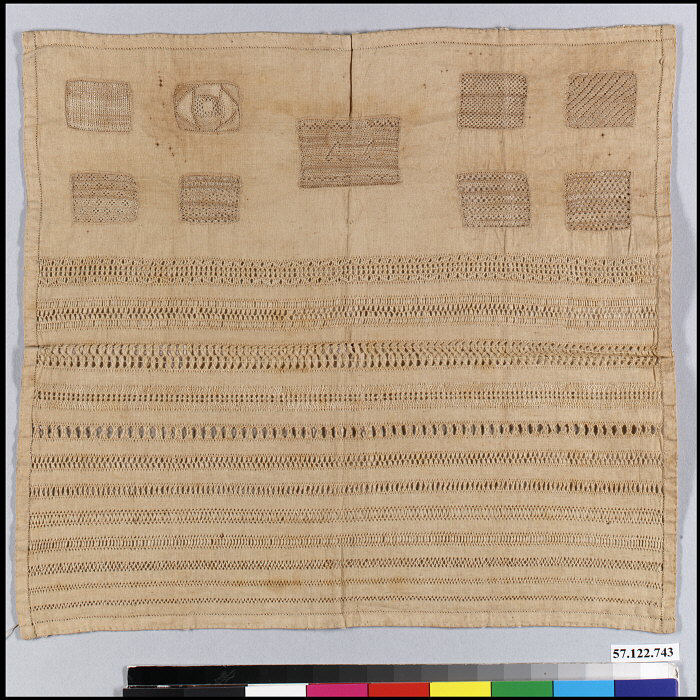
The sampler, historically a humble pedagogical tool used to demonstrate stitching proficiency, has undergone a profound metamorphosis within the haute couture sphere. At Katherine Fashion Lab, this transformation is not merely a stylistic revival but a deep, scholarly excavation of global textile heritage. The subject of this analysis—a standalone study titled “Sampler”—is constructed from pure linen, intricate drawnwork, and delicate needle lace. It is a singular piece, devoid of the typical garment silhouette, intended to be appreciated as an art object in its own right. This analysis will deconstruct the piece’s materiality, technique, and cultural resonance, positioning it as a masterful synthesis of global traditions and contemporary couture sensibilities.
Materiality: Linen as the Canvas of Tradition
The choice of linen as the foundational material is neither arbitrary nor merely aesthetic. Linen, derived from the flax plant, is one of the oldest textile fibers known to humanity, with a history spanning millennia across Europe, the Middle East, and North Africa. In this context, linen is not simply a substrate; it is a narrative medium. Its natural, unbleached ecru tone provides a neutral, luminous ground that absorbs and reflects light in a way that enhances the dimensionality of the drawnwork and lace. The fabric’s inherent stiffness, when compared to cotton or silk, lends itself perfectly to the structural integrity required for drawnwork—a technique that relies on the precise removal and re-weaving of warp and weft threads. This material choice grounds the piece in a sense of durability and timelessness, evoking the domestic and monastic traditions where samplers were originally created as records of skill and devotion.
Furthermore, the linen used in this piece is of a high-grade, long-staple variety, ensuring a smooth, even weave that facilitates the intricate manipulations of drawnwork. The fabric’s slight slubs and natural irregularities are not flaws but rather intentional markers of artisanal authenticity. They speak to a pre-industrial ethos, where the hand of the maker is visible and celebrated. This aligns with Katherine Fashion Lab’s commitment to slow fashion and heritage techniques, countering the ephemerality of fast fashion with a tangible, heirloom-quality object.
Technique: The Architecture of Drawnwork and Needle Lace
The technical execution of the “Sampler” is a tour de force of needlework precision. Drawnwork, also known as punto tirato in Italian or broderie à fils tirés in French, involves the careful extraction of select warp or weft threads from the linen ground. The remaining threads are then grouped, twisted, or stitched into geometric patterns. In this piece, the drawnwork is concentrated in a central, rectangular field, forming a lattice of open spaces and dense, reworked threads. The pattern is symmetrical, echoing the classical motifs found in Renaissance-era Italian reticella—a precursor to needle lace. The precision is remarkable: each thread is drawn with surgical accuracy, and the tension is uniformly maintained, preventing any distortion of the fabric’s original grid.
Surrounding the drawnwork field is a border of needle lace, executed in a technique known as punto in aria (“stitch in the air”). Unlike bobbin lace, which is made on a pillow, needle lace is constructed entirely with a needle and thread, building loops and stitches upon a foundation thread. The lace in this sampler features a repeating floral motif—a stylized rose—rendered in buttonhole stitch, with picots (small loops) defining the edges. The thread used for the lace is a fine, twisted linen, slightly lighter in tone than the base fabric, creating a subtle, ethereal contrast. The lace does not merely border the drawnwork; it extends beyond it in scalloped edges, giving the piece a soft, organic contour that contrasts with the rigid geometry of the drawnwork.
The interplay between the two techniques is a study in tension and release. The drawnwork is dense, structured, and intellectual, requiring the viewer to trace the logic of thread removal and reformation. The needle lace, by contrast, is airy, decorative, and emotive, evoking the fragility of a spider’s web. Together, they create a visual rhythm: solid to void, line to curve, order to ornament. This duality is central to the sampler’s conceptual framework, reflecting the dual nature of couture as both a technical discipline and an expressive art.
Global Heritage: A Confluence of Cultures
The “Sampler” is not a product of a single geographic tradition but a curated anthology of global heritage. The drawnwork technique, while perfected in Renaissance Italy, has parallel traditions in Eastern Europe, particularly in Hungary and Romania, where cămașa (traditional shirts) feature elaborate drawnwork on linen. The needle lace, meanwhile, bears the mark of Flemish and French influences, particularly the 17th-century point de France, which was patronized by Louis XIV to rival Italian lace. However, the piece also incorporates subtle nods to non-European traditions. The geometric precision of the drawnwork echoes the sashiko stitching of Japan, albeit in a more open, lace-like form. The floral motif of the needle lace, with its stylized, symmetrical petals, recalls the chikan work of Lucknow, India, where white-on-white embroidery on muslin and linen is a centuries-old craft.
This deliberate amalgamation is not appropriation but homage. Katherine Fashion Lab positions the sampler as a “global heritage” artifact, acknowledging that textile techniques have always traveled along trade routes, migrating with merchants, missionaries, and migrants. The linen itself, sourced from Belgium (renowned for its flax), is a testament to this global network. The piece thus becomes a silent dialogue between cultures, a map of human ingenuity stitched into fiber. It challenges the Eurocentric narrative of lace and drawnwork as purely Western innovations, inviting the viewer to see the shared DNA of textile arts across continents.
Context: The Sampler as Standalone Study
Perhaps the most radical aspect of this piece is its context as a “standalone study.” It is not a garment, a textile panel for a gown, or a decorative accessory. It is, in essence, a conceptual object—a piece of wearable art that refuses the body. This decision elevates the sampler from a mere technique demonstration to a philosophical statement. In an era where couture is increasingly commodified as spectacle, the “Sampler” asks the viewer to slow down, to read the stitches, and to appreciate the labor and history embedded in each thread.
This standalone format also allows for a purity of focus. Without the distraction of silhouette, draping, or fit, the viewer’s attention is directed entirely to the surface and structure. The piece is designed to be displayed flat, perhaps framed or mounted, like a manuscript page. This curatorial choice references the historic practice of preserving samplers in museums and private collections as documents of female education and domestic artistry. By recontextualizing the sampler in a couture lab, Katherine Fashion Lab reclaims these often-overlooked artifacts as legitimate subjects of high fashion discourse.
Conclusion: The Sampler as a Manifesto
In conclusion, the “Sampler” by Katherine Fashion Lab is not merely a study of technique; it is a manifesto for a new kind of couture—one that values heritage, precision, and cultural dialogue over novelty and spectacle. The linen ground, the drawnwork’s architectural logic, the needle lace’s delicate poetry, and the global references all converge to create a piece that is at once ancient and avant-garde. It challenges the fashion industry to look backward to move forward, to find innovation in tradition, and to see the sampler not as a relic but as a living, breathing form of artistic expression. For the discerning connoisseur, this piece is a masterclass in the language of thread, a testament to the enduring power of the hand, and a quiet, elegant revolution in the world of haute couture.