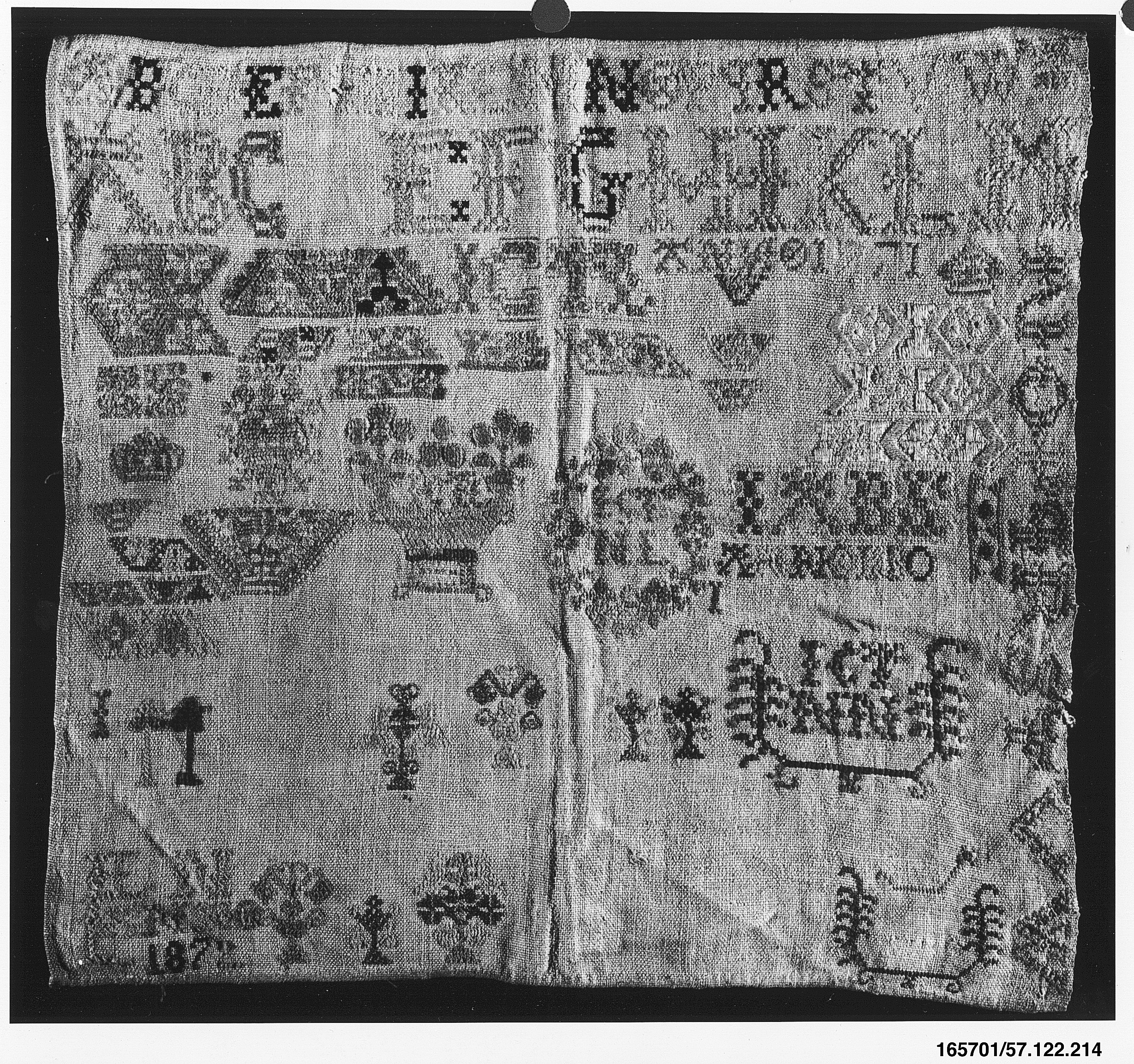
The Sampler: A Tapestry of Global Heritage in Couture Analysis
In the rarefied world of haute couture, where innovation often vies with tradition, the Sampler emerges as a profound meditation on heritage, technique, and narrative. At Katherine Fashion Lab, this standalone study transcends its pedagogical origins, offering a tactile dialogue between global craftsmanship and modernist design. The Sampler is not merely a swatch or a prototype; it is a curated artifact that recontextualizes the domestic needlework of centuries past into a statement of cultural fluency. This analysis deconstructs the Sampler’s materiality, its global lineage, and its strategic significance within the couture ecosystem.
Material Alchemy: Cotton, Linen, and Wool on Linen
The Sampler’s foundation is a masterclass in material contrast and cohesion. The base—a fine, unbleached linen—serves as a neutral canvas, evoking the austerity of historical samplers used for teaching embroidery stitches. Yet, the interplay of cotton and wool threads introduces a deliberate tension between softness and structure. Cotton, with its matte finish and pliability, allows for intricate, repetitive motifs—such as geometric borders and floral sprigs—that recall the Mughal-influenced *chikan* work of South Asia. Conversely, the wool threads, dyed in deep indigo and madder red, bring a tactile density and warmth, echoing the *boteh* (paisley) patterns of Persian textiles or the rugged *saami* weaving of Nordic traditions.
This triad of fibers is not arbitrary. The linen base provides durability and a subtle sheen, while the cotton and wool threads create a dimensional hierarchy. Wool’s natural crimp lends a slight relief to the surface, making certain stitches—like the chain stitch or herringbone—appear almost sculptural. The cotton, finer in gauge, recedes into the fabric, allowing for delicate shading. The result is a piece that invites tactile exploration: a run of the fingertips across the surface reveals a rhythm of raised and recessed textures, a sensory archive of global techniques.
Global Heritage: A Cross-Continental Lexicon
The Sampler’s title, “Global Heritage,” is not a mere branding gesture; it is a deliberate cartography of stitch languages. Each quadrant of the sampler references a distinct cultural tradition, yet the composition avoids pastiche through a unifying modernist grid. For example, the upper left quadrant features a satin stitch motif derived from Chinese *su embroidery*, where silk-like cotton threads mimic the luminosity of traditional imperial robes. The lower right, by contrast, employs a cross-stitch pattern reminiscent of Eastern European folk embroidery, its geometric precision offset by the irregular, hand-dyed wool.
Central to the design is a tree of life motif—a recurring symbol in Indian, Persian, and pre-Columbian textiles—rendered in a composite of stem stitch and French knots. Here, the wool’s texture evokes the bark of an ancient oak, while the cotton’s smoothness suggests blossoms. This motif anchors the piece, suggesting that despite geographical dispersal, certain archetypes of beauty and fertility persist across cultures. The Sampler thus becomes a microcosm of global textile history, where the needle acts as a bridge between the looms of Gujarat, the *hardanger* of Norway, and the *broderie anglaise* of England.
Contextual Autonomy: The Standalone Study as Couture Statement
In the context of Katherine Fashion Lab, the Sampler is presented as a standalone study—a departure from the conventional runway ensemble. This autonomy is critical. By isolating the sampler from a garment, the Lab elevates it from a preparatory sample to a finished artwork. This aligns with a broader couture trend wherein textile research is valorized as a form of intellectual property and aesthetic capital. The Sampler is not a prototype for a dress; it is the dress’s conceptual DNA, laid bare for scrutiny.
The decision to frame it as a standalone piece also challenges the hierarchy between “craft” and “couture.” Historically, samplers were the domain of young women learning domestic skills, often dismissed as amateur. By recontextualizing this form within a luxury fashion lab, Katherine Fashion Lab reclaims the sampler as a site of expertise and curatorial rigor. The piece’s scale—approximately 24 by 18 inches—invites close viewing, akin to a painting or a manuscript illumination. The viewer is compelled to read the stitches as sentences, each one a testament to hours of labor and cross-cultural knowledge.
Strategic Implications for Couture Practice
From a strategic MBA perspective, the Sampler represents a differentiation strategy in a saturated market. In an era where fast fashion and digital printing dominate, the Sampler’s insistence on handwork and heritage offers a counter-narrative of scarcity and authenticity. It appeals to a discerning clientele that values provenance and skill—a demographic willing to invest in pieces that tell stories rather than merely cover bodies. Moreover, the Sampler’s modular design allows for future scalability: individual motifs can be licensed, adapted into prints, or translated into embroidery for bespoke garments, creating multiple revenue streams from a single intellectual asset.
The use of natural fibers (cotton, linen, wool) also aligns with sustainability imperatives, though the Lab avoids overt eco-branding. Instead, the focus remains on artisanal longevity: a sampler that requires weeks of handwork inherently resists disposability. This positions Katherine Fashion Lab within the “slow fashion” movement, but with a couture-level price point that justifies the labor. The Sampler, therefore, is not just a design object; it is a business model for cultural preservation, where each stitch adds quantifiable value.
Conclusion: The Sampler as a Living Archive
Ultimately, the Sampler by Katherine Fashion Lab is a triumph of material intelligence and global literacy. It transforms a humble pedagogical tool into a luxury artifact, weaving together cotton, linen, and wool into a narrative that spans continents. As a standalone study, it demands to be read, touched, and debated—a rare quality in an industry often fixated on the ephemeral. For the connoisseur, it offers a map of human ingenuity; for the strategist, a blueprint for sustainable, heritage-driven innovation. In the hands of the Lab, the sampler is no longer a relic of the past but a blueprint for the couture of tomorrow.