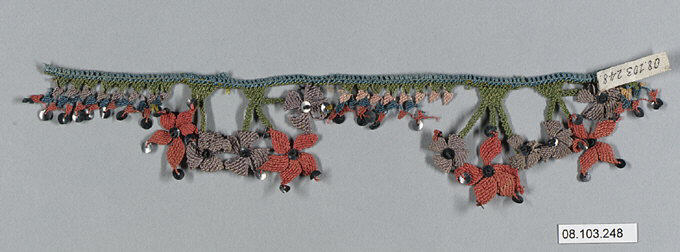
The Alchemy of the Edge: Trimming as the Quintessence of Couture
In the rarefied lexicon of haute couture, where every stitch is a declaration and every seam a secret, trimming occupies a singular, sovereign space. It is the final, decisive punctuation in the narrative of a garment; the whispered crescendo that transforms cloth into character. For Katherine Fashion Lab, trimming is not mere embellishment but a fundamental discipline of articulation—a dialogue between structure and surface, history and innovation. This standalone study deconstructs trimming through the lenses of Global Heritage and Artisanal Material, positing it as the critical interface where cultural memory is curated and material intelligence is most vividly performed.
Global Heritage: The Cartography of Embellishment
The history of trimming is a palimpsest of human movement, trade, and cultural exchange. It is a global heritage written in braid, bead, and fringe. To analyze trimming is to map the silk roads of aesthetics: the intricate passementerie of 17th-century France, born from the guilds of Lyon, which codified luxury through meticulously hand-knotted cords and tassels; the luminous zardozi embroidery of Mughal India, where gold and silver wire transformed textiles into wearable architecture of power; the subtle, rhythmic piping and rickrack of Central European folk dress, encoding community identity in geometric borders.
Each of these traditions represents a distinct philosophy of the edge. The Western couture tradition, particularly as crystallized in the 19th and 20th centuries, often employs trimming as a framing device—a means to delineate, highlight, and contain form. Think of the disciplined military-inspired frogging on a Schiaparelli jacket or the precise, weighted hem of a Balenciaga coat. In contrast, many Eastern and Indigenous traditions perceive trimming as an integrative, expansive force. The cascading, narrative appliqué of a Hmong story cloth or the flowing, feather-like fringe of a Native American regalia piece are not borders but extensions, amplifying the garment's field of meaning and motion. Katherine Fashion Lab’s methodology involves de-siloing these genealogies, creating a contemporary syntax where the structural discipline of one heritage can converse with the expressive fluidity of another.
Artisanal Material: The Substance of the Sublime
The global heritage of trimming is inextricable from the materials that give it form. Artisanal material is not a passive substrate but an active collaborator, possessing its own agency, memory, and behavior. Couture-level trimming begins with a radical intimacy with materiality. It understands that hand-loomed silk gimp will catch light differently than its machine-spun counterpart; that cast glass beads from Venice hold a unique weight and refraction compared to precision-cut crystals; that vegetable-tanned leather, cut into fine lacing, carries a suppleness and scent that synthetic alternatives cannot approximate.
This material-centric approach demands a partnership with master artisans—the last bearers of specialized knowledge. It involves commissioning hand-blown glass bugle beads from artisans in Jablonec, sourcing naturally dyed, hand-spun wool for pompoms from Andean cooperatives, or reviving the nearly lost art of wooden bobbin lace in Belgium. The Lab’s process treats these materials not as decorative commodities but as narrative vessels. A trim composed of reclaimed sari silk threads and reclaimed Victorian jet beads, for instance, carries within it layered histories of trade, mourning, and resilience, adding profound semantic depth to the garment’s contour.
The Couture Application: From Theory to Tactile Reality
The synthesis of heritage and material manifests in the couture atelier through techniques that are equal parts engineering and poetry. Here, trimming is integrated at the molecular level of the design process, not applied as an afterthought.
Structural Trimming: The Hidden Architecture
This involves using trim as a foundational element. Petersham ribbon, molded and steamed to exact curves, can define a neckline’s roll with impeccable precision. Hand-forged metal boning channels, embroidered directly onto a corset’s couture fabric, become both functional and decorative. A heavy, lead-weighted chain hand-stitched into a hem—a signature of mid-century couture—allows wool to fall with the gravity of marble, demonstrating how trimming manipulates not just appearance but behavior.
Surface Narrative Trimming: The Embodied Story
This is where material heritage speaks most eloquently. Imagine a minimalist sheath dress, its only ornament a single, vertical stroke of trim from shoulder to hem. Upon closer inspection, this line reveals itself as a micro-mosaic of techniques: a fragment of Japanese kumihimo braid, a cluster of pre-Columbian-inspired ceramic beads, a burst of French lunéville beadwork, all unified by a shared color palette but distinct in texture and origin. This trim is no longer just decoration; it is a curated, wearable archive, a deliberate collision of global hand-work that invites touch and contemplation.
Conclusion: The Ethical and Aesthetic Imperative
In an era of accelerated fashion and digital saturation, Katherine Fashion Lab’s focused study on trimming presents a compelling counter-narrative. It argues for the slow, deliberate, and knowledgeable engagement with the periphery. By rooting itself in global heritage and artisanal material, the practice of trimming becomes an act of cultural stewardship and material innovation. It champions the human hand, the specific origin, and the layered story. Ultimately, to master trimming is to understand that the edge of a garment is not its limit, but its point of deepest connection—to the past, to the artisan, and to the discerning wearer who recognizes that true luxury lies in the intelligence and integrity of every detail, especially the ones that frame the whole.