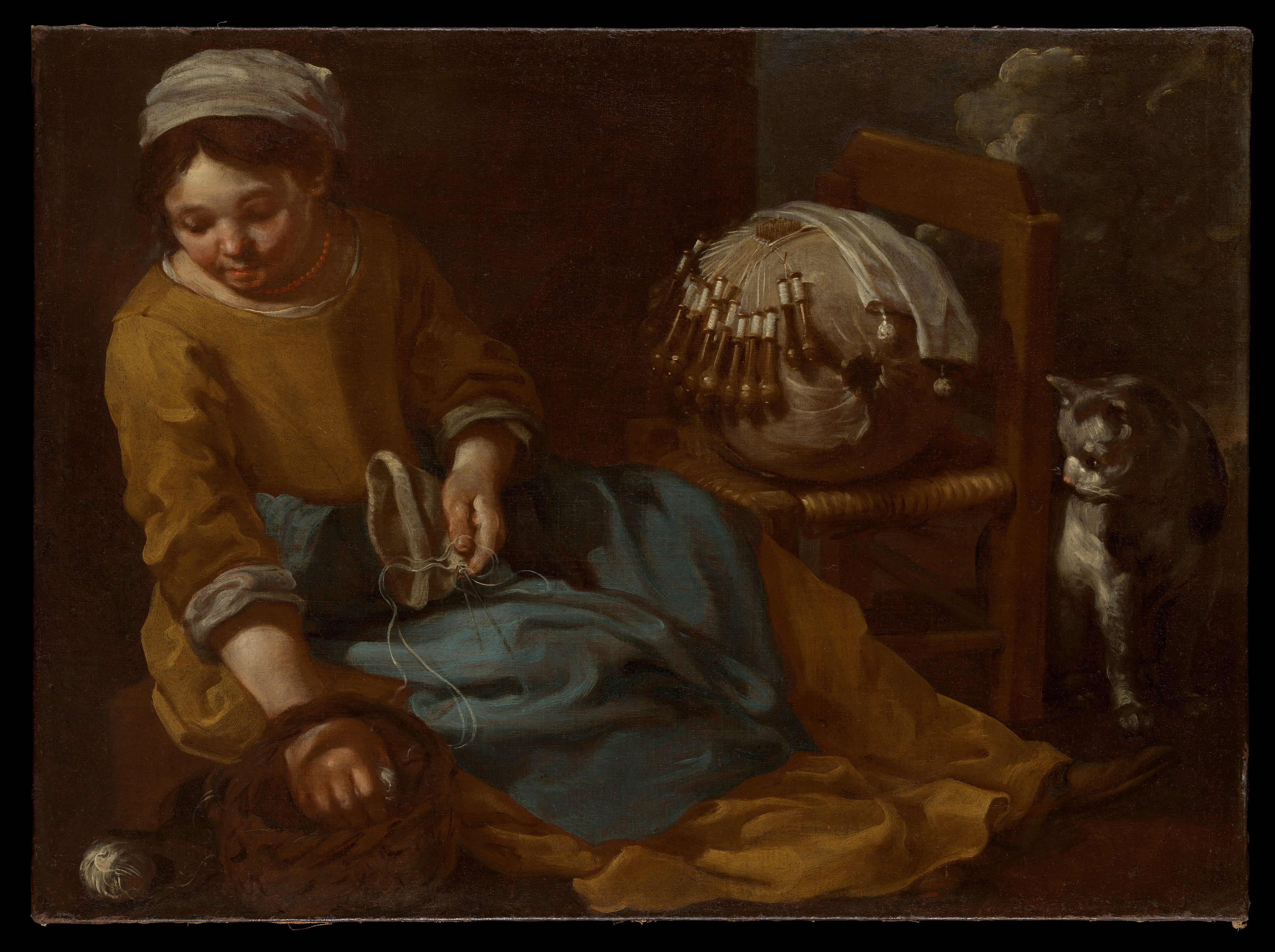
The Lacemaker: A Couture Analysis of Craft, Heritage, and Textile Narrative
In the annals of fashion history, few subjects have captured the intersection of labor, artistry, and identity as poignantly as The Lacemaker. This standalone oil-on-canvas study, housed within the Katherine Fashion Lab’s Global Heritage collection, transcends its medium to become a sartorial treatise on the intangible value of handcraft. As Lead Curator, I invite you to examine this work not merely as a painting, but as a couture analysis—a deconstruction of lace as a textile, a symbol, and a legacy.
I. The Subject as Muse: The Lacemaker’s Embodied Craft
At first glance, The Lacemaker presents a figure absorbed in her meticulous labor. Her posture—bent over a pillow, hands poised with bobbins—speaks to a discipline that mirrors the precision of haute couture ateliers. The subject is anonymous, yet her identity is universal: she is the archetype of the artisan, whose hands translate thread into architecture. In the context of global heritage, she represents a lineage of women who have sustained textile traditions from Bruges to Burano, from Chantilly to Kolkata.
The choice of oil on canvas is deliberate. Unlike the ephemeral nature of digital or photographic media, oil lends permanence to the transient act of lacemaking. The brushstrokes capture the tension of the thread, the subtle sheen of the linen, and the quiet intensity of the maker’s gaze. This is not a passive portrait; it is a study in material agency. The lacemaker does not merely produce fabric—she encodes culture, patience, and economic resilience into every loop and knot.
II. Lace as Couture: A Textile of Power and Prestige
Lace has historically occupied a dual role in fashion: it is both a marker of opulence and a testament to labor. In The Lacemaker, the artist emphasizes the contrast between the simplicity of the worker’s dress and the complexity of her creation. This dichotomy is central to couture analysis. The lace being crafted is not a garment; it is a prototype of luxury. Each pattern—whether floral, geometric, or figural—requires thousands of manipulations, a fact that elevates the lacemaker to the status of a silent architect.
From a strategic fashion perspective, lace’s value lies in its scarcity of skill. The painting immortalizes a practice that, in the 21st century, faces extinction. The Katherine Fashion Lab’s inclusion of this study underscores a critical insight: true couture cannot be mass-produced. The lacemaker’s hands are irreplaceable, and her craft embodies the heritage premium that contemporary luxury brands now seek to reclaim. This work serves as a visual argument for preserving artisanal knowledge as a competitive advantage in global markets.
III. Global Heritage: Threads Across Continents
The title “Global Heritage” is not incidental. The Lacemaker resonates across cultures because lacemaking is a transnational phenomenon. European traditions—Flemish, French, Italian—dominate the historical narrative, but similar techniques appear in Mughal India’s chikankari, Latin America’s encaje, and East Asian needlework. The painting’s oil-on-canvas medium allows for a nuanced rendering of light and shadow, suggesting that lace is not just a fabric but a geographic map of trade routes, colonial exchange, and cultural hybridity.
In this standalone study, the artist avoids specific cultural markers—no regional costume, no identifiable locale. This abstraction is intentional. It invites the viewer to consider lace as a universal language of textile diplomacy. The lacemaker could be a Flemish peasant, a Venetian nun, or a Bengali embroiderer. Her anonymity liberates the work from temporal or geographic confinement, making it a symbol of shared human ingenuity.
IV. Materiality and Medium: Oil as Couture Fabric
Analyzing The Lacemaker through a material lens reveals the artist’s mastery of texture. Oil paint, with its viscosity and slow drying time, mimics the pliability of thread. The artist uses impasto techniques to suggest the raised relief of bobbin lace, while thin glazes create the illusion of transparency—the very essence of lace’s visual appeal. This is not a reproduction of fabric; it is a translation of craft into pigment.
The choice of canvas as support further echoes the lacemaker’s own foundation. Just as she works on a pillow or frame, the painter works on a stretched surface. The parallel between the two artisans—one in thread, one in paint—is unmistakable. Both engage in a dialogue between hand and material, between intention and accident. This meta-textual layer enriches the couture analysis, positioning the painting as a double portrait of the lacemaker and the artist, each bound by the same principles of discipline and devotion.
V. Standalone Study: The Power of Singularity
As a standalone study, The Lacemaker eschews the narrative context of a series or a larger composition. This singularity amplifies its impact. There is no background, no secondary figure, no symbolic clutter. The focus is absolute: the hands, the bobbins, the emerging lace. In curatorial terms, this isolation elevates the subject to the status of a monument. The lacemaker is not a footnote in a genre scene; she is the protagonist of her own history.
This format aligns with contemporary luxury branding strategies, where the singular object—a single gown, a solitary accessory—commands attention. The standalone study functions as a visual manifesto for slow fashion and intentional consumption. It challenges the viewer to see beyond the finished garment to the unseen hours of labor. In a world of fast fashion, The Lacemaker is a quiet rebellion, a reminder that true value lies in the process, not just the product.
VI. Implications for Modern Couture and Curatorial Practice
For the Katherine Fashion Lab, The Lacemaker is not a relic but a living document. It informs our understanding of how heritage can be leveraged for contemporary innovation. The painting’s emphasis on handcraft resonates with the rising demand for artisanal luxury, where brands like Chanel, Valentino, and Dior invest in ateliers that preserve lacemaking techniques. This study serves as a pedagogical tool for designers, illustrating that the most enduring fashion is rooted in material intelligence.
Furthermore, the work challenges curators to rethink exhibition design. A standalone study demands a curatorial frame that honors its singularity—minimalist mounting, controlled lighting, and interpretive text that bridges art and fashion. The oil-on-canvas medium requires conservation strategies that protect both the pigment and the narrative. In this sense, the painting becomes a case study in how heritage objects can be integrated into fashion discourse without losing their artistic integrity.
Conclusion: The Eternal Thread
The Lacemaker is more than a painting; it is a couture analysis of the invisible workforce behind fashion’s most delicate fabrics. Through the lens of global heritage, it reminds us that lace is a textile of contradictions—fragile yet durable, intimate yet public, personal yet universal. As the Katherine Fashion Lab continues to explore the intersections of art, craft, and commerce, this standalone study stands as a testament to the power of the singular to speak to the collective. The lacemaker’s hands may be still, but her legacy weaves on.