The Deconstruction of Domesticity: A Couture Analysis of the Napkin as Textile Artifact
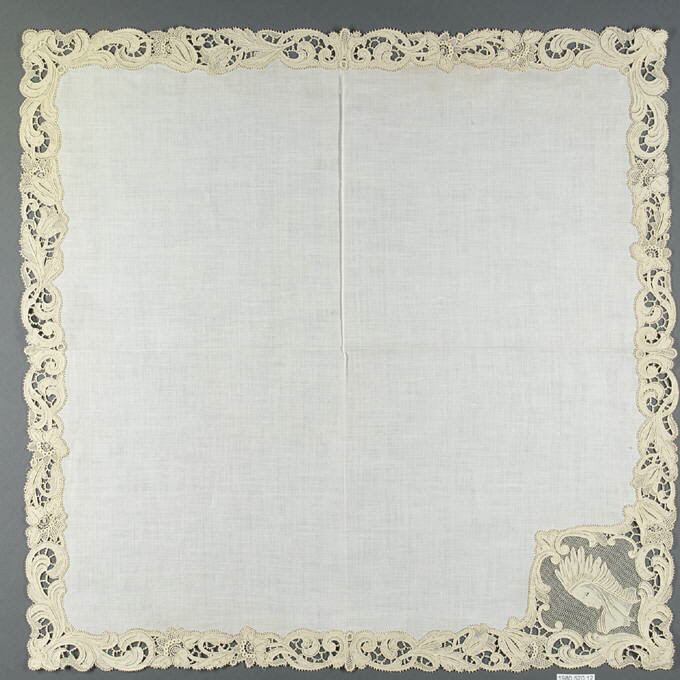
In the realm of haute couture, the lexicon of garments often overshadows the profound narrative potential of ancillary textiles. Yet, within the Katherine Fashion Lab’s exploration of “Global Heritage,” a singular object—the napkin from a set of table linens—emerges as a compelling study in materiality, cultural memory, and the subversion of domestic utility. This analysis moves beyond the napkin’s conventional role as a tool of hygiene or etiquette, positioning it instead as a standalone couture artifact. Constructed from pure linen and adorned with intricate needle lace, this piece embodies a tension between the quotidian and the ceremonial, the functional and the decorative. The Lab’s curation invites a critical examination of how heritage textiles can be recontextualized as autonomous expressions of craftsmanship, challenging the hierarchical boundaries between fashion and interior design.
Materiality and the Linen Narrative
The foundation of this napkin is linen, a fiber that carries a distinct genealogy within the Global Heritage context. Linen’s origins trace back to the ancient civilizations of the Nile and the Levant, where flax cultivation and weaving were elevated to art forms. Unlike cotton, which often symbolizes industrial mass production, linen retains a tactile memory of hand-processing—the retting, scutching, and heckling that transform a plant stem into a lustrous thread. In this napkin, the linen is not merely a substrate; it is a storyteller. Its natural, undyed ecru hue evokes the earthiness of pre-industrial Europe, while its crisp yet supple hand suggests meticulous craftsmanship. The material’s inherent breathability and durability, historically prized for table linens, here serve as a metaphor for resilience and cultural continuity. The napkin’s square form, typically a standard 18 inches, becomes a canvas upon which the linen’s weave—a balanced plain weave with a subtle slub texture—asserts its organic origin. This is not a sterile, machine-perfected cloth; it is a textile that breathes with the irregularities of human touch, aligning it with the ethos of slow fashion and artisanal revival.
Furthermore, the linen’s weight and drape are critical to the napkin’s couture analysis. When folded, it holds a crisp architectural line; when unfurled, it cascades with a soft, fluidity that mimics the fall of a silk gown. This duality positions the napkin as a transitional object—one that bridges the rigidity of formal dining and the fluidity of personal expression. In the Katherine Fashion Lab’s standalone study, the napkin is often displayed on a mannequin’s shoulder or draped across a sculptural form, divorcing it from its original tabletop context. This recontextualization forces the viewer to appreciate the linen’s aesthetic properties—its light-reflecting luster, its ability to absorb and hold folds—as intrinsic to a garment’s vocabulary. The material, in essence, becomes a protagonist in a narrative of global exchange, where flax from Northern Europe meets the hands of artisans who transform it into a luxury object.
Needle Lace: The Couture Embellishment as Heritage Code
The needle lace that adorns the napkin’s hem and corners is the piece’s defining couture element. Needle lace, unlike bobbin lace, is created using a single needle and thread, building loops and stitches into intricate patterns that resemble embroidery but are structurally independent. This technique, which flourished in Renaissance Italy and later spread across Europe, represents a pinnacle of textile artistry—time-intensive, delicate, and often reserved for ecclesiastical or aristocratic use. On this napkin, the lace is not merely decorative; it is a code of cultural heritage. The pattern, a geometric repeat of diamond motifs interspersed with floral tendrils, echoes the designs found in 17th-century Venetian punto in aria or “stitches in air.” This choice of motif is deliberate: it references a period when lace was a marker of social status and global trade, as silk and silver threads traveled along the Spice Route.
From a couture perspective, the needle lace functions as a form of haute couture embellishment—akin to beading or appliqué on a gown. Its placement along the edge of the napkin creates a frame that draws the eye inward, transforming the linen field into a stage. The lace’s openwork, where negative space becomes positive design, introduces a play of light and shadow that is both ethereal and structural. In the Lab’s analysis, this lace is not subordinate to the linen; it is a co-author of the napkin’s identity. The threads, likely a fine linen or cotton, are hand-stitched with a tension that only a master artisan can achieve, resulting in a surface that is both resilient and fragile. This paradox—strength in delicacy—mirrors the dual nature of couture itself: art that is meant to be worn, yet often too precious for daily use. The napkin, therefore, becomes a wearable artifact, its lace edges reminiscent of a collar or cuff, inviting the viewer to imagine it as a garment fragment.
Contextual Reimagination: From Table to Torso
The Katherine Fashion Lab’s decision to present this napkin as a “standalone study” rather than part of a table setting is a curatorial act of subversion. In its original context, the napkin is a passive object—folded, placed on a lap, or used to wipe fingertips. Its value is instrumental, tied to the ritual of dining. By isolating the napkin, the Lab elevates it to the status of an autonomous art piece, akin to a designer’s toile or a sample of textile engineering. The viewer is invited to consider its lines, textures, and construction without the distraction of function. This reimagination aligns with contemporary fashion’s trend toward deconstruction, where designers like Martin Margiela or Rei Kawakubo have repurposed domestic textiles—tablecloths, curtains, and napkins—into avant-garde garments. Here, the napkin’s square geometry becomes a modular unit, capable of being pleated, twisted, or draped to form a bodice, a skirt, or a headpiece.
Moreover, the Global Heritage origin of the napkin—a hybrid of European linen and lace traditions—speaks to a broader narrative of cultural appropriation and appreciation. The Lab’s analysis does not romanticize this heritage; instead, it interrogates how such objects are collected, displayed, and commodified in a globalized market. The napkin, once a symbol of domestic labor and female craftsmanship, is now a luxury item in a fashion lab, its value extracted from its history. This tension is central to the piece’s couture analysis: it asks whether the napkin can be truly liberated from its utilitarian past, or if it remains tethered to the very domesticity it seeks to transcend. The answer lies in the viewer’s gaze—a gaze that the Lab cultivates through lighting, positioning, and textual accompaniment, forcing a dialogue between object and observer.
Conclusion: The Napkin as Couture Manifesto
In conclusion, the napkin from Katherine Fashion Lab’s Global Heritage collection is far more than a table linen; it is a manifesto for the revaluation of overlooked textiles within couture. Its linen body, rich with historical and material intelligence, and its needle lace, a testament to artisanal virtuosity, coalesce into a standalone artifact that challenges the boundaries of fashion. By decontextualizing this object, the Lab opens a space for critical inquiry into the politics of heritage, the labor of craftsmanship, and the poetic potential of the everyday. For the MBA-level professional, this analysis underscores a key insight: luxury is not merely about rarity or expense, but about the narrative density embedded in material and technique. The napkin, in its quiet dignity, reminds us that couture’s most profound statements often emerge from the most unassuming origins. As the fashion industry continues to seek authenticity in a world of mass production, this napkin stands as a testament to the enduring power of the handmade—a single thread connecting past, present, and future.