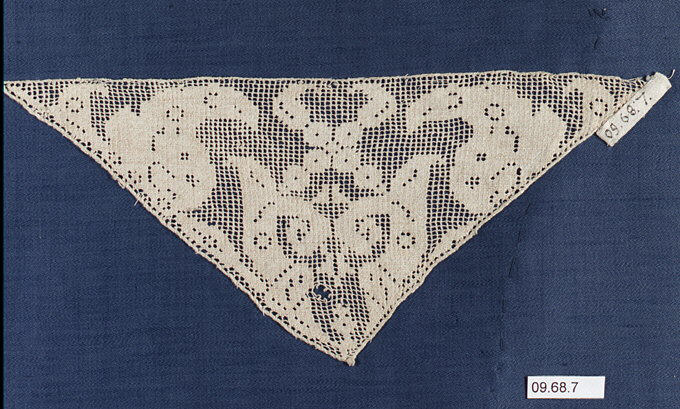
The Triangular Construct: A Study in Embroidered Net and Global Heritage
In the rarefied echelons of haute couture, where silhouette meets symbolism, Katherine Fashion Lab presents a singular artifact of profound significance: the Triangular Piece. This standalone study, executed in embroidered net, transcends mere garment construction to become a thesis on heritage, geometry, and the tactile poetry of thread. As Lead Curator, I dissect this piece not as an accessory, but as a manifesto—a dialogue between ancestral craft and contemporary minimalism.
Geometry as Narrative: The Triangle’s Cultural Lexicon
The triangle, in global heritage, is never neutral. It is the pyramid of Giza, the trinity of Christian iconography, the mandala of Hindu cosmology, and the shield of nomadic tribes. Katherine Fashion Lab harnesses this polyvalence, constructing a piece that is both abstract and deeply referential. The triangular form here is not merely a shape but a container for meaning: its apex suggests aspiration, its base stability, and its three points the intersection of past, present, and future. In the context of a standalone study, this geometry compels the viewer to engage with the piece as an object of contemplation, free from the distraction of full-body draping or utilitarian function.
The decision to isolate the triangle—unadorned by sleeves, collars, or hemlines—is a curatorial masterstroke. It forces a focus on materiality and craft. The embroidered net, traditionally a substrate for bridal veils or mantillas, is recontextualized here as a structural element. The net’s transparency, when cut into a rigid triangle, creates a paradox: lightness of weight meets severity of form. This tension is the piece’s intellectual core.
Embroidered Net: The Alchemy of Thread and Void
The net itself is a textile of global lineage. From the tulle of French lace-making to the khadi mesh of Indian handlooms, netting represents the interplay of absence and presence. Katherine Fashion Lab elevates this base material through intricate embroidery that respects the net’s transparency while asserting its own narrative. The embroidery is not dense; rather, it is selective—floral motifs reminiscent of Ottoman oya lace, geometric interlocking patterns echoing West African strip-weaving, and linear stitches that mimic the calligraphic scrolls of Persian manuscripts.
Each stitch is a decision. The thread, a blend of silk and metallic filament, catches light differently depending on the angle, creating a moiré effect that shifts between opacity and luminescence. This is not decoration for decoration’s sake; it is a cartography of heritage. The embroidered net becomes a map of migratory aesthetics, where a single triangular piece can evoke the hijab of the Maghreb, the rebozo of Mexico, or the shawl of Kashmir. The global heritage is not referenced through motifs alone but through the technique—the labor-intensive, hand-done embroidery that defies the speed of industrial fashion.
Standalone Study: The Object as Argument
Why a standalone study? In couture, context is often king: a piece is designed to be worn, to move, to interact with a body. Katherine Fashion Lab subverts this expectation. The Triangular Piece is presented as an artifact, mounted on a minimalist stand or pinned to a wall, akin to a textile artwork. This curatorial choice elevates the piece from apparel to conceptual object. It invites the observer to read the embroidery as one reads a manuscript—line by line, stitch by stitch.
The absence of a wearer is deliberate. It allows the triangle to exist in a state of pure potentiality. It could be a collar, a capelet, a headpiece, or a wall hanging. This ambiguity is a hallmark of advanced couture: the piece refuses to be categorized. It is a study in how geometry and textile can generate meaning without the crutch of function. The embroidered net, when isolated, becomes a lens through which we examine the global heritage of adornment—how triangles have been used in tribal jewelry, in architectural motifs, and in ritual garments across cultures.
Technical Mastery: The Intersection of Craft and Innovation
From a technical standpoint, the piece demands scrutiny. The net is a delicate substrate; its stability is compromised by cutting into sharp angles. Katherine Fashion Lab employs a reinforced edge—a fine, hand-rolled hem of silk thread—that prevents fraying while adding a subtle, almost invisible frame. The embroidery itself is executed with a combination of tambour and needlepoint, allowing for both speed and precision. The tambour hook, a tool historically used in French lace, creates chain stitches that flow along the net’s grid, while needlepoint fills in denser areas with satin and cross-stitches.
The color palette is restrained: ivory, ecru, and a whisper of gold. This restraint is strategic. It ensures that the embroidery does not compete with the triangle’s geometry but rather enhances it. The gold thread catches the eye, guiding it along the triangle’s edges and into its interior motifs. The result is a piece that feels ancient yet modern—a relic of a future where heritage is not preserved in amber but reimagined through the lens of contemporary design.
Global Heritage as a Living Vocabulary
The Triangular Piece does not merely borrow from global heritage; it synthesizes it. The embroidery motifs are not direct copies but abstractions. A lotus petal from Indian temple art becomes a geometric diamond; a Celtic knot unravels into a linear spiral. This synthesis avoids the trap of cultural appropriation by transforming rather than extracting. The piece acknowledges its sources—the triangular amulets of the Silk Road, the embroidered nets of Venetian Renaissance fashion—but it speaks in its own voice.
In the context of a standalone study, this piece serves as a pedagogical tool. It teaches the viewer to see couture as a language, where each triangle, each stitch, each void in the net is a word in a global lexicon. Katherine Fashion Lab positions the piece as a starting point for dialogue: How do we honor heritage without fetishizing it? How do we use geometry to bridge cultures? The embroidered net, with its transparency, suggests that heritage is not a solid wall but a permeable membrane—one that allows light, ideas, and influences to pass through.
Conclusion: The Triangle’s Enduring Echo
As a standalone study, the Triangular Piece by Katherine Fashion Lab is a triumph of conceptual couture. It distills global heritage into a single, powerful shape, executed in embroidered net with technical virtuosity. It asks no questions of wearability but instead demands that we look, think, and feel. The triangle’s three points—craft, heritage, geometry—converge in a work that is both intimate and universal. In an era of fast fashion and visual noise, this piece stands as a quiet, rigorous testament to the enduring power of the handmade, the symbolic, and the meticulously considered. It is not just a garment; it is a provocation—a triangular mirror reflecting the global heritage we all share, stitch by stitch.