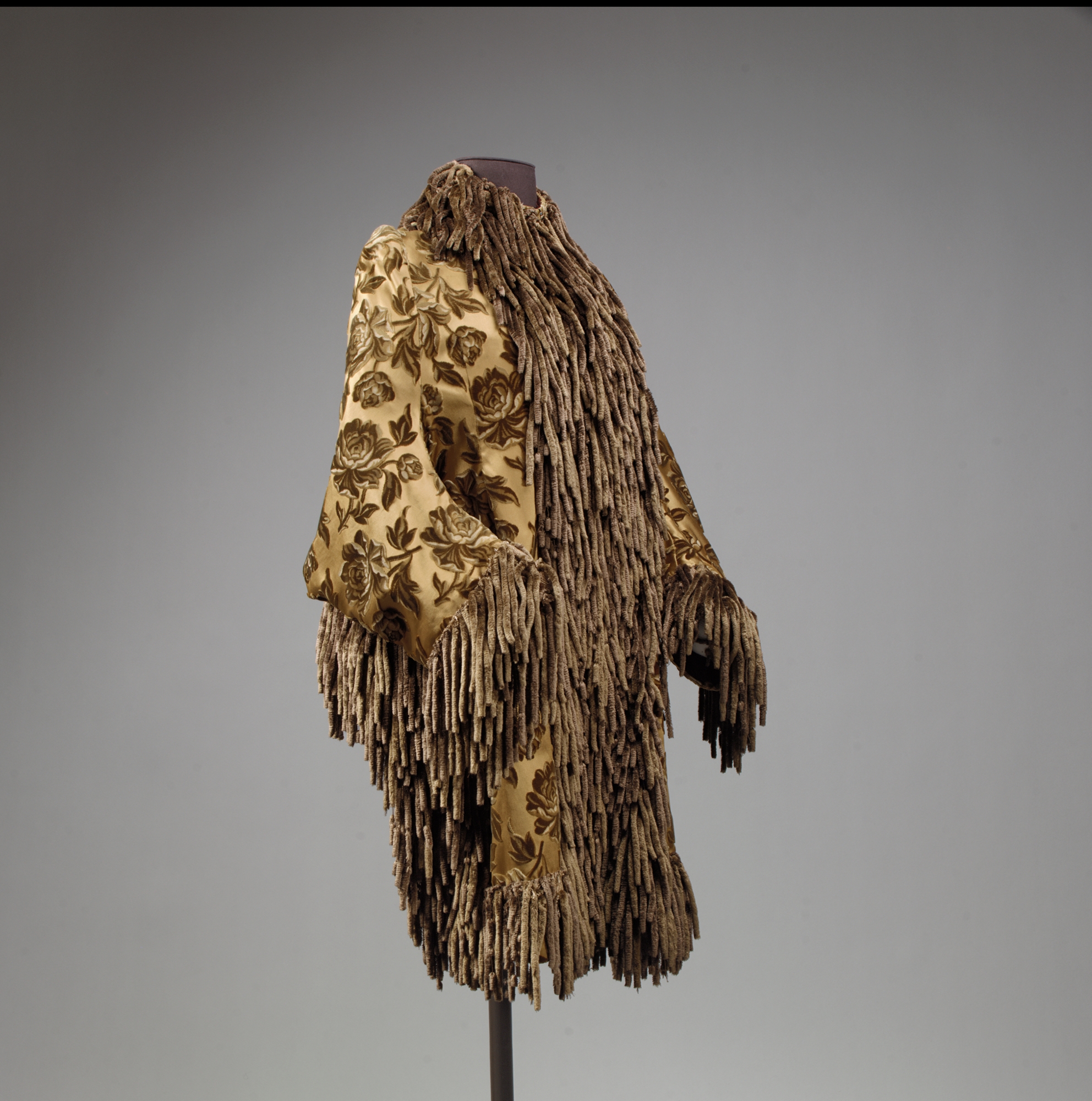
The Dolman Silhouette: An American Couture Study in Silk
In the lexicon of fashion, few silhouettes possess the architectural audacity and historical resonance of the dolman. At Katherine Fashion Lab, our analysis of this form—rooted in American design sensibility and executed in the most unforgiving of natural fibers, silk—reveals a garment that is simultaneously a study in restraint and liberation. The dolman, characterized by its deep, cape-like armholes that extend seamlessly from the body, challenges the very premise of tailoring. It is not a sleeve; it is an extension of the torso, a continuous flow of fabric that redefines the relationship between the garment and the human form. For the American couturier, this presents a unique opportunity: to leverage the nation’s pragmatic, often sportswear-influenced heritage, and elevate it into a statement of pure, unadulterated elegance.
Historical Precedent and the American Vernacular
The dolman’s origins trace back to the 19th-century Hungarian hussar uniform, a military garment designed for mobility and drama. Its adoption into women’s fashion of the 1910s and 1920s, particularly through the work of Paul Poiret, marked a radical departure from the corseted Victorian era. However, the American interpretation, as analyzed here, diverges significantly from its European antecedents. Where European couture often emphasized the dolman’s theatrical, almost sculptural volume, the American version—championed by designers like Claire McCardell and later, the minimalist movements of the 1990s—prioritizes function and fluidity. The American dolman is not a costume; it is a tool for living. It drapes rather than constructs, allowing the wearer’s movement to define the garment’s second-by-second architecture. This is a fundamentally democratic approach to luxury, one that values ease without sacrificing sophistication.
Silk as the Medium of Expression
The choice of silk for this standalone study is not arbitrary. Silk—specifically, a high-grade charmeuse or a matte crepe de chine—is the most demanding of canvases for the dolman silhouette. Unlike structured wools or rigid cottons, silk possesses a liquid quality that both exposes and celebrates every cut, every grain, every draping decision. In the dolman, where there are no armhole seams to anchor the fabric, the silk must be manipulated with surgical precision. The fabric’s bias cut becomes critical. A bias-cut dolman sleeve, for instance, allows the silk to stretch and recover, creating a gentle, organic curve that follows the arm’s natural arc. This is not a sleeve that hangs straight; it breathes with the body. The weight of the silk—ideally between 14 and 19 momme for a garment with significant fabric volume—must be calibrated to ensure the dolman’s dramatic wings do not collapse into shapelessness, nor stand stiffly away from the body. The perfect silk dolman achieves a state of controlled chaos: it moves, it ripples, it settles, but it never loses its essential form.
Construction and the Art of Negative Space
From a technical standpoint, the dolman is a masterclass in negative space. The garment’s defining feature—the absence of a conventional armhole seam—creates a void that must be filled by the wearer’s own physicality. In our analysis, we consider the “drop” measurement, which dictates the depth of the armhole extension. A shallow drop (4-6 inches from the shoulder) yields a more refined, almost kimono-like sleeve, suitable for a cocktail dress or a tailored blouse. A deep drop (8-12 inches) produces the iconic batwing effect, a silhouette that demands a confident wearer and a fabric with substantial drape. The shoulder seam itself becomes a fulcrum. In American couture, we often see the shoulder seam shifted slightly forward or backward to alter the garment’s line of gravity. A forward-shifted seam creates a more enveloping, protective front; a backward shift opens the chest, inviting a more regal, statuesque posture. The neckline, too, must be meticulously considered. A jewel neckline anchors the dolman’s volume above the collarbone, while a deep V-neck extends the vertical line, elongating the torso and counterbalancing the horizontal expanse of the sleeves.
Draping and the Kinetic Silhouette
The true artistry of the dolman in silk emerges during the draping process. Unlike a tailored jacket, which is built from a pattern of discrete panels, the dolman is often developed on the dress form through direct manipulation of the fabric. At Katherine Fashion Lab, our approach involves pinning a single, continuous length of silk—sometimes up to three yards—directly onto the form. We allow the silk to fall under its own weight, observing how the bias creates subtle spirals of tension and release. The armhole opening, which in a conventional garment would be a precise, seamed curve, becomes a soft, raw edge that is either turned under with a delicate hand-rolled hem or left as a clean, narrow facing. The hem of the dolman sleeve itself is a critical design element. A straight, floor-length hem creates a dramatic, cape-like finish. A curved hem, dipping lower at the back, introduces a sense of movement and asymmetry that is inherently modern. The weight of the silk ensures that even a wide, sweeping hem falls in elegant, deliberate folds, never appearing bulky or unkempt.
Market Positioning and the American Luxury Consumer
In the context of contemporary American luxury, the dolman in silk occupies a distinct niche. It is not a garment for the boardroom, nor for the red carpet in its most structured form. Instead, it appeals to the discerning consumer who values effortless sophistication—a woman who understands that true luxury is not about restriction but about freedom. This consumer is often a professional, a creative, or a cultural leader who requires a wardrobe that transitions seamlessly from a morning meeting to an evening gallery opening. The dolman offers a solution: it is a single, statement piece that requires minimal styling. Paired with tailored trousers, it reads as avant-garde yet professional. Over a bias-cut slip dress, it becomes an outerwear piece of extraordinary grace. The price point for such a garment, given the yardage of high-quality silk and the labor-intensive hand-finishing techniques required, typically starts at $1,200 and escalates with the complexity of the draping and the rarity of the silk weave. This positions the dolman as a cornerstone of a curated, investment-driven wardrobe.
Conclusion: The Dolman as a Testament to American Craft
The American dolman in silk is not merely a revival of a historical silhouette; it is a reassertion of couture principles in a market often dominated by fast fashion and disposable trends. It demands of the designer a deep understanding of fabric physics, a reverence for the body’s natural architecture, and a willingness to let go of rigid construction in favor of fluid, kinetic design. For the wearer, it offers a rare combination of comfort and spectacle, of intimacy and presence. At Katherine Fashion Lab, we view this garment as a benchmark for American couture—a piece that proves that the most powerful designs are often those that give the most back. The dolman in silk is a garment that does not constrain; it liberates. And in that liberation, it finds its truest expression of luxury.