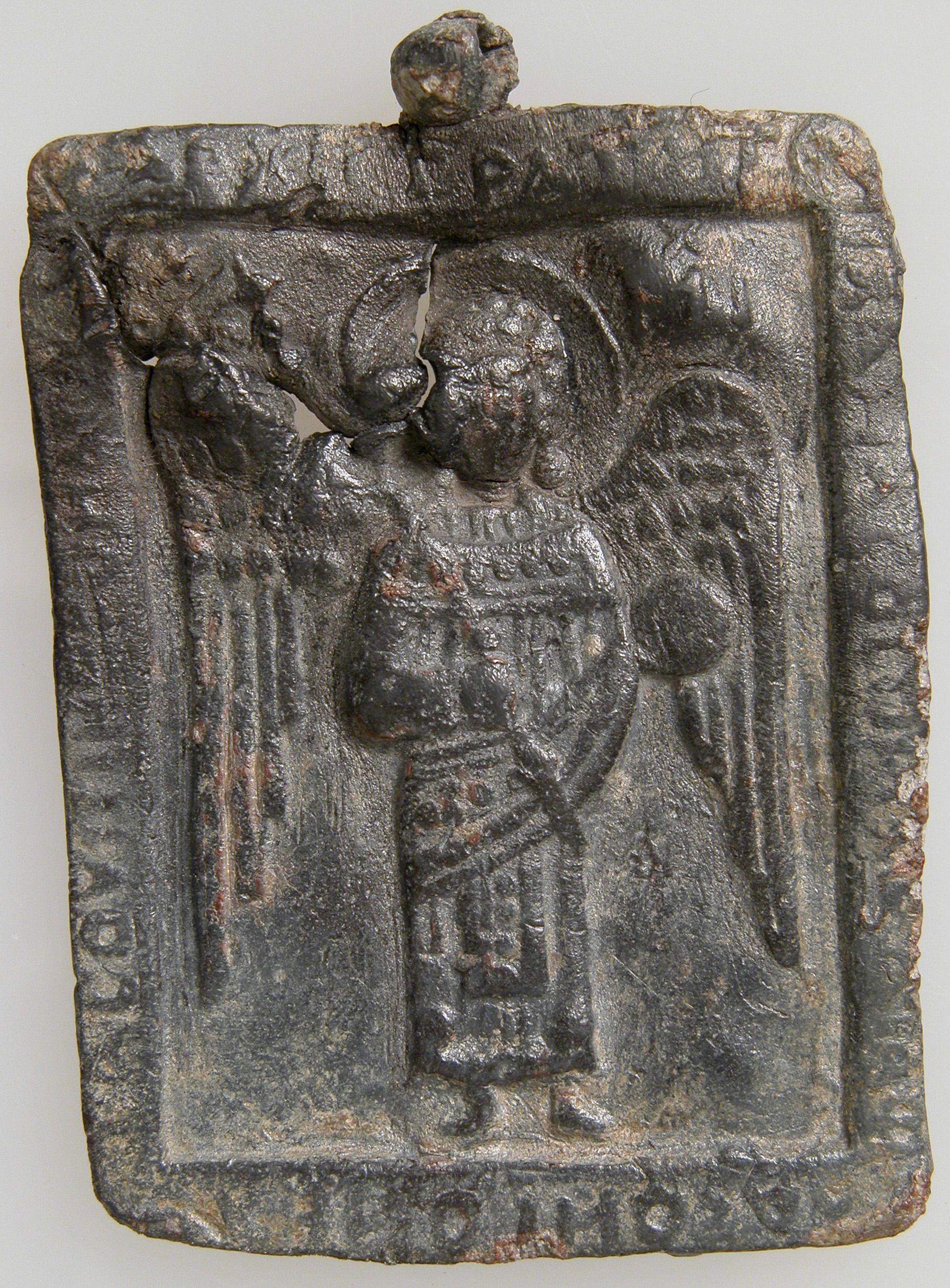
The Icon Pendant of Archangel Michael: A Study in Byzantine Leadwork and Spiritual Authority
Historical and Cultural Provenance
The Icon Pendant depicting the Archangel Michael, rendered in lead and attributed to the Byzantine tradition, represents a singular artifact of devotional material culture. Dating most plausibly to the late 10th to 12th centuries, this object emerges from a period of profound theological consolidation and artistic refinement within the Eastern Roman Empire. The Byzantine Empire, particularly after the Iconoclasm controversies (726–843 AD), placed immense emphasis on the materiality of the sacred. Icons were not merely representations; they were considered conduits of divine presence, mediating between the earthly and the celestial. This pendant, however, occupies a unique niche: a wearable, portable icon, likely intended for personal protection, intercessory prayer, or as a marker of spiritual allegiance. Its material—lead—introduces a compelling paradox, as lead is both humble and enduring, a metal associated with weight, permanence, and, in alchemical traditions, transformation.
Materiality and Symbolic Resonance of Lead
The choice of lead as the primary material for this pendant demands rigorous analysis. In Byzantine craftsmanship, precious metals such as gold, silver, and gilded bronze were conventionally reserved for high-status liturgical objects, reliquaries, and imperial commissions. Lead, by contrast, was utilitarian—used for seals, weights, and piping. Yet, its deployment here is neither accidental nor merely economical. Lead possesses a dense, malleable quality that allows for intricate casting, enabling the preservation of fine iconographic details. More significantly, lead carries symbolic weight: its gray, subdued patina evokes the somber humility of asceticism, contrasting sharply with the luminous gold of imperial icons. The Archangel Michael, as a warrior-saint and psychopomp, is traditionally associated with the weighing of souls at the Final Judgment. Lead, in this context, becomes a material metaphor—heavy with the burden of sin, yet malleable enough to be redeemed through divine grace. The pendant thus embodies a theological tension: the lowliness of the medium mirrors the humility required for salvation, while the iconography asserts heavenly power.
Iconographic Analysis: Archangel Michael as Commander of the Heavenly Host
The central depiction of Archangel Michael follows canonical Byzantine conventions, yet reveals distinctive nuances. Typically, Michael is portrayed as a youthful, beardless figure, clad in military attire—a *loros* or *chlamys*—holding a *labarum* (a military standard) or a *globus cruciger* (orb with a cross), and often trampling a serpent or demon. In this pendant, the iconography is compressed into a circular format, necessitating a refined economy of detail. Michael’s wings are symmetrically displayed, their feathers rendered as incised lines that radiate outward, suggesting both protection and dynamic movement. His right hand likely holds a spear or sword, symbols of spiritual warfare, while his left may grasp a shield or a scroll, indicating his role as a messenger and protector of the faithful. The nimbus encircling his head, typical of Byzantine sainthood, is inscribed with a cross, affirming his Christological allegiance. The reverse of the pendant, if preserved, might bear an invocation or a prayer in Greek, further personalizing its devotional function. The circular form itself is significant: it echoes the *clipeus* (shield) of Roman imperial iconography, transformed here into a shield of faith.
Technique and Craftsmanship: The Art of Lead Casting
The production of this pendant required specialized metallurgical knowledge. Lead, with a low melting point (approximately 327°C), was cast into a carved stone or clay mold, a technique known as *lost-wax casting* or direct investment. The resulting surface, though initially bright, would rapidly oxidize to a muted gray, a process that artisans may have embraced for its matte finish, which reduces glare and enhances legibility in low light—ideal for a pendant worn close to the body. The level of detail achieved in such a small format (likely 3–5 cm in diameter) is remarkable: the folds of Michael’s garment, the feather patterns, and the facial features are rendered with precision, indicating a master craftsman familiar with both theological iconography and the limitations of the medium. The pendant’s suspension loop, integrally cast, suggests it was worn on a leather cord or chain, possibly as a *phylactery* (protective amulet). This practical design underscores its role as a daily companion in a world where spiritual and physical threats were intertwined.
Contextual Significance: Devotional Wear in Byzantine Society
Standalone study of this pendant reveals its function beyond mere ornament. In Byzantine society, personal devotional objects served as tangible links to the divine, particularly for the laity who might not have direct access to church-sanctioned icons. The Archangel Michael, as a patron of warriors, travelers, and the dying, was widely venerated. This pendant likely belonged to a soldier, a merchant, or a pilgrim—individuals whose vocations exposed them to peril. The weight of lead against the chest would serve as a constant tactile reminder of Michael’s protection, a physical anchor for prayer. Moreover, the pendant’s portability allowed for private devotion in public spaces, a subtle but powerful assertion of faith in a multi-religious empire. The use of lead, rather than precious metal, also democratized access to sacred imagery, enabling individuals of modest means to possess a consecrated object. This aligns with broader Byzantine practices of blessing and sanctifying everyday materials, transforming the mundane into the sacramental.
Comparative Analysis: Lead Pendants in the Byzantine Corpus
Comparable artifacts from Byzantine collections—such as those in the Dumbarton Oaks Collection or the British Museum—include lead seals and pilgrim tokens, often bearing similar iconography. However, this pendant’s specific combination of material, size, and iconographic focus on Michael distinguishes it. Lead seals, used for official documents, typically feature imperial or ecclesiastical figures, while pilgrim tokens from sites like Ephesus or Jerusalem often depict saints or biblical scenes. This pendant, by contrast, functions as a personal amulet, bridging the public and private spheres. Its circular shape and central figure align with the tradition of *enkolpia* (medallions worn on the chest), but the use of lead marks a departure from the more common bronze or silver. This suggests a regional or economic context where lead was accessible and valued for its symbolic properties. Further research into trace element analysis of the lead could reveal its provenance—perhaps from the mines of Anatolia or the Balkans—providing deeper insights into trade networks and material circulation.
Theological and Aesthetic Implications
Ultimately, the Icon Pendant of Archangel Michael in lead offers a rich case study for understanding Byzantine material theology. It demonstrates how even the most unassuming materials can be elevated to convey profound spiritual narratives. The pendant’s aesthetic is not one of opulence but of austere elegance, where every line and curve is imbued with meaning. The Archangel’s role as a protector against evil is visually reinforced by the pendant’s physical weight and permanence, suggesting that faith, like lead, is heavy yet enduring. In a contemporary context, this object challenges modern assumptions about luxury and value in fashion and adornment. It posits that true worth lies not in material expense but in the depth of symbolic resonance and the authenticity of craft. For Katherine Fashion Lab, this artifact serves as a powerful reminder that couture can transcend the ephemeral, drawing on ancient traditions to inspire designs that are both timeless and spiritually grounded.
Conclusion: A Legacy of Faith and Craft
In conclusion, the Icon Pendant of Archangel Michael is far more than a relic of Byzantine piety; it is a masterwork of material storytelling. Its leaden form, far from being a limitation, becomes a medium for exploring themes of humility, protection, and transcendence. As a standalone study, it invites us to reconsider the hierarchies of materials in art and fashion, asserting that even the most humble substances can bear the weight of the divine. For curators, historians, and designers alike, this pendant offers a profound lesson in the intersection of faith, craftsmanship, and personal identity—a lesson that resonates across centuries, reminding us that the sacred often resides in the most unexpected places.