Deconstructing the Blade: A Couture Analysis of ‘Boy with a Sword’
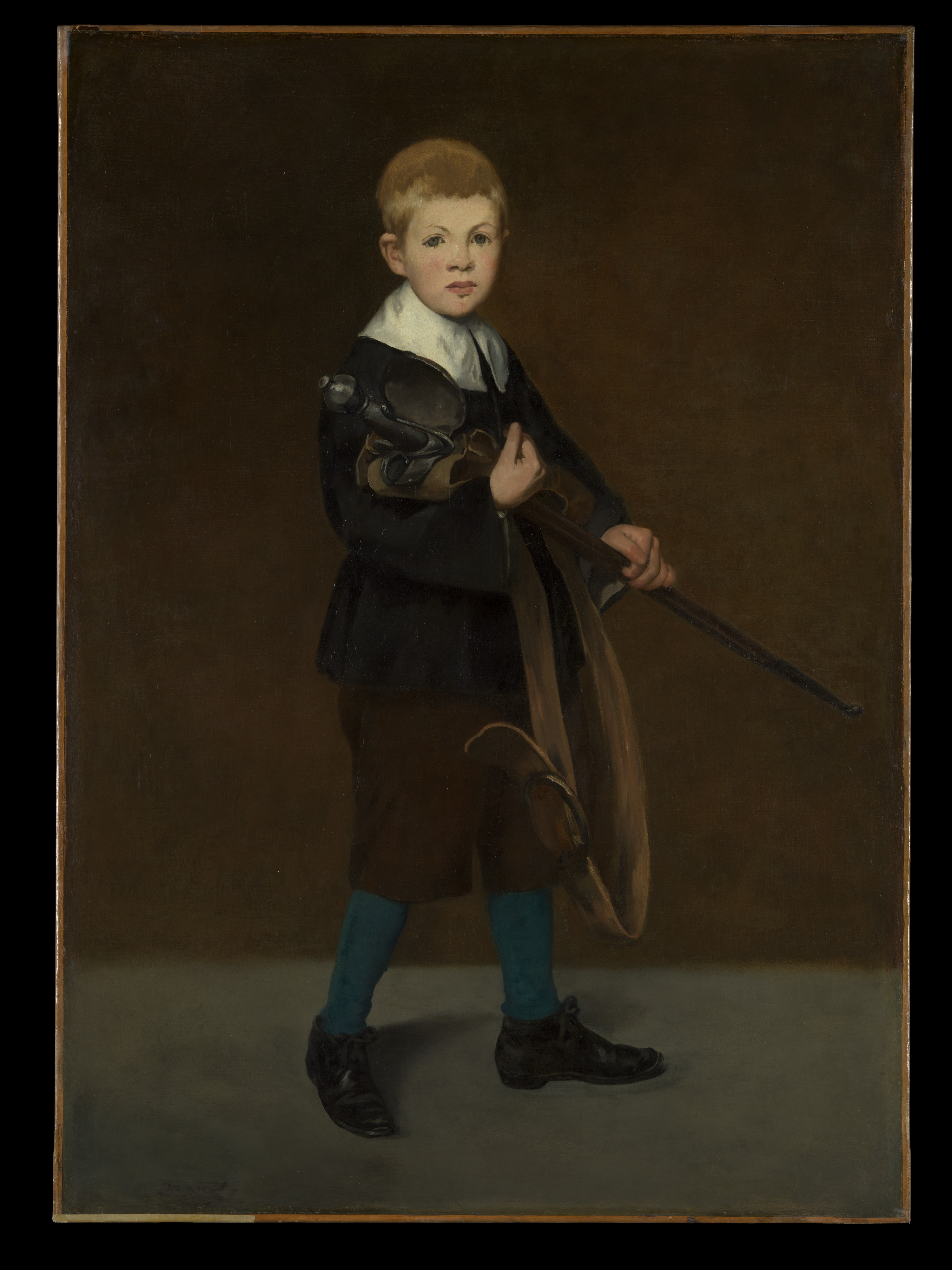
In the rarefied air of haute couture, where fabric becomes narrative and silhouette speaks of lineage, the standalone study ‘Boy with a Sword’ emerges as a profound meditation on the intersection of youth, power, and global heritage. Rendered in oil on canvas, this work transcends its medium to become a sartorial manifesto—a blueprint for a collection that is at once ancestral and avant-garde. As Lead Curator of Katherine Fashion Lab, I approach this piece not merely as a painting, but as a living document of textile potential, a dialogue between the brushstroke and the seam.
The subject—a boy, not yet a man, clutching a blade—immediately evokes the tension between innocence and authority. In fashion, the sword is not a weapon but a symbol: a line of tailoring, a cut of fabric, a decisive seam. This analysis will dissect the work through three lenses: Materiality and Textile Memory, Silhouette as Power Geometry, and Global Heritage as Color Palette. Each element is a thread in a larger tapestry of couture storytelling.
Materiality and Textile Memory: The Oil as Fabric
The choice of oil on canvas is itself a couture decision. Oil paint possesses a viscosity, a weight, that mirrors the drape of heavy silk gazar or duchesse satin. In ‘Boy with a Sword’, the artist’s brushwork is not uniform; it is a study in texture. The boy’s tunic, rendered in layered ochres and deep umbers, suggests a fabric that has been worn, mended, and passed down—a textile memory of generations. For Katherine Fashion Lab, this translates into a call for reclaimed heritage textiles: handwoven ikat from Uzbekistan, naturally dyed cotton from West Africa, or raw silk from the Mekong Delta.
The sword’s blade, painted with sharp, metallic strokes, offers a contrast. It is cold, precise, and modern—a nod to the architectural rigor of couture tailoring. Here, the materiality shifts. The blade could be interpreted as a liquid metal finish on a bonded leather, or a chainmail weave of stainless steel rings. The interplay between the organic, lived-in fabric of the tunic and the industrial precision of the blade is a core tension. In a standalone study, this duality becomes a design principle: the union of the handcrafted and the engineered. A jacket might feature hand-embroidered motifs on the body, with laser-cut metal epaulets. The boy’s story is told in the friction between these textures.
Silhouette as Power Geometry: The Blade’s Line
The sword is not merely an object; it is a line that organizes the composition. In ‘Boy with a Sword’, the blade cuts diagonally across the canvas, creating a dynamic visual vector. For couture, this diagonal is a masterclass in silhouette. It suggests a deconstructed tailoring where seams are not symmetrical but purposeful in their asymmetry. The boy’s stance—one hand on the hilt, the other relaxed—implies a body that is both prepared and at ease. This is the posture of the modern power suit: sharp shoulders, a cinched waist, and a flowing hem that moves like a cape.
Katherine Fashion Lab can translate this into a signature cut: a single-shouldered gown with a sweeping train that mimics the arc of the blade. The sword’s guard, often ornate, becomes a jeweled collar or a structural neckpiece. The hilt, wrapped in leather, suggests a tactile detail—perhaps a corset lacing or a bound cuff. The silhouette is not about aggression but about controlled presence. The boy does not wield the sword; he holds it, as one holds a scepter. In fashion, this translates to garments that empower without overwhelming—a balance of volume and restraint.
The boy’s age is crucial. He is not a warrior but a custodian. The silhouette thus avoids martial heaviness. Instead, it is youthful and fluid. A cropped jacket with exaggerated shoulders, paired with wide-leg trousers that puddle at the ankle, mirrors the boy’s unsteady yet confident grip. The sword becomes a design motif repeated in the stitching, the buttons, or the hemline. It is a whisper, not a shout.
Global Heritage as Color Palette: A Cartography of Hue
The painting’s origin—Global Heritage—is not a geographical claim but a conceptual one. The colors in ‘Boy with a Sword’ are a map of the world. The background is a muted, dusty rose—reminiscent of the clay of Mali or the sunsets of Rajasthan. The boy’s skin tone is a warm terracotta, a hue found in the ochre pits of the Australian Outback and the frescoes of Pompeii. The sword’s steel is a cool, reflective gray, like the fjords of Scandinavia or the polished marble of ancient Greece.
For the couture collection, this palette is both a challenge and an invitation. It demands color as narrative. The dusty rose becomes a base fabric—a silk organza that shifts from pink to brown under light. The terracotta is a dye extracted from earth pigments, applied in gradients to a pleated skirt. The steel gray is a metallic thread woven into a brocade, catching light like a blade. Each color tells a part of the boy’s story: the earth of his ancestors, the sky of his present, the metal of his future.
The global heritage is not a pastiche but a synthesis. A single garment might combine a Japanese indigo shibori with a Moroccan silk thread, or a Peruvian alpaca wool dyed with cochineal. The boy’s sword is a universal symbol, but his tunic is a patchwork of global craft. In the standalone study, this is evident in the painterly layering—the way the artist has built up the canvas with glazes and scumbles. In fashion, this translates to textile layering: a sheer overlay over a solid base, a matte finish next to a gloss, a hand-embroidered motif on a machine-woven ground.
Conclusion: The Standalone as Collection Seed
‘Boy with a Sword’ is a standalone study, but its implications are vast. It is a seed from which a full collection can grow—a narrative of youth, heritage, and the delicate balance of power. For Katherine Fashion Lab, this analysis is a call to action: to translate the oil’s texture into fabric, the blade’s line into silhouette, and the global palette into a cohesive color story. The boy’s sword is not a weapon of war but a tool of transformation. In the hands of a couturier, it becomes a needle, a scissor, a stitch—a means to create garments that are both timeless and of the moment.
This is the essence of couture as critical practice: to see a painting and envision a dress, to hear a story and weave a thread. The boy stands at the threshold of adulthood, and his sword is the line between past and future. Our collection must stand there with him, honoring the global heritage of craft while cutting a new path forward.