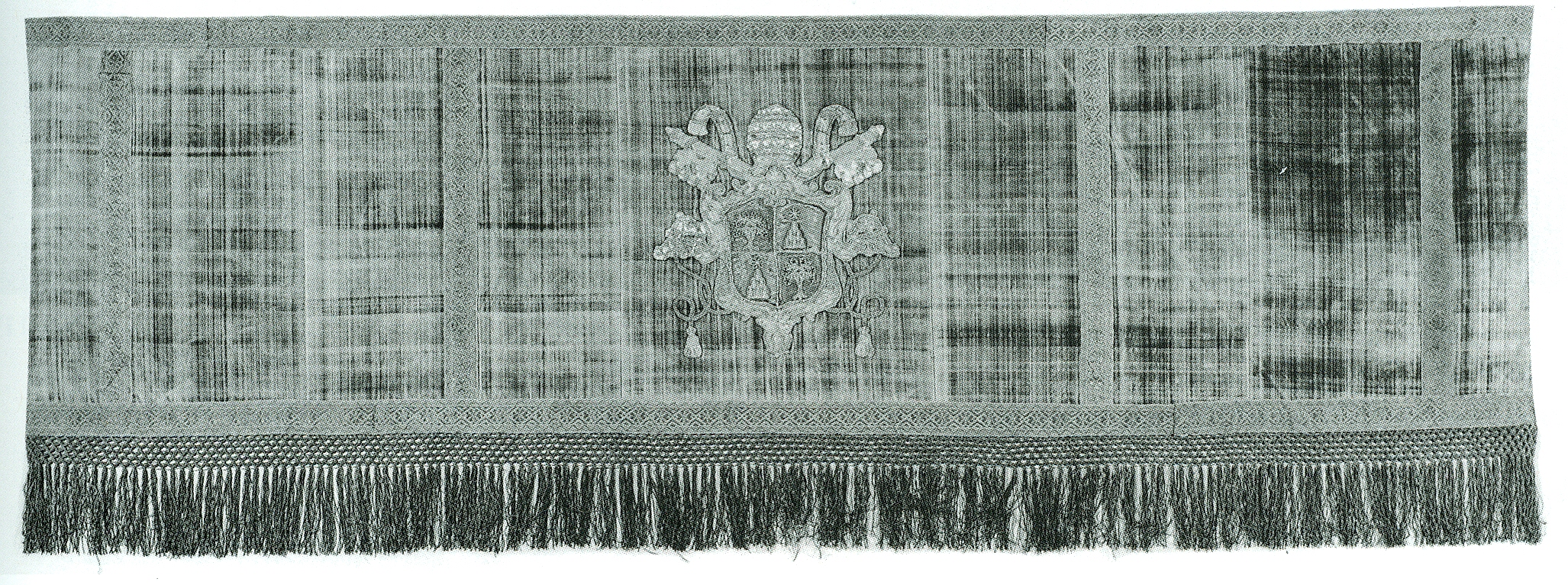
Deconstructing Sovereignty: The Valance with Chigi Coat of Arms as a Study in Italian Couture Power
Introduction: The Valance as a Narrative Device
In the lexicon of textile arts, few objects possess the dual capacity for both ornamental grandeur and heraldic precision as the valance. This particular example, originating from the Italian peninsula and bearing the Chigi coat of arms, transcends its functional role as a decorative canopy trim. It emerges as a standalone artifact of profound cultural, political, and artisanal significance. For Katherine Fashion Lab, this piece is not merely an antique; it is a masterclass in how materiality, technique, and iconography converge to articulate power. The valance’s construction—a symphony of red silk cut velvet, meticulously applied linen and silk rep weave, and couched gilt and cotton cording terminating in tassels—reveals a sophisticated dialogue between structural integrity and symbolic communication. This analysis will dissect the valance through three lenses: its heraldic language, its technical virtuosity, and its contextual resonance within Italian Renaissance and Baroque couture traditions.
Heraldic Language: The Chigi Coat of Arms as a Textile Emblem
The Chigi family, a dynasty of Sienese bankers and papal patrons that reached its zenith under Pope Alexander VII (Fabio Chigi, reigned 1655–1667), understood the strategic deployment of visual identity. The coat of arms emblazoned on this valance is not a mere decorative motif; it is a branding device avant la lettre. The Chigi stemma typically features a six-pointed star, a mountain with three peaks, and an oak tree—symbols of nobility, stability, and renewal. Here, these elements are rendered with painstaking precision through applied fabrics, elevating the valance from household furnishing to a declaration of lineage. The choice of red silk cut velvet as the base fabric is deliberate: red, in heraldic tradition, signifies magnanimity, military strength, and the blood of Christ—attributes the Chigi family sought to project as both secular rulers and ecclesiastical benefactors. The appliquéd linen and silk rep weave create a tactile contrast, with the linen’s matte finish grounding the lustrous rep weave, which mimics the texture of brocade. This interplay of textures mirrors the Chigi’s dual identity as earthly bankers and spiritual patrons, a duality central to their power.
Technical Virtuosity: The Art of Cut Velvet, Appliqué, and Couching
From a technical standpoint, this valance exemplifies the apogee of Italian textile craftsmanship in the 17th century. The red silk cut velvet base is a feat in itself: cut velvet requires the weaving of two layers of silk—a pile and a ground—which are then selectively sliced to create a raised, plush pattern. The result is a fabric that absorbs and reflects light dynamically, lending the valance a living, breathing quality. The Chigi arms are then appliquéd using linen and silk rep weave. Appliqué in this context is not a simple patchwork; it is a strategic layering that adds depth and dimensionality. The linen provides a sturdy, non-reflective counterpoint to the silk rep weave, which is woven with a distinct ribbed texture that catches light differently from the velvet. This creates a chiaroscuro effect, visually separating the heraldic elements from the background while uniting them through the valance’s overall chromatic harmony.
The couched gilt and cotton cording is perhaps the most technically demanding element. Couching involves laying a heavy thread—in this case, gilt-wrapped silk or metal—onto the fabric surface and securing it with small, invisible stitches. This technique requires extraordinary control; the cording must follow the intricate curves of the coat of arms without buckling or distorting. The gilt thread, likely composed of silver-gilt (silver wire wrapped in gold leaf), introduces a metallic sheen that evokes the opulence of papal Rome. The cotton cording, less precious but equally essential, provides structural support and a subtle contrast in texture. The tassels, terminating each section of cording, are not mere afterthoughts. They are functional punctuation marks, adding weight to the valance’s drape and creating a rhythmic visual cadence. Each tassel is hand-wrapped, with the gilt threads woven into the core, ensuring that even the smallest components participate in the overall narrative of luxury.
Contextual Resonance: The Valance as a Standalone Study in Power and Patronage
To fully appreciate this valance, one must situate it within the sociopolitical milieu of Renaissance and Baroque Italy. The Chigi family, like the Medici, understood that textiles were instruments of soft power. A valance of this quality would have adorned a state bed, a throne canopy, or a ceremonial baldachin in a palazzo or church. Its visibility to guests, diplomats, and clergy was a calculated display of the family’s wealth, taste, and divine favor. The red silk cut velvet, imported from Lucca or Genoa, signals access to the most exclusive trade networks. The appliqué technique, which required specialized embroiderers and weavers, underscores the patron’s ability to commission bespoke artistry. The couched gilt cording, with its precious metal content, is a literal investment in display.
Moreover, the valance’s survival as a standalone study is significant. Unlike complete bed hangings or tapestries, which are often fragmented or lost, this piece remains intact, offering a concentrated dose of heraldic and technical information. It allows the contemporary viewer—and the Katherine Fashion Lab—to isolate and analyze the micro-decisions that define haute couture: the choice of weave, the weight of the cording, the density of the pile. In this sense, the valance functions as a prototype for modern fashion thinking. It demonstrates that luxury is not merely about material cost but about the conceptual integration of symbolism, technique, and context. The Chigi valance is, in essence, a three-dimensional mood board for power dressing.
Implications for Contemporary Couture: Lessons from the Valance
For Katherine Fashion Lab, this valance offers several actionable insights. First, it reaffirms the power of heraldic or emblematic design in creating brand identity. Just as the Chigi arms immediately communicate lineage and authority, a modern fashion house can use motifs—whether monograms, crests, or abstract symbols—to anchor collections in narrative. Second, the valance’s technical complexity challenges contemporary designers to value slow craftsmanship over mass production. The cut velvet, appliqué, and couching techniques are labor-intensive, but they produce a textural richness that digital printing cannot replicate. Third, the valance’s use of material contrast—velvet versus linen, gilt versus cotton—teaches a lesson in sensory hierarchy. In an era of minimalist aesthetics, this piece argues for maximalist tactility, where every surface invites touch and scrutiny.
Finally, the valance’s standalone status reminds us that fragments can be as potent as wholes. In fashion, a single sleeve, a collar, or a train can encapsulate a collection’s thesis. The Chigi valance, stripped of its original architectural context, still commands attention. It is a testament to the idea that true couture is context-independent; its excellence is intrinsic, not contingent on its surroundings.
Conclusion: The Valance as a Timeless Couture Artifact
The Valance with Chigi coat of arms is far more than a relic of Italian patrician life. It is a textile manifesto that articulates power through materiality, technique, and symbolism. Its red silk cut velvet base, appliquéd linen and silk rep weave, and couched gilt and cotton cording ending in tassels represent the pinnacle of artisanal achievement. For Katherine Fashion Lab, this piece serves as a benchmark for how heritage can inform innovation. It challenges us to see couture not as ephemeral trend but as a permanent record of human ambition. In the hands of a skilled analyst, this valance speaks volumes about the Chigi family, Italian artistry, and the enduring language of luxury. It is, without question, a standalone masterpiece worthy of deep study and emulation.