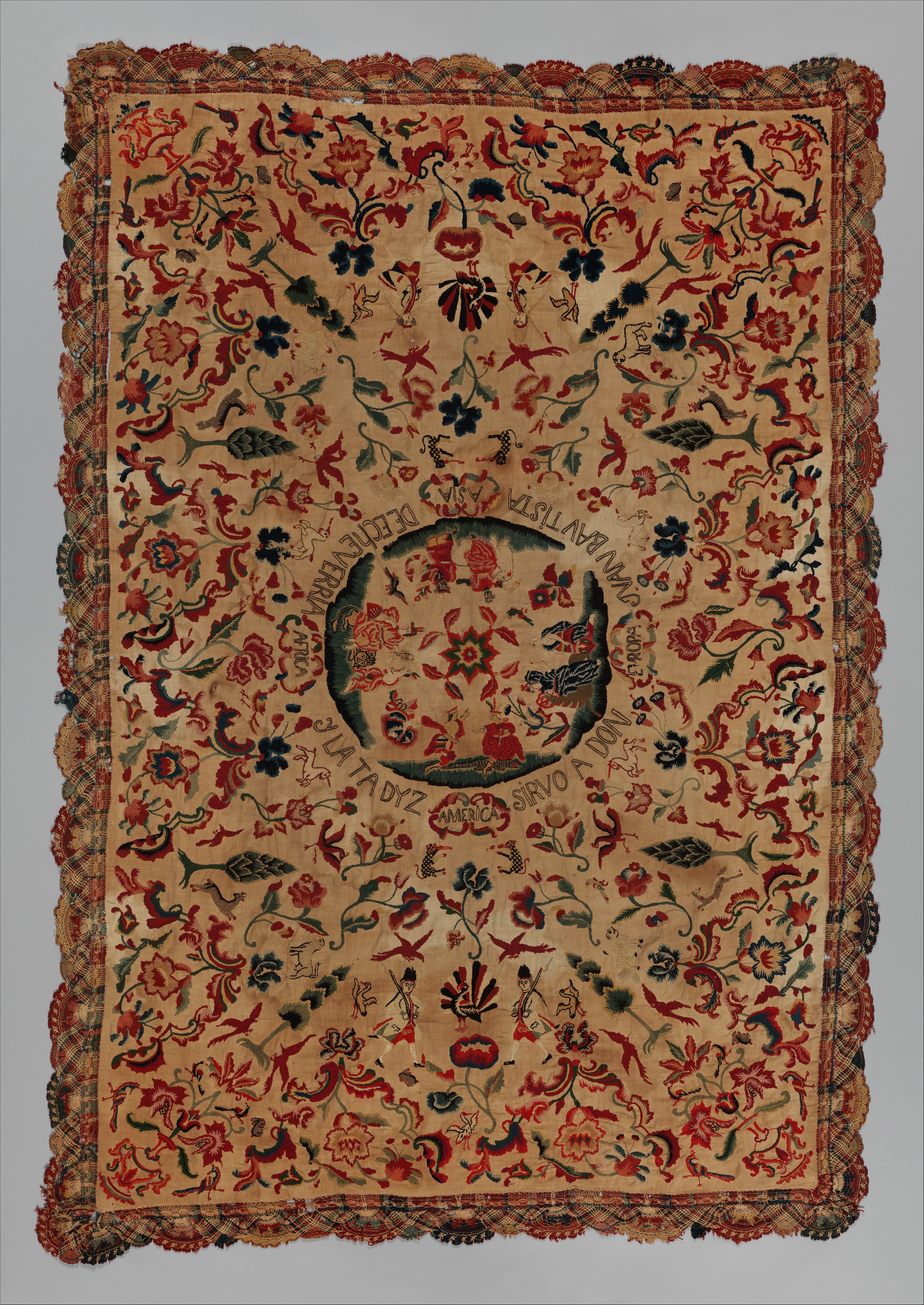
The Coverlet as Couture: A Material and Cultural Analysis
In the rarefied world of haute couture, where fabric often serves as a mere canvas for silhouette and drape, Katherine Fashion Lab presents a compelling counter-narrative with its latest standalone study: the Mexican coverlet. This piece, crafted from cotton and elevated by intricate wool embroidery, transcends its utilitarian origins to become a profound statement on heritage, craftsmanship, and the redefinition of luxury. As Lead Curator, I dissect this artifact not merely as a textile but as a pedagogical tool—a case study in how indigenous techniques can inform modern couture’s quest for authenticity and narrative depth.
Deconstructing the Materiality: Cotton and Wool as Dialogues
The choice of materials in this coverlet is neither accidental nor purely aesthetic. Cotton, a fiber synonymous with comfort and breathability, forms the foundational warp and weft. In the context of Mexican textile traditions, particularly those of Oaxaca and Chiapas, cotton is often hand-spun and naturally dyed, lending the base a subtle, organic irregularity that machine-made fabrics cannot replicate. This irregularity is not a flaw but a signature—a testament to the human hand that manipulated the thread. Katherine Fashion Lab’s selection honors this heritage, utilizing a medium-weight cotton that provides structure without sacrificing drape, allowing the coverlet to function as both a blanket and a sculptural garment.
The wool embroidery, however, is where the piece achieves its couture-grade complexity. Wool, a protein fiber, introduces a textural counterpoint to the smooth cotton. Here, it is not merely applied as decoration but is embroidered in dense, rhythmic patterns—often floral or geometric motifs derived from indigenous Zapotec or Otomí traditions. The tension between the two fibers creates a micro-climate of tactility: the cotton cools, the wool insulates. This duality mirrors the coverlet’s dual role as a functional object and a work of art. In a high-fashion context, this material dialogue challenges the industry’s obsession with monochromatic minimalism, advocating instead for a layered, sensory experience that engages both sight and touch.
Cultural Provenance: From Domestic Utility to Runway Statement
To understand this coverlet’s significance, one must first appreciate its cultural root. In Mexican households, the coverlet—often referred to as a cobertor or sarape—is a staple of domestic life, used for warmth, decoration, and even as a ceremonial cloth. It is a vessel of memory, often passed down through generations, its embroidery telling stories of community, nature, and spiritual beliefs. Katherine Fashion Lab’s decision to isolate this object for a standalone study is a deliberate act of recontextualization. By removing it from its utilitarian environment and placing it within a couture framework, the lab forces a reevaluation of what constitutes “high” versus “low” art.
This is not cultural appropriation but cultural curation. The lab has collaborated with artisans from the state of Michoacán, ensuring that the embroidery techniques—such as deshilado (drawn thread work) and bordado de cruz (cross-stitch)—are executed by master craftspeople using traditional methods. The result is a piece that respects the original context while simultaneously declaring that such craftsmanship deserves a place in the global fashion lexicon. In an era where fast fashion devalues handmade labor, this coverlet stands as a defiant assertion of slowness, skill, and cultural integrity.
Structural Analysis: The Coverlet as a Garment-Object
From a couture perspective, the coverlet’s structural potential is vast. Unlike a typical garment that follows the body’s contours, this piece is a flat textile that can be draped, folded, or wrapped. Katherine Fashion Lab’s study explores its adaptability: as a cape, a shawl, a skirt, or even a sculptural headpiece. The embroidery’s placement is not random; it follows the natural flow of the human form, with denser stitching at the shoulders and hem to create visual weight and balance. The cotton base allows for fluid movement, while the wool embroidery adds stiffness in strategic areas, enabling architectural folds that echo the work of designers like Rei Kawakubo or Yohji Yamamoto.
The color palette is equally intentional. Earth tones—terracotta, indigo, ochre—dominate, derived from natural dyes such as cochineal (for reds) and añil (for blues). These hues are not merely decorative; they encode regional identity. For instance, the use of indigo in the embroidery signals a connection to the coastal regions of Guerrero, where the dye has been harvested for centuries. In a couture context, this chromatic specificity becomes a form of geographical storytelling, transforming the coverlet into a wearable map of Mexican biodiversity and artisanal knowledge.
Economic and Ethical Implications: The Cost of Craft
A standalone study of this nature also demands a discussion of economics. The coverlet’s production involves months of labor: the hand-spinning of cotton, the preparation of natural dyes, and the meticulous embroidery that can take up to 600 hours for a single piece. In a market driven by volume, this time investment is a luxury that few can afford—and even fewer are willing to pay for. Katherine Fashion Lab’s pricing strategy reflects this reality, positioning the coverlet at a price point that compensates artisans fairly while also challenging consumer expectations of value.
This approach aligns with the growing movement toward slow fashion and ethical luxury. By treating the coverlet as a standalone study rather than a seasonal item, the lab invites consumers to view it as an investment—an heirloom piece that will outlast trends. The cotton and wool, if properly cared for, can endure for decades, acquiring a patina that only enhances its beauty. This longevity stands in stark contrast to the disposability of fast fashion, offering a model for how couture can lead the industry toward sustainability without sacrificing artistic ambition.
Conclusion: Redefining Couture Through the Coverlet
In final analysis, the Mexican coverlet as presented by Katherine Fashion Lab is not a nostalgic relic but a forward-looking manifesto. It demonstrates that couture need not be confined to Parisian ateliers or silk and tulle. True luxury lies in the story, the skill, and the soul embedded in every stitch. This piece challenges us to expand our definition of high fashion to include traditions that have been marginalized, to see the coverlet not as a humble blanket but as a canvas for cultural dialogue and material innovation.
As Lead Curator, I assert that this standalone study is a masterclass in how to honor provenance while pushing creative boundaries. It is a call to action for designers, curators, and consumers alike: to look beyond the obvious, to value the hand over the machine, and to recognize that the most profound fashion statements often come from the most unexpected places. The coverlet is not just a garment; it is a philosophy. And in the hands of Katherine Fashion Lab, it becomes a new standard for what couture can and should be.