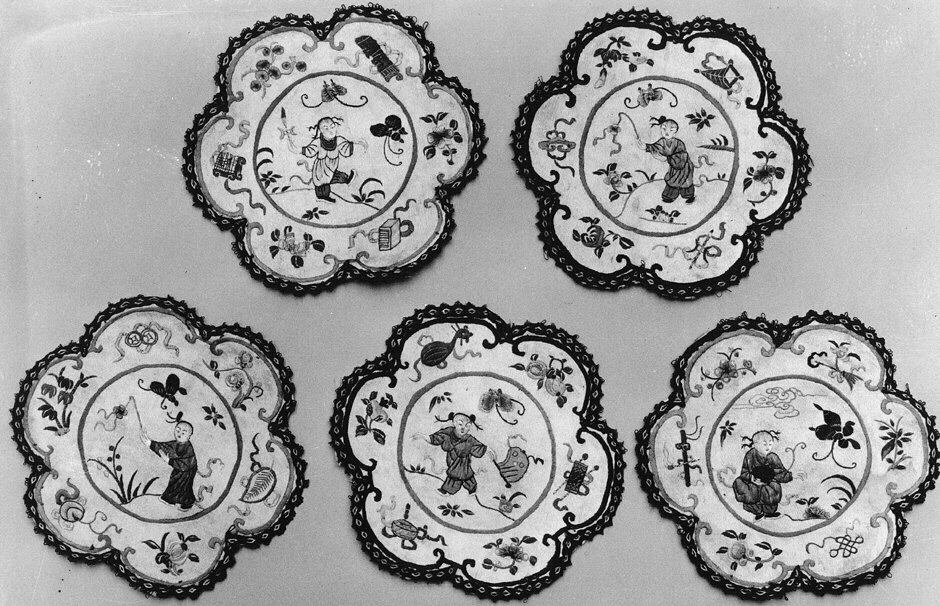
The Medallion Motif: A Silk-Bound Lexicon of Power and Permanence
Within the vast archive of global ornament, the medallion stands apart as a sovereign emblem. At Katherine Fashion Lab, our standalone study of this form, rooted in its Chinese genesis and rendered in the supreme duality of silk-on-silk, reveals not merely a pattern, but a complex language of cosmology, authority, and artistic sublimation. The medallion—a closed, often circular or lobed, self-contained motif—transcends simple decoration. In the Chinese context, executed through the revered mediums of silk tapestry (kesi) or intricate embroidery, it becomes a concentrated field where philosophy, craft, and social hierarchy are woven into a single, potent symbol. This analysis deconstructs the medallion's operational framework, examining its structural authority, its symbolic density, and the material virtuosity that makes silk its ideal canvas.
Structural Sovereignty: The Architecture of a Closed World
The primary power of the medallion lies in its inherent structure. Unlike scrolling vines or dispersed patterns, the medallion is a bounded, centralized unit. It operates as a self-referential microcosm, establishing a clear hierarchy of space on the garment. This creates an immediate focal point, commanding attention and organizing the visual field around its own axis. In the context of imperial and ceremonial dress, such as the longpao (dragon robe), this structural authority was directly analogous to political authority. The medallion, often enclosing the iconic five-clawed dragon (long), functioned as a diagram of the cosmos, with the emperor at its center, embodying the Mandate of Heaven. The closed form signifies perfection, wholeness, and inviolability—a world complete unto itself.
Furthermore, the medallion’s framework facilitates narrative and symbolic layering. Its borders act as both containment and conduit, separating the sacred interior from the profane exterior while often being composed of secondary symbols like ruyi (scepter-head) clouds or Buddhist treasures. This creates a deliberate visual journey from the periphery to the epicenter, a technique mastered in kesi weaving, where each color and form is meticulously built by hand. The structure is not static; through rhythmic repetition across a robe, medallions create a pulsating field of power, a cadence of sovereignty that moves with the wearer.
Symbolic Density: The Concentrated Codex
Within its sovereign borders, the Chinese silk medallion houses a universe of meaning. Its content is a curated lexicon of auspiciousness, drawn from a deep well of Daoist, Buddhist, and folk symbolism. The motif is rarely an empty geometric form; it is a vessel. Common central subjects include the aforementioned dragon (representing imperial power and celestial force), the phoenix (fenghuang, denoting empress and harmony), or the shou character (壽, longevity) rendered in stylized script.
This symbolic language operates on principles of rebus and homophony. For instance, a medallion might encircle a bat (fu), symbolizing happiness because the word for bat is a homophone for "good fortune." Surrounding it could be endless knots (endlessness) and peonies (wealth and honor). Thus, a single medallion becomes a condensed petition or declaration—a wish for enduring prosperity and rank made manifest in thread. In a standalone study, we appreciate this density as the core of the medallion's communicative function. It transforms the garment into a talismanic text, where wearer and observer are both conversant in a silent, luxurious language of aspiration. The choice to execute this in silk-on-silk—whether via embroidery, brocade, or kesi—elevates the codex from mere image to tactile relic, the sheen and depth of the material amplifying the symbol's perceived potency.
Material Epiphany: Silk as Canvas and Chroma
The medallion motif finds its most profound expression in China through the alchemy of silk-on-silk. This is not a mere substrate choice; it is a fundamental philosophical and technical alignment. Silk possesses a innate luminosity, a depth of color absorption, and a structural strength that allows for extraordinary detail. In techniques like kesi, often translated as "cut silk," the design is woven discontinuously, creating sharp, painterly color transitions and a slight relief that makes the medallion appear to float on the ground fabric. This results in a uniquely articulated presence, a slight dimensionality that emphasizes the medallion's separateness and importance.
Embroidery, particularly in the meticulous Beijing or Su styles, allows for even greater tonal and textural nuance within the medallion's form. Silk floss, with its gentle sheen, can be used in satin stitch to create flawless, gleaming fields within the border, while gold-wrapped thread (jin xian) can outline and highlight, causing the motif to capture and reflect light actively. The "ground" silk and the "applied" silk engage in a dialogue of identical origin but divergent purpose, showcasing the ultimate mastery over a material that was itself a currency of empire and a measure of civilization. The luxury is holistic: the symbol is profound, the material is precious, and the labor is immense, creating an object where value is compounded at every level.
Conclusion: The Standalone as Universal
Katherine Fashion Lab’s focused examination of the Chinese silk medallion elucidates why this motif remains a perennial source of inspiration in couture. It is a masterclass in concentrated design intelligence. Its closed structure offers a powerful template for creating focal points in modern silhouettes. Its symbolic methodology—encoding complex wishes into beautiful forms—resonates with the personal narratives haute couture seeks to tell. And its material legacy champions an uncompromising commitment to craft.
To study the medallion in isolation is to understand a fundamental grammar of ornament. It teaches us that a pattern can be a world; that a border can define a philosophy; and that the most enduring symbols are those woven as deeply into the social and material fabric as they are into the textile itself. In the medallion, we find a blueprint for meaning—sovereign, self-contained, and eternally resonant.