Heritage Analysis: The Girdle Clasp as a Symbol of Power and Adornment
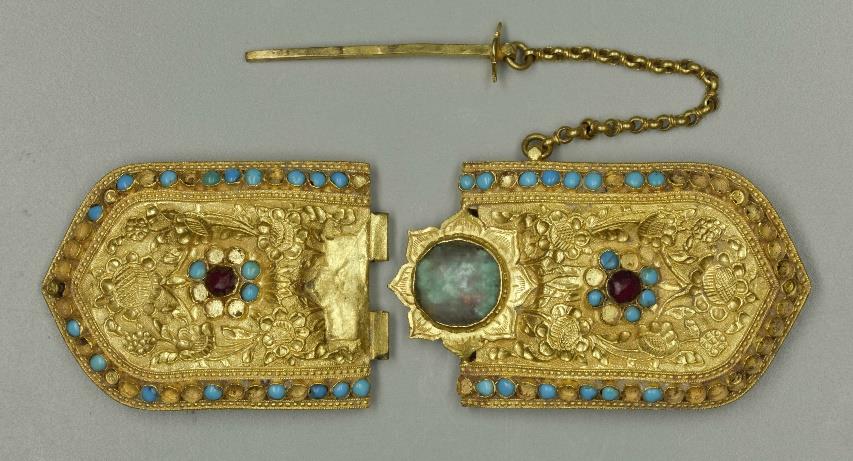
In the annals of ancient civilizations, few artifacts encapsulate the intersection of authority, spirituality, and personal identity as profoundly as the girdle clasp. Crafted from gold and inlaid with semi-precious stones and glass, this object transcends mere ornamentation to become a talisman of status and cosmic connection. For Katherine Fashion Lab, a strategic examination of the girdle clasp offers a rich reservoir of symbolic meaning and historical resonance, which can be translated into a 2026 high-end luxury strategy that merges heritage with avant-garde desirability.
Symbolic Power: The Girdle Clasp as an Emblem of Authority
The girdle clasp, often worn at the waistline, was far more than a functional fastener in ancient societies. In Mesopotamian, Egyptian, and Minoan cultures, the girdle served as a visible marker of hierarchical position. Gold, as a material, was reserved for deities, royalty, and the elite, signifying divine favor and unassailable power. The clasp’s placement at the waist—the body’s center of gravity—symbolized control over one’s domain, both physically and metaphysically. For a ruler, the girdle clasp was akin to a scepter or crown: a condensed emblem of sovereignty.
From a strategic standpoint, Katherine Fashion Lab can leverage this symbolism to position its 2026 collection as a statement of empowerment through heritage. By reinterpreting the girdle clasp as a modern accessory—perhaps a cinch belt or a detachable waist ornament—the brand invites wearers to embody the confidence of ancient leaders. The clasp becomes a narrative device, communicating that the wearer holds authority over their own narrative, a theme deeply resonant with contemporary luxury consumers seeking authenticity and self-determination.
Historical Adornment: Craftsmanship as Cultural Capital
The technical mastery required to produce a gold girdle clasp inlaid with semi-precious stones and glass speaks to the sophistication of ancient artisans. Lapis lazuli, carnelian, turquoise, and colored glass were not chosen arbitrarily; each material carried specific cultural and symbolic weight. Lapis lazuli, for instance, was associated with the heavens and royalty in Egypt, while carnelian represented vitality and protection. Glass, a material that mimicked precious stones, demonstrated technological prowess and access to trade networks.
For Katherine Fashion Lab, this historical context underscores the importance of artisanal storytelling in luxury branding. The 2026 strategy should emphasize the meticulous craftsmanship behind each piece, positioning the clasp as a collectible artifact rather than a disposable trend. Limited-edition runs, collaborations with master gem-setters, and transparent sourcing of materials can elevate the brand’s credibility. The inlay technique—where stones are set into the gold without visible prongs—can be revived as a signature method, offering a tactile and visual experience that digital renderings cannot replicate.
Moreover, the clasp’s function as a closure device for garments or belts can be reimagined as a modular element in high-end fashion. By creating interchangeable clasps that attach to various fabrics or leathers, Katherine Fashion Lab can offer consumers a personalized, investment-grade accessory that evolves with their wardrobe—a nod to the ancient practice of reusing precious metals across generations.
Spiritual Meaning: The Girdle Clasp as a Conduit for the Divine
Beyond its social utility, the girdle clasp held profound spiritual significance. In many ancient belief systems, the waist was considered a vulnerable point—a gateway between the upper and lower body, or between the mortal and divine realms. The clasp, therefore, functioned as an apotropaic device, warding off malevolent spirits and ensuring safe passage through life’s transitions. Gold, incorruptible and radiant, was believed to channel celestial energy, while inlaid stones were thought to amplify prayers or intentions.
This spiritual dimension offers Katherine Fashion Lab a unique positioning in the 2026 luxury market, where consumers increasingly seek items that serve as talismans for well-being. The brand can frame its girdle clasp as a modern “amulet of intention,” with each stone selected for its metaphysical properties—such as rose quartz for love or black onyx for protection. Marketing narratives should highlight the ritualistic aspect of wearing the clasp: as a daily affirmation of one’s inner strength or a connection to ancestral wisdom.
Collaborations with contemporary spiritual leaders or wellness advocates could further deepen this resonance. For instance, a limited collection co-designed with a historian of ancient religions or a modern mystic would lend authenticity. The clasp could be presented in a bespoke box reminiscent of a reliquary, complete with a card explaining the symbolic meaning of each material—transforming a purchase into a meaningful ceremony.
2026 High-End Luxury Strategy: Heritage as a Competitive Advantage
To translate these insights into a viable commercial strategy, Katherine Fashion Lab must adopt a multi-dimensional approach that balances exclusivity with accessibility. The following pillars are essential:
1. Narrative-Driven Product Design
The girdle clasp should be offered in three tiers: Heritage Edition (exact replicas of ancient designs using period-accurate techniques), Curated Collection (modern interpretations with ethically sourced gemstones), and Bespoke Service (custom clasps designed in collaboration with clients). Each tier reinforces the brand’s commitment to historical fidelity while allowing for personal expression. The clasp’s modularity—enabling attachment to belts, bags, or clothing—ensures versatility in a minimalist wardrobe.
2. Experiential Retail and Digital Storytelling
Physical and digital touchpoints should immerse consumers in the clasp’s heritage. Pop-up exhibitions featuring loaned ancient artifacts from museums, paired with holographic displays showing the clasp’s creation process, would create buzz. Online, a microsite could offer a “Symbolism Calculator,” where users input their aspirations (e.g., “protection,” “prosperity,” “creativity”) and receive a recommended stone combination. This interactivity builds emotional engagement and encourages social sharing.
3. Strategic Partnerships and Influencer Curation
Collaborations with academic institutions (e.g., archaeology departments) and luxury heritage houses (e.g., goldsmiths with centuries-old techniques) would reinforce credibility. Influencers should be selected for their expertise in history, spirituality, or sustainable luxury, rather than sheer follower count. A campaign featuring a historian explaining the clasp’s role in ancient courts, alongside a modern CEO wearing it as a power accessory, bridges past and present.
4. Sustainability as a Core Value
Ancient girdle clasps were often melted down and reforged, reflecting a circular economy. Katherine Fashion Lab can adopt this principle by offering a “Legacy Exchange” program: clients can return their clasp after a set period to have it redesigned or recast into a new piece, with the original materials repurposed. This reduces waste and deepens customer loyalty, as the clasp becomes a family heirloom in progress.
5. Pricing and Positioning
Pricing should reflect the clasp’s dual identity as art and accessory. Entry-level pieces (using glass and semi-precious stones) could start at $2,500, while Heritage Editions with genuine lapis lazuli or gold alloys could reach $25,000. The brand must avoid discounting, instead offering payment plans or layaway options that mirror ancient patronage systems. The clasp should be marketed as an “investment in identity”—a piece that appreciates in emotional and cultural value over time.
Conclusion: The Girdle Clasp as a Strategic Archetype
The ancient girdle clasp, with its fusion of gold, stone, and glass, embodies a timeless dialogue between power, beauty, and the sacred. For Katherine Fashion Lab, this artifact is not merely a design inspiration but a strategic archetype. By honoring its symbolic power, historical craftsmanship, and spiritual depth, the brand can craft a 2026 collection that resonates with discerning consumers who seek meaning in their possessions. In an era of digital saturation, the tangible, story-rich clasp offers a return to the tangible—a reminder that luxury, at its core, is about connection to heritage, self, and the cosmos.