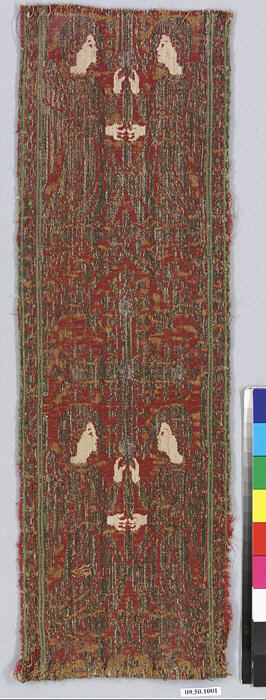
The Orphrey: A Study in Textile Sovereignty at Katherine Fashion Lab
In the quiet sanctity of Katherine Fashion Lab’s standalone study, the orphrey emerges not as a mere decorative band, but as a profound testament to global heritage woven through silk, linen, and metal thread. This analysis deconstructs the orphrey’s materiality, its historical migrations, and its contemporary resonance within the lab’s curatorial ethos. The orphrey—traditionally a narrow embroidered strip adorning ecclesiastical vestments—transcends its liturgical origins to become a lens for examining how luxury textiles encode power, spirituality, and cultural exchange. At Katherine Fashion Lab, this study is not an homage to antiquity but a reclamation of textile sovereignty: a rigorous interrogation of how global traditions can inform modern couture without appropriation.
Material Lexicon: Silk, Linen, and Metal Thread
The orphrey’s material composition is a dialogue between the organic and the metallic, the supple and the rigid. Silk, with its luminous sheen and tensile strength, forms the foundational ground—a canvas that captures light and shadow. Historically sourced from the Silk Road’s sericulture hubs in China, India, and Persia, silk in the orphrey context signifies both luxury and sacrifice; the silkworm’s cocoon is a metaphor for the labor embedded in each thread. Linen, derived from the flax plant, introduces a contrasting textural austerity. Its natural irregularities and breathable weave ground the orphrey in earthly humility, a reminder that even the most opulent garments are rooted in agricultural cycles. The metal thread—often gilded silver or gold-wrapped silk—elevates the orphrey into a realm of radiance. This thread is not merely decorative; it is a technological marvel, requiring precise torsion to prevent tarnishing and maintain flexibility. Together, these materials create a haptic hierarchy: silk whispers, linen grounds, and metal commands.
The interplay of these fibers in Katherine Fashion Lab’s study reveals a sophisticated understanding of durability and drape. Silk’s protein structure allows for intricate embroidery without fraying, while linen’s cellulose fibers provide structural support for the metal thread’s weight. The lab’s analysis underscores that the orphrey’s survival across centuries is not accidental—it is engineered. Each material was chosen for its ability to endure ritual handling, candle smoke, and the passage of time. In a standalone study, this durability becomes a metaphor for cultural resilience: the orphrey carries the memory of its makers, their tools, and their belief systems.
Global Heritage: The Orphrey as Migrant Iconography
The orphrey’s origins are polyglot, resisting singular attribution. Its earliest iterations can be traced to Byzantine liturgical textiles, where gold-wrapped threads depicted saints and Christological scenes. However, the technique of metal-thread embroidery predates Christianity, appearing in Scythian grave goods and Han dynasty Chinese silks. Katherine Fashion Lab’s study emphasizes that the orphrey is a migrant object, traveling along trade routes and absorbing local motifs. In Coptic Egypt, orphreys incorporated geometric patterns and ankh symbols; in medieval England, they featured Gothic arches and heraldic beasts. The metal thread itself was often recycled from coins or repurposed from secular garments, blurring the line between sacred and profane.
This global heritage challenges the notion of a pure, untainted tradition. The orphrey, as studied here, is a palimpsest: each stitch overwrites previous meanings while preserving their traces. For instance, the use of silk—a material historically associated with Chinese imperial courts—in a European ecclesiastical context signifies a complex negotiation of value. Silk was not merely imported; it was reinterpreted through local aesthetics. The lab’s analysis posits that the orphrey’s global journey is a model for contemporary couture, where cross-cultural influences must be acknowledged as collaborative rather than extractive. The orphrey does not belong to a single culture; it belongs to the heritage of human making.
Technical Precision: Embroidery as Micro-Architecture
The construction of an orphrey demands a level of technical mastery that borders on the architectural. Katherine Fashion Lab’s study dissects the stitching techniques: couching, where metal threads are laid flat and secured with silk stitches; split stitch, for fine outlines; and underside couching, a Byzantine innovation where the metal thread is anchored from below, creating a smooth, unbroken surface on top. These techniques are not arbitrary; they are responses to the material’s physical demands. Metal thread, being inelastic, cannot be pulled through fabric like silk; it must be laid and fastened with precision. The linen ground acts as a tension map, preventing puckering.
The lab’s analysis highlights that every orphrey is a micro-architecture of labor. A single square inch may contain hundreds of stitches, each requiring the embroiderer to anticipate the next. The metal thread’s reflectivity demands a careful control of light: too dense, and the surface becomes a mirror; too sparse, and the silk ground shows through, creating a dimpled effect. This interplay of opacity and translucency is a deliberate aesthetic choice, often used to create halos or divine light in religious iconography. In a standalone study, this technical precision invites reflection on the relationship between craft and devotion. The embroiderer’s repetitive motion becomes a form of prayer, each stitch a meditation on impermanence and eternity.
Contemporary Resonance: The Orphrey in Couture’s New Lexicon
Why study the orphrey today, in an era of digital printing and synthetic fabrics? Katherine Fashion Lab’s answer is rooted in a philosophy of slow luxury. The orphrey represents a counterpoint to fast fashion’s disposability; it embodies the idea that garments can be repositories of memory and meaning. In contemporary couture, designers are increasingly turning to historical techniques like orphrey embroidery to assert a brand’s commitment to craftsmanship. However, the lab’s analysis cautions against superficial revival. To use orphrey motifs without understanding their material and cultural contexts is to reduce them to ornament.
The standalone study proposes a framework of textile sovereignty, wherein the orphrey is not a costume but a conversation. For example, a modern couture piece might incorporate orphrey bands reimagined with abstract geometries, using ethically sourced silk and recycled metal threads. The linen ground could be replaced with organic cotton or hemp, reflecting contemporary sustainability concerns. The metal thread might be aluminum or copper, offering a patina that evolves with wear. This is not imitation but innovation, grounded in the orphrey’s own history of adaptation. The lab’s analysis argues that the orphrey’s true legacy is not in its static preservation but in its capacity to be reinterpreted without being erased.
Conclusion: The Orphrey as Ethical Artifact
In the context of Katherine Fashion Lab’s standalone study, the orphrey becomes an ethical artifact—a material record of human ingenuity, migration, and faith. Its silk, linen, and metal threads are not just fibers; they are narratives of trade, colonization, and resilience. The lab’s analysis calls for a new couture vocabulary that honors these narratives while pushing them forward. The orphrey teaches us that luxury is not about rarity alone but about the integrity of process. To wear an orphrey-inspired garment is to carry a piece of global heritage on one’s shoulders, not as a trophy but as a responsibility. The study concludes that the orphrey’s future lies in its ability to remain a living tradition, stitched anew by each generation with respect for its past and vision for its tomorrow.