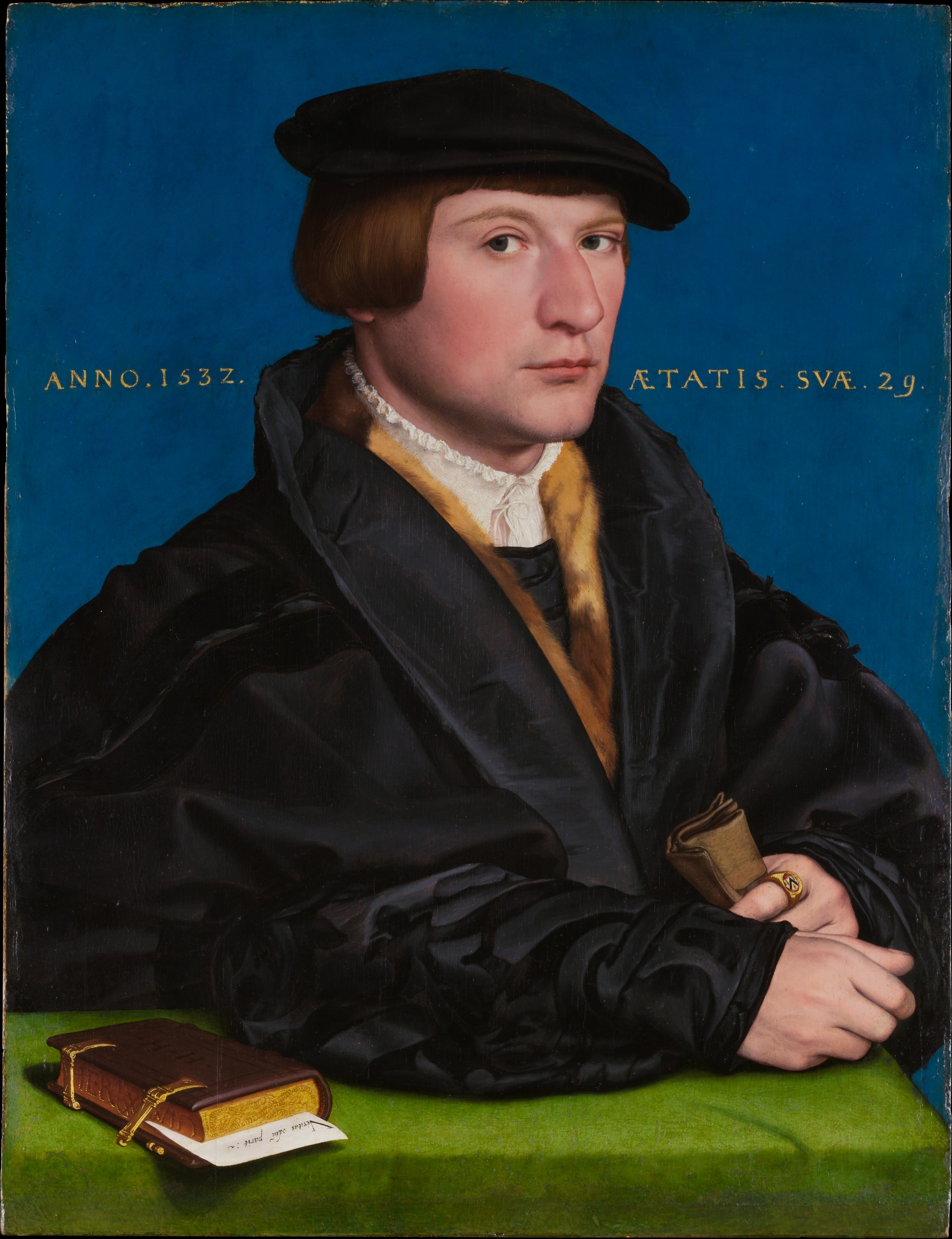
The Renaissance Portrait as Couture: Deconstructing Hermann von Wedigh III
In the pantheon of fashion history, the portrait of Hermann von Wedigh III (died 1560) stands as a masterclass in the intersection of art, identity, and textile diplomacy. This standalone study, rendered in oil and gold on oak, transcends mere documentation of a Hanseatic merchant. It is a sartorial manifesto—a strategic deployment of fabric, color, and material wealth to assert global influence in an era of nascent capitalism. As Lead Curator of Katherine Fashion Lab, I analyze this work not as a static artifact but as a living archive of couture logic, where every thread and pigment speaks to power, provenance, and the art of self-construction.
Materiality as Message: Oil, Gold, and the Economics of Luxury
The choice of oil and gold on oak is itself a textile metaphor. In the 16th century, oak panels were the canvas of Northern Renaissance commerce—durable, portable, and symbolic of the Baltic timber trade that underpinned Hanseatic wealth. The medium of oil paint allowed for unprecedented verisimilitude, rendering the texture of velvet, the sheen of fur, and the crispness of linen with forensic precision. Yet it is the gold leaf that elevates this portrait from likeness to liturgy. Applied not as mere backdrop but as a structural element—gilding the chain, the buttons, the hilt of the dagger—gold transforms the sitter’s attire into a wearable treasury. For von Wedigh, a merchant of the Hanseatic League, gold was not ornament but currency. Each brushstroke of gold leaf declares liquidity, solvency, and access to global trade routes that stretched from Antwerp to Novgorod.
The Black Velvet Doublet: A Study in Restraint and Opulence
Von Wedigh’s black velvet doublet is the anchor of this couture narrative. Black, in 16th-century Northern Europe, was the most expensive dye to achieve with stability—a feat of chemical engineering that required imported logwood and complex mordants. Far from a sign of mourning, black velvet signaled sobriety, authority, and technological mastery. The doublet’s construction is a lesson in tailoring: a fitted silhouette, high neckline, and padded shoulders that exaggerate the male form into a geometric ideal. The velvet’s pile catches light differently at every angle, creating a living texture that mimics the movement of liquid metal. This is not mere cloth; it is a statement of control over nature, a fabric that bends to the will of its wearer. The absence of visible embroidery or slashing—common in Spanish or Italian fashion of the period—speaks to a Northern European aesthetic of austere luxury. Every detail is edited, every seam deliberate.
The Fur Collar: Global Heritage in a Single Garment
Perhaps the most arresting element is the broad fur collar that frames von Wedigh’s face. Likely sable or marten, this pelt originates from the Russian steppes, a commodity controlled by Hanseatic monopolies. The fur is not merely warm; it is a geopolitical trophy. Its deep brown-black hue, rendered in layers of translucent oil glazes, creates a chiaroscuro that draws the eye upward to the sitter’s gaze. The texture is almost tactile—one can imagine the weight of the pelt, the softness against the cheek, the faint scent of woodsmoke and amber. In contemporary couture terms, this fur functions as a statement collar, a piece that transforms the silhouette and announces the wearer’s access to distant ecosystems. It is the 16th-century equivalent of a Birkin bag or a bespoke vicuña coat: a marker of exclusivity and global reach.
The White Linen Ruff: Architecture of Status
At the throat, a white linen ruff emerges with architectural precision. Stiffened with starch—a Flemish innovation—the ruff is a marvel of textile engineering. Each pleat is meticulously pressed, creating a radial pattern that frames the face like a halo. The whiteness is achieved through labor-intensive bleaching, a process that required sunlight, urine, and skilled laundresses. This is visible labor rendered as luxury. The ruff’s height and rigidity force the wearer into a posture of dignity; to slouch is to crush the collar, to lose face. In this way, the garment disciplines the body, turning posture into a performance of class. The ruff also serves as a neutral canvas against which the gold chain and dark velvet pop—a lesson in color theory that any fashion director would recognize.
Accessories as Armor: The Gold Chain and Dagger
Von Wedigh’s accessories are not decorative but functional signifiers of sovereignty. The heavy gold chain, with links that alternate between smooth and twisted textures, is a portable bank. In an era before paper currency, a merchant’s wealth was worn on the body. The chain’s weight is palpable; it anchors the chest, drawing the eye downward to the dagger at the waist. The dagger’s hilt is gilded, its scabbard leather—a tool of both commerce and self-defense. Together, these objects tell a story of mobility: von Wedigh is a man who travels, who negotiates, who protects his assets. The chain and dagger are the original power accessories, predating the Rolex or the Hermès scarf by centuries. Their placement in the portrait is deliberate: the chain aligns with the heart, the dagger with the hand. This is a body mapped for action.
Color Palette: The Economics of Hue
The portrait’s chromatic strategy is a lesson in global supply chains. Black (from logwood), white (from bleached linen), gold (from mined ore), and the deep brown of fur (from Siberian forests) are not arbitrary choices. Each pigment represents a trade route, a labor system, a cost. The absence of red—a color associated with cardinal or Spanish wealth—is notable. Von Wedigh does not compete with ecclesiastical or imperial power; he asserts a mercantile aristocracy that is distinct from the old nobility. The palette is cool, restrained, and intellectual. It whispers rather than shouts, a strategy of understatement that modern luxury brands like Loro Piana or Brunello Cucinelli have perfected. The skin tones, rendered in subtle ochres and pinks, are the only warm element—a reminder that the human face is the ultimate luxury, the one asset that cannot be traded.
The Hands: A Couture Detail Overlooked
In many Renaissance portraits, hands are afterthoughts. Here, they are narrative anchors. Von Wedigh’s right hand rests on a table, fingers slightly spread, as if gesturing during a negotiation. The left hand holds a pair of gloves—another status marker. Gloves, like the ruff, are pristine white, suggesting that von Wedigh does not engage in manual labor. Yet the hands are not soft; they are broad, with visible tendons. This is a man who has handled goods, who has inspected bales of wool and barrels of herring. The gloves are a barrier between the body and the world, a couture object that mediates touch. In contemporary terms, they are the equivalent of a leather driving glove or a surgical glove—a tool that signals both protection and professionalism.
Conclusion: The Portrait as a Business Strategy
Hermann von Wedigh III’s portrait is not a passive record of fashion. It is an active instrument of brand building. Every element—the gold leaf, the fur, the starched ruff, the dagger—is a calculated choice in a visual economy where appearance was capital. For Katherine Fashion Lab, this work offers a blueprint for how luxury can communicate heritage, craftsmanship, and global reach without resorting to logos or overt branding. The portrait teaches us that true couture is always context-aware—it knows its audience, its materials, and its message. Von Wedigh, a merchant of the Hanseatic League, understood what every fashion house must: that clothes are not just worn; they are read. And in this reading, a 16th-century merchant becomes a timeless icon of strategic self-presentation.