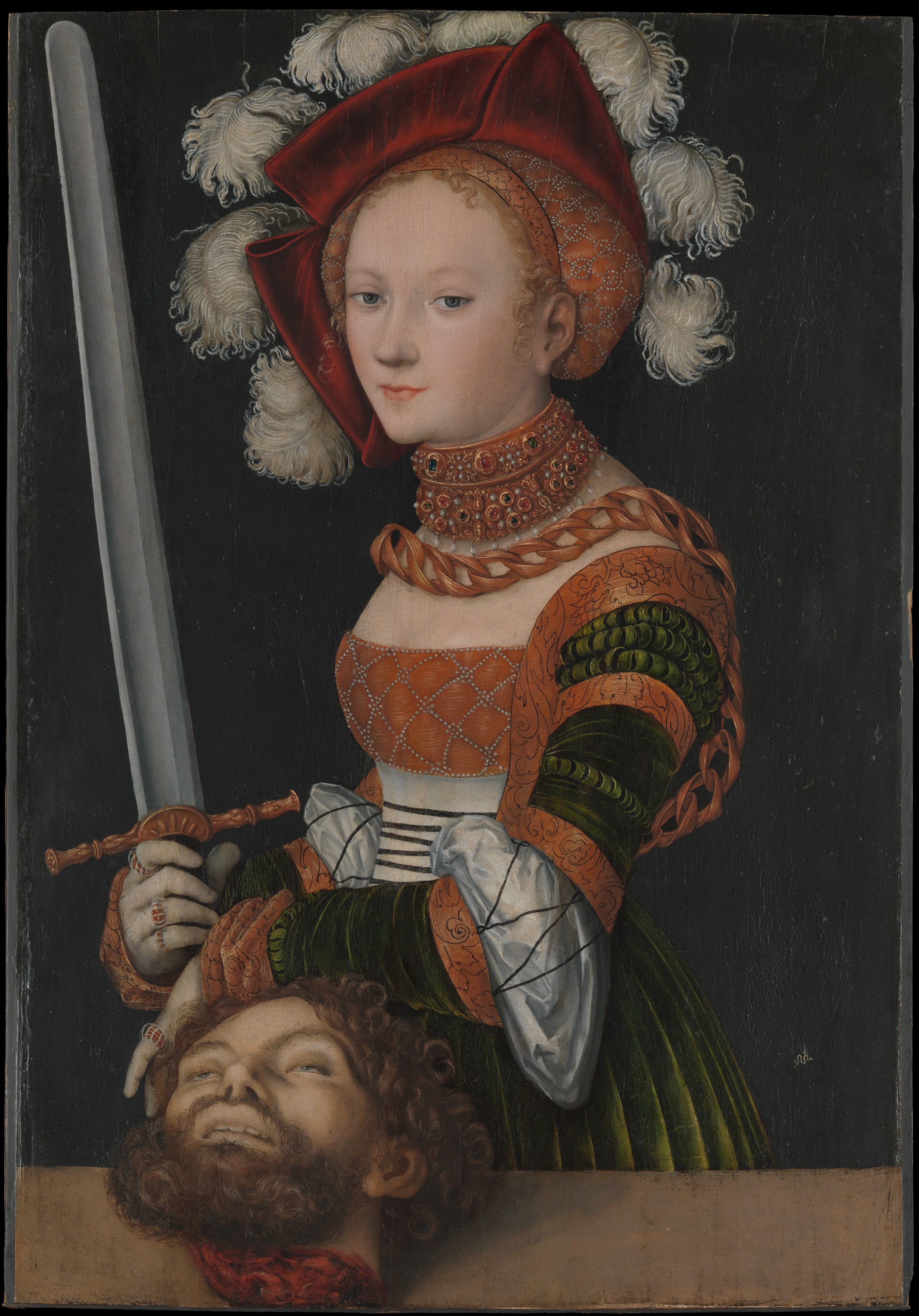
Heritage Analysis: Judith with the Head of Holofernes
Context and Provenance
This analysis examines the oil-on-linden depiction of Judith with the Head of Holofernes, a subject deeply rooted in ancient civilization and biblical apocrypha. The medium—oil on linden wood—evokes the craftsmanship of Northern Renaissance workshops, where such panels were revered for their luminous, durable finish. The subject itself originates from the Book of Judith, a text of Jewish antiquity (circa 2nd century BCE), recounting the widow Judith’s strategic seduction and decapitation of the Assyrian general Holofernes to save her besieged city, Bethulia. For Katherine Fashion Lab, this artifact serves as a strategic standalone research focus, offering a rich lexicon of symbolic power, historical adornment, and spiritual meaning—elements that can be translated into a 2026 high-end luxury strategy.
Symbolic Power: The Feminine as Sovereign Force
The narrative of Judith is one of transgressive empowerment. She is not a warrior in the traditional sense but a woman who wields intellect, faith, and physical allure as weapons. The scene—typically depicting Judith holding Holofernes’ severed head—represents a radical inversion of patriarchal power. Her act is not merely violent; it is a calculated assertion of agency, where feminine beauty becomes a tool for liberation. In ancient Near Eastern contexts, decapitation symbolized the complete annihilation of an enemy’s authority, and Judith’s possession of the head signifies her mastery over chaos and tyranny.
For luxury strategy, this symbolism is potent. It speaks to the 2026 consumer’s desire for narratives of quiet dominance—power that is not loud but deliberate, not aggressive but precise. Judith’s story aligns with the rising archetype of the “self-made sovereign,” a figure who commands through wit, heritage, and restrained opulence. Brands that reference this symbolism can position themselves as purveyors of intellectual luxury, where the product is not just an object but a talisman of inner authority.
Historical Adornment: Garments as Armor
In artistic depictions, Judith is often portrayed in sumptuous attire—velvets, brocades, and jewels—that contrasts starkly with the brutality of her deed. This adornment is not mere decoration; it is strategic armor. In the biblical text, she “put off her widow’s garments” and adorned herself with “bracelets, earrings, rings, and all her ornaments” to captivate Holofernes. Her jewelry and textiles function as tools of seduction and, ultimately, destruction. Historically, this reflects the ancient understanding of adornment as a form of power—symbols of status, fertility, and divine favor.
For Katherine Fashion Lab, this invites a reexamination of ornamentation as a weapon. In 2026, high-end luxury can reclaim this concept, designing pieces that are not passive accessories but active statements of intent. Consider a collection where each piece—a choker, a cuff, a brooch—is named after a moment of strategic triumph. The materials should be weighty, precious, and tactile: gold, onyx, blood-red coral, and blackened silver. The linden wood panel’s grain suggests an organic, tactile quality; similarly, luxury items should feel hewn from the earth, bearing the marks of their creation.
Spiritual Meaning: Faith as a Luxury Commodity
Judith’s story is steeped in spiritual meaning. She acts not out of personal vengeance but as an instrument of divine will. Her faith is her ultimate resource, granting her the clarity to act when others falter. The head of Holofernes is not a trophy of violence but a symbol of spiritual victory—the triumph of righteousness over hubris. In ancient iconography, this scene was often placed in churches and private chapels as a reminder of God’s deliverance through the weak.
For a 2026 luxury strategy, spirituality must be reframed not as organized religion but as personal transcendence. The modern affluent consumer seeks meaning beyond materialism; they want objects that serve as anchors for their own inner narratives. A Judith-inspired piece—perhaps a pendant containing a miniature, abstracted head—could symbolize the wearer’s own victories over personal or professional “demons.” This aligns with the growing trend of “sacred luxury,” where brands collaborate with artisans who imbue objects with ritualistic significance. The linden wood itself, historically used for religious icons, suggests a medium that can be sanctified through craft.
2026 High-End Luxury Strategy: The Judith Archetype
To translate this heritage into a marketable strategy, Katherine Fashion Lab must consider three pillars: Narrative Ownership, Material Alchemy, and Experiential Ritual.
Narrative Ownership
The 2026 luxury consumer is a collector of stories, not just objects. A Judith-inspired collection should be launched with a curated narrative—a short film, a limited-edition monograph, or an immersive exhibition—that explores the duality of feminine power. The campaign should feature women in positions of quiet authority: CEOs, artists, activists. The tagline might be: “She who holds the head, holds the future.” This positions the brand as a custodian of ancient wisdom, offering clients a piece of that legacy.
Material Alchemy
The oil-on-linden medium suggests a reverence for natural materials and artisanal process. For 2026, luxury goods should emphasize raw, unpolished elements—rough-cut diamonds, hand-hammered gold, wood inlays—that celebrate the maker’s hand. A handbag might feature a clasp shaped like a miniature sword, or a silk scarf printed with a deconstructed version of the Judith scene, abstracted to the point of being a pattern of swirling forms and deep crimson. The color palette should draw from the painting: deep burgundy, ivory, aged gold, and the stark black of Holofernes’ hair.
Experiential Ritual
Spiritual meaning can be activated through bespoke experiences. Katherine Fashion Lab could offer a “Judith Consultation,” where clients work with a heritage curator to select pieces that symbolize a personal triumph. Each purchase might include a ritual card—a small, linden-wood token inscribed with a blessing or a line from the Book of Judith. This transforms the transaction into a ceremony, aligning with the 2026 trend of “slow luxury” where the act of acquiring is as meaningful as the object itself.
Conclusion
Judith with the Head of Holofernes is far more than a historical curiosity; it is a blueprint for modern luxury. Its symbolic power—feminine sovereignty—resonates with a generation seeking authenticity and agency. Its historical adornment—garments as armor—redefines ornamentation as strategic. Its spiritual meaning—faith as a resource—offers a pathway to transcendent branding. For Katherine Fashion Lab, this heritage analysis provides a rigorous foundation for a 2026 strategy that is not merely fashionable but culturally profound. The linden wood panel, with its delicate grain and enduring presence, reminds us that true luxury is both ancient and eternal.