The Architectural Echo: Deconstructing “Section of the West Front, Houghton Hall, Norfolk” for Couture
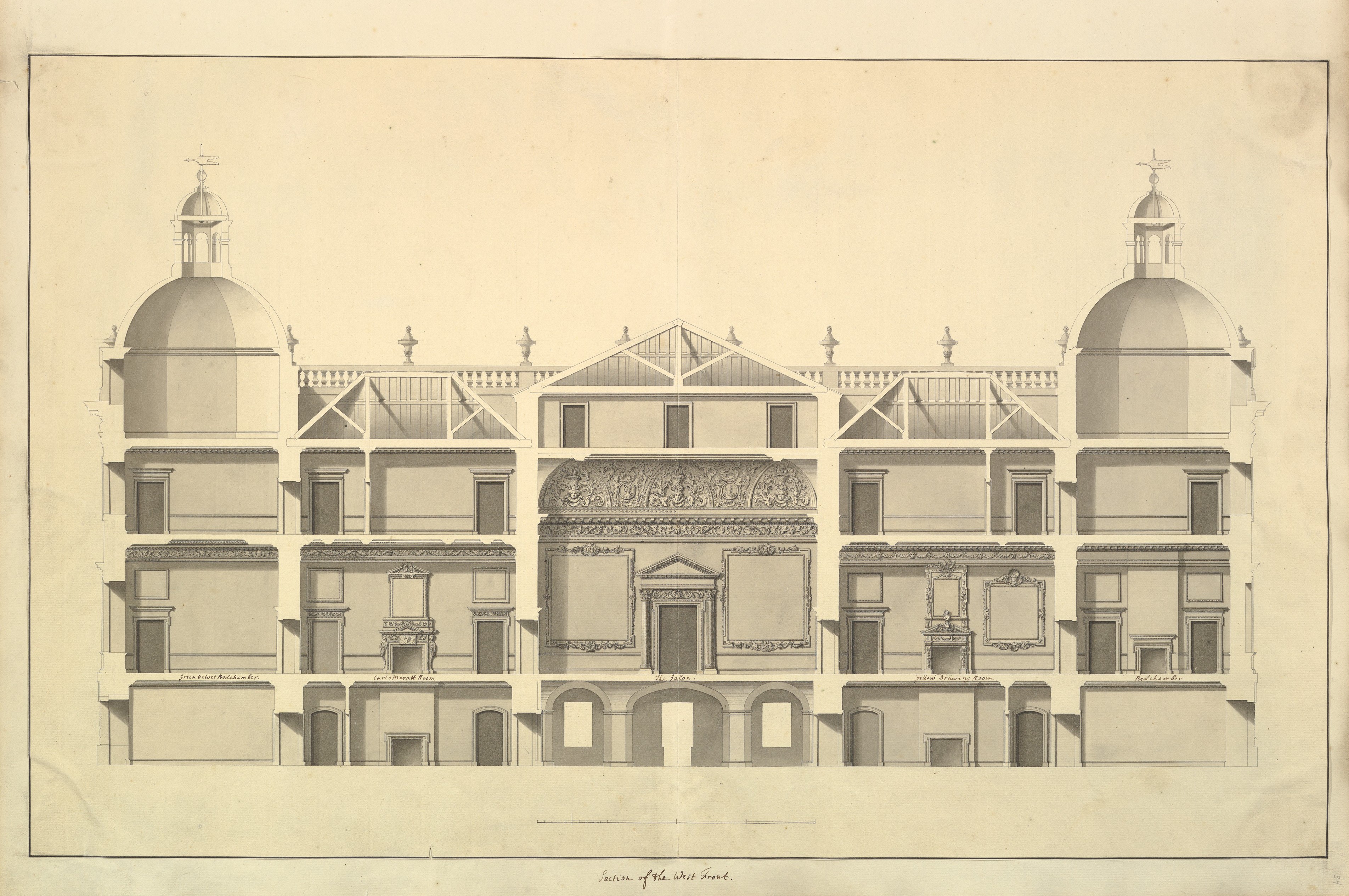
In the hallowed halls of global heritage, where the patina of history meets the precision of architectural draftsmanship, Katherine Fashion Lab finds its most profound muse. The subject before us—a pen and black ink, brush and gray wash study titled Section of the West Front, Houghton Hall, Norfolk—is far more than a mere architectural record. It is a standalone meditation on proportion, shadow, and the silent authority of structure. For the discerning eye of a couture curator, this eighteenth-century Palladian elevation is not a blueprint for stone, but a pattern for fabric; not a static facade, but a dynamic silhouette waiting to be draped.
The Grammar of Gray Wash: Translating Monochrome into Texture
The medium itself—pen and black ink over a foundation of brush and gray wash—dictates the initial palette of our collection. The gray wash, applied in delicate, graduated layers, creates a volumetric chiaroscuro that defines every pilaster, cornice, and window recess. In couture, this translates directly into a study of tonal gradation. Imagine a column dress crafted from a single piece of double-faced cashmere, where the “gray wash” effect is achieved through a painstaking manual pleating technique. The front panel, nearest the light source, remains a pristine, unbleached ivory; as the fabric wraps to the back, it deepens into a charcoal heather, mimicking the shadows cast by the Norfolk sun on Houghton Hall’s west facade.
The pen-and-ink lines, meanwhile, are not mere outlines but structural seams. Each stroke—whether the crisp delineation of a sash window or the fluid curve of a decorative pediment—becomes a topstitch or a piped edge. A tailored jacket, for instance, could feature a network of black silk-cord embroidery that exactly replicates the rhythm of the hall’s fenestration. The windows become negative space, cutouts of peau de soie, while the stone mullions are rendered in matte black grosgrain ribbon. This is not decoration; it is architectural logic applied to the body.
Proportion and the Palladian Silhouette
Houghton Hall, designed by Colen Campbell and James Gibbs, is a masterclass in Palladian symmetry. The west front is a composition of balanced masses: a central portico flanked by two projecting wings, each anchored by a series of evenly spaced bays. For the couture collection, this symmetry is not slavishly copied but reinterpreted as a structural principle. The human form becomes the central portico—the torso—while the arms and shoulders act as the flanking wings. A gown’s silhouette, therefore, must achieve a similar equilibrium.
Consider a floor-length evening coat. The bodice is cut with a severe, straight neckline, echoing the horizontal entablature of the hall. The shoulders are constructed with subtle, architectural padding—not aggressive, but purposeful—that extends the line of the collarbone outward, mimicking the slight projection of the hall’s corner pavilions. The skirt, falling in a column of pleated organza, is anchored by two vertical seams that run from the bust to the hem, replicating the pilasters that divide the facade. Each seam is weighted with a fine chain, ensuring the fabric hangs with the same gravity and stillness as carved stone. The result is a silhouette that is both monumental and fluid, a paradox central to great architecture and great couture.
Negative Space and the Void of the Window
The most compelling element of the Houghton Hall study is its treatment of voids. The windows are not simply left blank; they are rendered as negative shapes within the dense gray wash of the wall. In couture, this concept of negative space is a powerful tool for creating illusion and movement. A sheath dress, for example, could feature strategic cutouts that mirror the hall’s window rhythm. A single, elongated cutout on the left side of the bodice, framed by a black silk binding, reveals a sliver of bare skin—the “light” escaping the void. On the back of the dress, a series of smaller, horizontal cutouts along the spine echo the multi-pane sash windows, creating a visual rhythm that shifts with the wearer’s motion.
This is not mere skin-baring; it is a dialogue between solid and void. The gray wash study teaches us that the wall is defined by the window, just as the fabric is defined by the absence of fabric. A master tailor might employ a technique called appliqué de vide, where a sheer, nude-toned tulle is layered beneath the cutouts, preserving the silhouette while suggesting the transparency of light through glass. The effect is one of architectural transience—the building breathes, and so does the garment.
Materiality: From Stone to Silk
The pen and ink medium demands a reverence for line, while the brush and gray wash demands a reverence for texture. In the Katherine Fashion Lab collection, these demands are met through a careful selection of fabrics. The primary material is a double-faced wool crepe, whose matte finish and substantial weight echo the limestone of Houghton Hall. It is a fabric that holds a crease like a chiseled edge, yet drapes with a softness that belies its architectural inspiration.
For the “black ink” elements, we turn to Japanese silk gazar, a fabric so rigid and crisp that it can be folded into permanent, knife-like pleats. These pleats are used to recreate the vertical fluting of the hall’s Ionic columns, running down the center of a skirt or the sleeve of a bolero. The “gray wash” effect is achieved through a technique of hand-painted indigo gradients applied by artisans in Kyoto. Each garment is a canvas, with the darkest wash at the hem or the cuff, lightening toward the bodice or the shoulder, mirroring the way light falls across the west front from dawn to dusk.
Finally, the hardware—the buttons, the clasps, the zippers—is cast in oxidized silver, mimicking the leaded glass and ironwork of the hall’s windows. Each button is a miniature architectural detail: a tiny pediment, a minuscule keystone. The collection is not merely inspired by Houghton Hall; it is constructed from its visual grammar.
Conclusion: The Standalone Study as Garment
The genius of this pen-and-ink study is its standalone nature. It is not a plan, not a section, not a detail—it is a complete, self-sufficient composition. The couture collection it inspires must similarly function as a series of autonomous, complete works. Each piece—whether a coat, a gown, or a jacket—must be understood on its own terms, as a study in proportion, light, and shadow. The wearer becomes the gallery, the body the plinth.
In the final analysis, Section of the West Front, Houghton Hall, Norfolk is a testament to the enduring power of classical proportion. Katherine Fashion Lab does not seek to replicate the past, but to reanimate its principles through the language of couture. The gray wash becomes a gradient, the pen stroke a seam, the window a cutout. The stone becomes silk, and the building becomes a body. This is the essence of architectural couture: not to wear a building, but to inhabit its logic.