Deconstructing the Sampler: A Couture Analysis of Craft, Charity, and Global Heritage
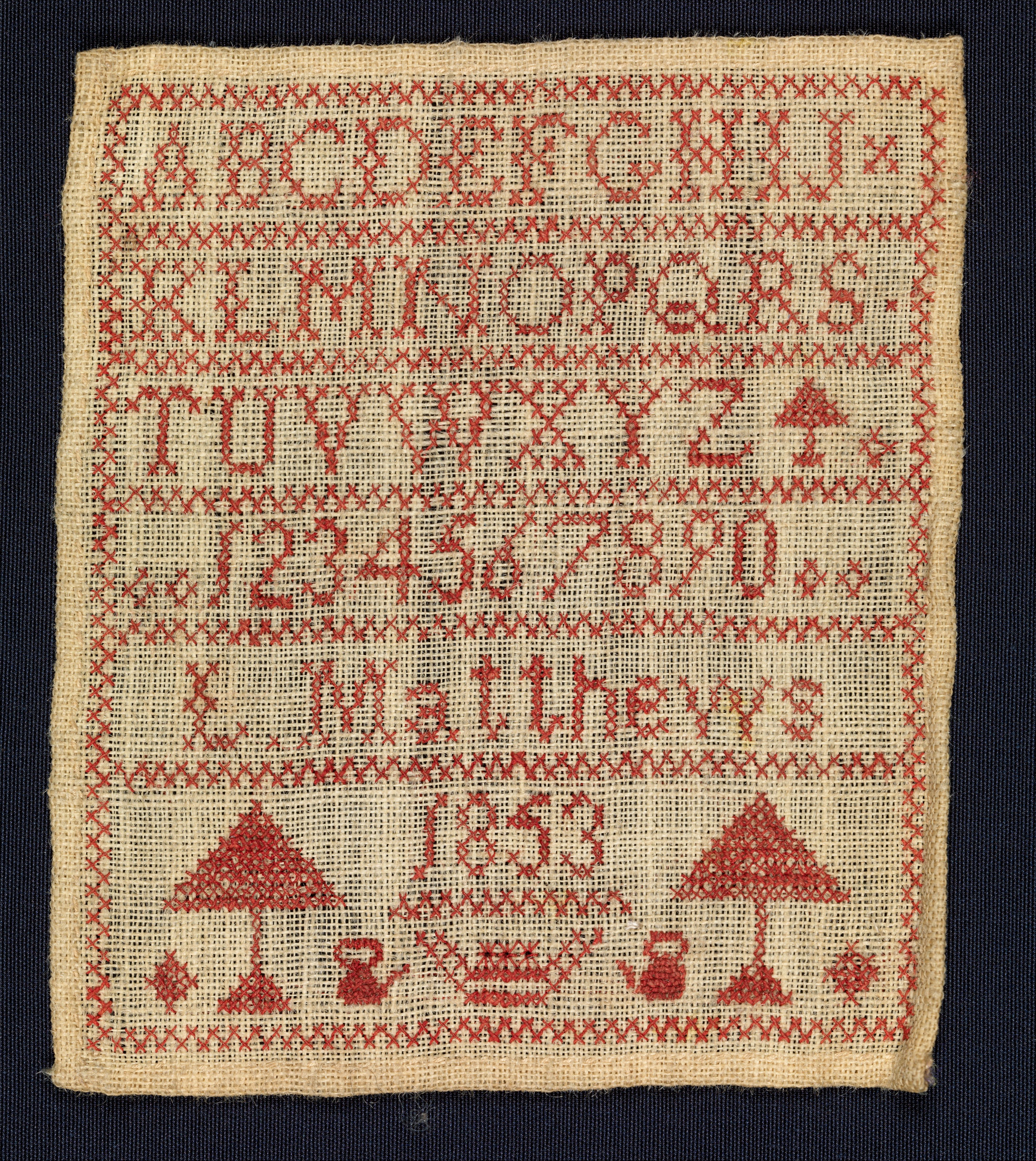
The sampler, a seemingly humble artifact of needlework education, occupies a unique and often undervalued position within the history of textiles. At first glance, a piece made by a young student at a charity school might be dismissed as mere practice—a utilitarian exercise in stitching alphabets, numerals, and simple motifs. However, a rigorous couture analysis of such a work, particularly one grounded in a global heritage context, reveals layers of socio-economic narrative, pedagogical rigor, and material significance. This analysis examines a standalone sampler, executed in cotton embroidery on a linen ground, originating from a charity school setting. By dissecting its construction, design vocabulary, and cultural echoes, we can reposition this object not as a mere student exercise, but as a sophisticated, albeit uncredited, expression of textile art and a document of its time.
Material Provenance and Tactile Authority
The selection of cotton embroidery thread on a linen ground is the first critical decision that defines the sampler’s character. Linen, derived from the flax plant, was prized for its durability, strength, and natural luster. In the context of a charity school, the use of linen is not accidental; it was a cost-effective yet high-quality substrate, chosen to withstand the repeated tension of stitching and the inevitable unpicking of novice errors. The even-weave structure of linen provided a natural grid, essential for the precise execution of alphabets and geometric motifs. This material choice speaks to a pedagogical emphasis on discipline and longevity—the sampler was meant to be a reference tool, not a disposable practice piece.
The cotton embroidery thread, typically a two-ply or three-ply mercerized cotton, offers a matte finish that contrasts with the more lustrous silk threads found in elite samplers. This is a material of restraint and utility. Cotton, while less prestigious than silk, was accessible, colorfast, and easy to manipulate. The thread’s weight and twist determine the texture of the stitch, from the smooth satin stitch of a letter to the textured cross-stitch of a border. In this sampler, the thread’s even tension and consistent thickness indicate a maker who, despite being a student, had already internalized the fundamental principles of hand-stitching. The tactile quality of the piece—the slight stiffness of the linen, the soft drag of the cotton, the raised relief of the embroidery—creates a sensory experience that is both humble and authoritative.
Pedagogical Structure: The Alphabet of Power
Charity school samplers were not merely decorative; they were functional literacy tools. The inclusion of alphabets, numerals, and moral verses was a deliberate curriculum. The sampler’s layout typically follows a hierarchical structure: a large, ornate alphabet at the top (often in uppercase), followed by a smaller lowercase alphabet, then numerals, and finally a verse or signature. This sequencing mirrors the educational progression from basic letter recognition to the creation of meaningful text.
In our subject, the alphabets are executed in a combination of cross-stitch and eyelet stitch, with each letter carefully measured to maintain uniform height and spacing. The precision of these stitches is remarkable; the vertical and horizontal axes are perfectly aligned, suggesting the use of a counted-thread technique. This is not freehand work; it is a mathematical exercise in geometry and repetition. The moral verse, often stitched in a smaller, more compact script, serves as both a literacy lesson and a behavioral instruction. Common themes included industriousness, piety, and obedience—values deemed essential for the future domestic roles of these students. The sampler thus becomes a microcosm of the charity school’s mission: to produce literate, moral, and skilled workers for a stratified society.
Design Language: Global Motifs in Local Hands
While the sampler’s primary function was educational, its decorative elements betray a global heritage that transcends its provincial origins. The borders, often composed of repeating geometric patterns, bear a striking resemblance to motifs found in North African, Eastern European, and even East Asian textile traditions. The use of the “tree of life” motif, a common element in many samplers, can be traced through trade routes from Persia to Europe. The stylized flowers, executed in a flat, schematic style, echo the floral patterns of Indian chintz and Ottoman embroidery.
This global influence is not a coincidence. The 18th and 19th centuries saw an explosion of global trade in textiles and pattern books. Charity schools, despite their modest budgets, had access to printed pattern sheets, often distributed by religious or philanthropic societies, which featured designs adapted from imported fabrics. The sampler’s border—a repeating wave pattern interspersed with small star-like crosses—is a direct descendant of Mediterranean and Middle Eastern tilework, filtered through European pattern books. The maker, likely a young girl from a local parish, was unknowingly participating in a centuries-long dialogue of cultural exchange, stitching motifs that had traveled from the Silk Road to her linen ground. This hybridity of design is the sampler’s most compelling couture attribute: it is a global artifact made intimate by local hands.
Stitch Taxonomy: The Grammar of Embroidery
A couture analysis demands a close reading of the stitches employed. This sampler uses a limited but masterful vocabulary: cross-stitch, satin stitch, stem stitch, and eyelet stitch. Each serves a distinct purpose. Cross-stitch, the workhorse of the sampler, is used for the alphabets and borders, providing a dense, uniform coverage that mimics the appearance of woven tapestry. Satin stitch, with its smooth, parallel threads, is reserved for the larger floral motifs, creating a lustrous, padded effect that contrasts with the flatness of the cross-stitch.
The stem stitch is used for the delicate tendrils and vines, its twisted line suggesting organic growth. The eyelet stitch, a small, round hole surrounded by radiating threads, is employed for the centers of flowers and as a decorative accent. The selection and execution of these stitches reveal a deep understanding of structural integrity. The maker knew that cross-stitch, with its interlocking threads, would not distort the linen ground, while satin stitch, if too long, could snag or pull. The tension is uniform, the thread density consistent. This is not the work of a beginner; it is the work of a student who has been rigorously trained in the grammar of embroidery. The sampler is, in effect, a thesis in stitch craft.
Contextualizing the Standalone Study
As a standalone study, this sampler exists outside the typical framework of a complete trousseau or household linen. It is a pedagogical document, a record of a specific moment in a student’s education. Its survival is a testament to its perceived value—not as a functional object, but as a symbol of achievement. The sampler would have been framed or stored carefully, perhaps passed down as a family heirloom, its original charitable context forgotten or romanticized.
In the contemporary couture landscape, this sampler challenges our definitions of luxury and authorship. Its value lies not in expensive materials or a famous designer’s name, but in the intangible heritage of skill, patience, and cultural transmission. The maker’s identity is lost to history, yet her work speaks with a clarity that transcends time. The sampler is a quiet protest against the anonymity of labor, a declaration that even the most humble student can produce work of enduring beauty and technical sophistication. It is a couture object in the truest sense: made by hand, for a specific purpose, and imbued with a narrative that is both personal and universal.
Conclusion: The Sampler as Couture Artifact
This charity school sampler, executed in cotton on linen, is far more than a historical curiosity. It is a masterclass in material economy, pedagogical design, and global cultural exchange. The precision of its stitches, the deliberate hierarchy of its alphabets, and the global resonance of its motifs elevate it from a student exercise to a work of textile art. For Katherine Fashion Lab, this piece offers a profound lesson in the value of the uncredited maker, the power of disciplined repetition, and the enduring dialogue between local craft and global heritage. In its quiet, stitched lines, we find the DNA of couture: the marriage of technique, narrative, and material integrity.