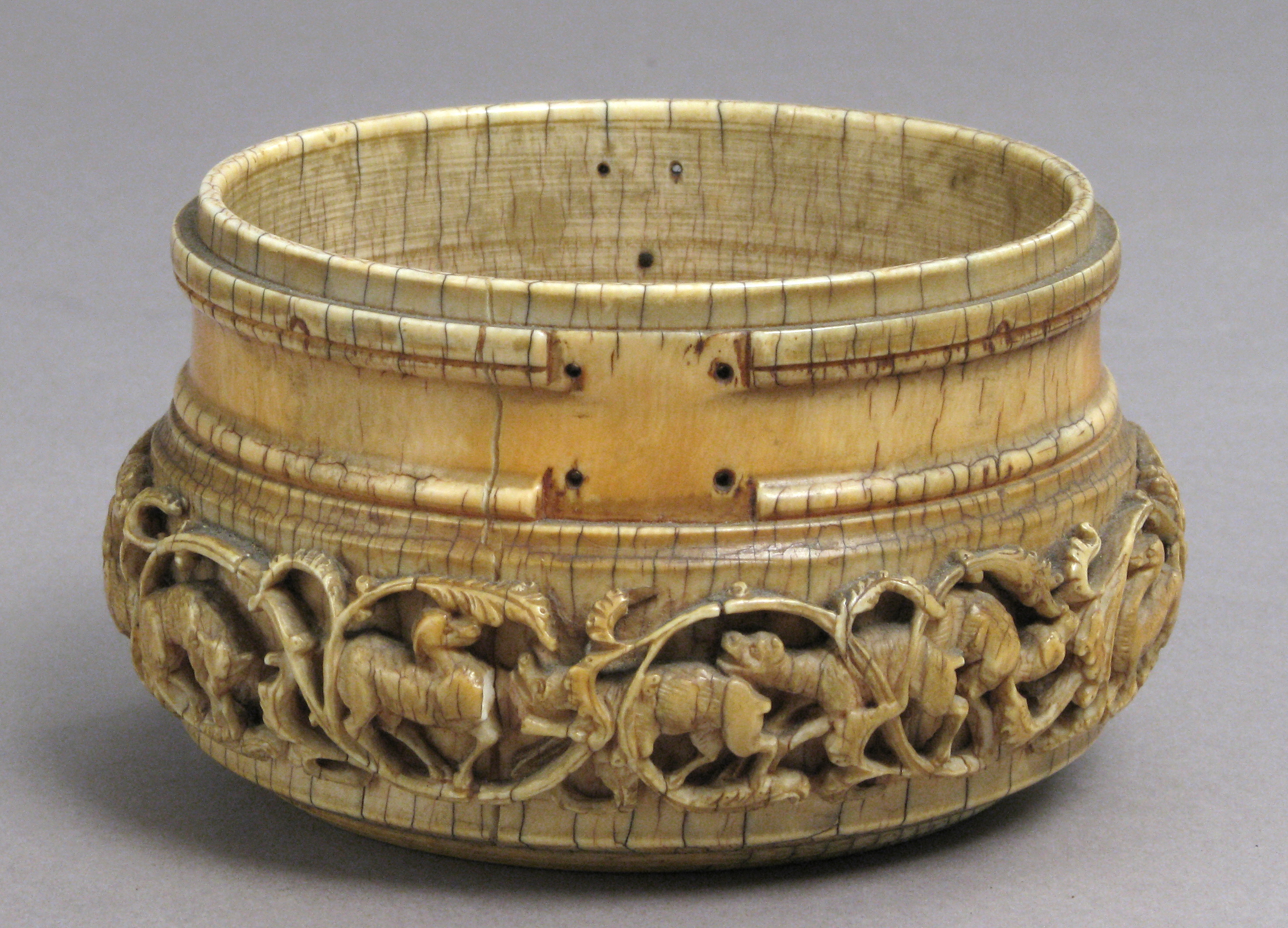
The Circular Box with a Hunting Scene: An Ivory Microcosm of Power and Patronage
In the rarefied domain of historical couture and decorative arts, few objects command the analytical reverence reserved for the Circular Box with a Hunting Scene, a masterwork attributed to Italian craftsmanship of the late Renaissance or early Baroque period. Crafted from elephant ivory, this standalone artifact transcends its utilitarian function as a container, serving instead as a microcosm of aristocratic ideology, technical virtuosity, and the intricate semiotics of power. As Lead Curator at Katherine Fashion Lab, I am compelled to dissect this object not merely as a relic, but as a sophisticated statement of aesthetic and political capital, one that resonates deeply with contemporary discussions of luxury, sustainability, and narrative design.
Materiality and the Politics of Ivory
The choice of elephant ivory as the primary material is the first and most critical element of analysis. In the context of its probable Italian origin, ivory was not a native resource but a precious import, often sourced from African trade routes via Portuguese or Venetian intermediaries. Its use signified far more than aesthetic preference; it was a declaration of global reach, economic potency, and access to exotic commodities. The material’s creamy patina, fine grain, and ability to hold intricate carving made it the medium of choice for objects destined for the studiolo—the private, intellectual sanctuary of a Renaissance prince or cardinal.
Today, the ethical implications of elephant ivory demand a nuanced curatorial lens. At Katherine Fashion Lab, we approach this artifact with a dual consciousness: we honor its historical significance while acknowledging the contemporary imperative for conservation. The box’s survival invites reflection on how luxury materials have historically been entangled with exploitation and ecological cost, a dialogue that enriches our understanding of modern sustainable couture practices. The object itself becomes a pedagogical tool, illustrating the tension between artistic achievement and ethical stewardship.
Technical Mastery: The Art of Intaglio and Relief
The box’s surface is a tour de force of intaglio and high-relief carving. The hunting scene, rendered with microscopic precision, depicts a dynamic chase: hounds in full pursuit, a stag at bay, and mounted hunters armed with spears. The composition is not merely decorative; it is a narrative frozen in time, demanding the viewer to traverse the cylindrical surface as one would turn the pages of a manuscript. The carver’s ability to create depth within the limited circumference of the box is extraordinary. Layers of foreground and background are distinguished by varying degrees of relief, with the hunters and animals emerging almost three-dimensionally from the ivory ground.
This technical complexity speaks to the master-apprentice system that defined Italian decorative arts. The carver would have required years of training to handle the brittle yet dense ivory, which fractures easily if cut against the grain. The absence of any visible tool marks or repairs suggests a level of control that borders on the superhuman. For the modern fashion and design professional, this object serves as a benchmark for artisanal excellence—a reminder that true luxury is inseparable from the mastery of material and technique.
Iconography and the Semiotics of the Hunt
The hunting scene is far from a generic pastoral motif. In Renaissance and Baroque iconography, the hunt was a multilayered symbol. On the surface, it represented the noble pastime of the aristocracy, a display of physical prowess and command over nature. But beneath this lay a deeper allegory: the hunt as a metaphor for the pursuit of virtue, the conquest of vice, or even the soul’s journey toward salvation. The stag, often associated with Christ in medieval bestiaries, adds a spiritual dimension, while the hounds may represent fidelity or the senses.
Furthermore, the circular form of the box itself is laden with meaning. The circle—endless, without beginning or end—evokes eternity, perfection, and the cyclical nature of life and death. By placing a violent, linear narrative of pursuit within this geometric boundary, the artist creates a tension between chaos and order. The box becomes a container not only for physical objects—perhaps jewels, spices, or sacred relics—but for the very idea of control. The owner, by possessing this box, symbolically contained the wild, untamed forces of the natural world within the rational, ordered space of their cabinet.
Contextualizing the Object: The Italian Studiolo
To fully appreciate this box, one must place it within the context of the Italian studiolo. These private chambers, epitomized by Federico da Montefeltro’s in Urbino or Francesco I de’ Medici’s in Florence, were designed as theaters of the self. They housed collections of naturalia, artificialia, and scientifica—objects that demonstrated the owner’s learning, taste, and dominion over knowledge. The Circular Box with a Hunting Scene would have been a prized component of such a collection, displayed alongside cameos, bronzes, and miniature paintings.
The box’s standalone status—its lack of a known pair or set—suggests it was a unique commission, possibly a gift exchanged between courts to cement alliances. The hunting theme, popular among the nobility of Italy, France, and the Holy Roman Empire, would have resonated across borders, making it a diplomatic tool as much as an artistic one. Its small scale (typical of such boxes, often no more than 10–15 cm in diameter) encouraged intimate, tactile engagement, reinforcing the bond between owner and object.
Implications for Contemporary Couture and Design
At Katherine Fashion Lab, we draw direct parallels between this historical artifact and the principles of modern haute couture. The Circular Box with a Hunting Scene exemplifies narrative-driven design, where every detail—from the material to the motif—serves a story. In an era of fast fashion and digital saturation, this object reminds us of the power of slow, intentional craftsmanship. The box’s ability to communicate status, intellect, and personal mythology is a lesson for today’s luxury brands: true value lies not in logos, but in the depth of the narrative and the integrity of the making process.
Moreover, the box’s circular form and intricate carving challenge contemporary designers to think beyond the flat surface. It is a three-dimensional canvas that rewards close examination, much like the texture of a finely woven fabric or the construction of a bespoke garment. The interplay of light and shadow across the carved ivory anticipates the way a sculptural gown moves with the body. The box’s function as a container also invites reflection on the relationship between object and space—how a single, well-crafted item can anchor an entire environment, whether a Renaissance studiolo or a modern minimalist interior.
Conclusion: A Legacy of Craft and Consequence
The Circular Box with a Hunting Scene is far more than a decorative curiosity. It is a testament to the heights of human artistry, the complexities of material ethics, and the enduring human desire to inscribe meaning onto physical form. As we study it at Katherine Fashion Lab, we are reminded that the objects we create today will be the artifacts of tomorrow, bearing witness to our values, our skills, and our contradictions. In this ivory box, we see the past reflected—and the future, waiting to be carved.