Theatrical Stillness: Deconstructing the Couture Narrative in the “Actresses Series” (N664)
Contextual Provenance: From Tobacco Card to Fashion Artifact
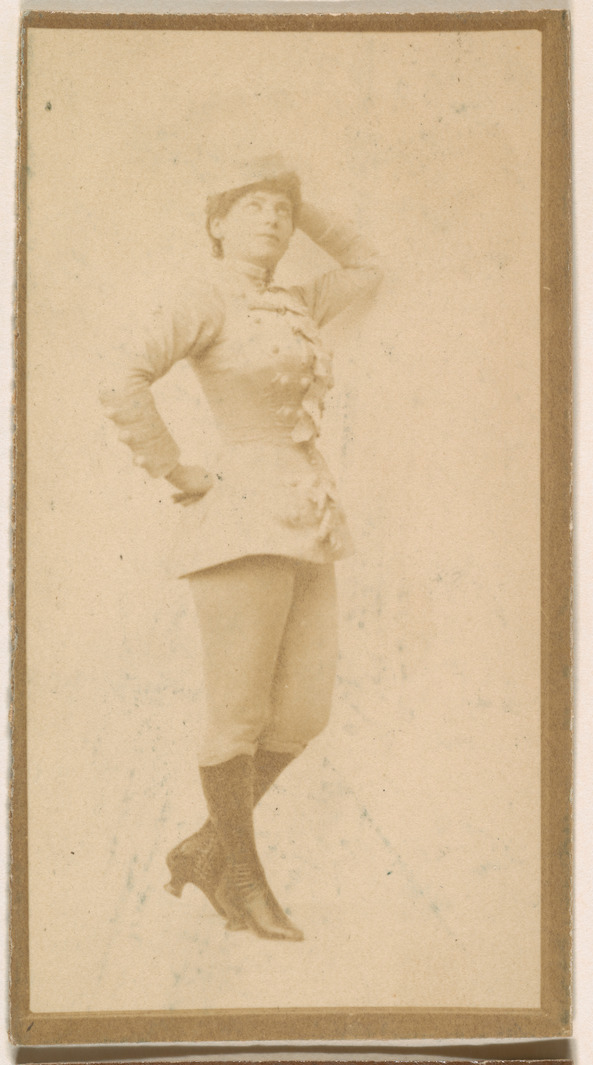
The subject under analysis—an actress leaning against a wall from the Actresses series (N664), originally produced to promote Old Fashion Fine Cut Tobacco—represents a fascinating intersection of commercial ephemera and proto-fashion iconography. As a Global Heritage artifact rendered as an albumen photograph, this standalone study transcends its promotional origins to become a document of late 19th-century sartorial codes. The photograph, likely dating from the 1880s–1890s, captures a moment when the actress was both a commodity for tobacco branding and a living mannequin for the era’s evolving silhouettes. At Katherine Fashion Lab, we recognize this image as a critical, albeit overlooked, touchstone in the genealogy of modern couture—a silent dialogue between theatrical performance, consumer culture, and garment construction.
Silhouette and Structure: The Architectural Frame of the Gown
The actress’s posture—leaning with a subtle contrapposto against a plain wall—serves not merely as a compositional device but as a structural reveal of her gown’s engineering. The albumen print’s sepia tones accentuate the interplay of light and shadow across what appears to be a tightly fitted bodice, likely boned or reinforced with internal stays, characteristic of the cuirass bodice popular in the 1880s. This silhouette extends the torso into a pronounced, almost architectural V-shape, narrowing at the waist before flaring into a bustle-backed skirt. The leaning pose accentuates the bustle’s volume, creating a dramatic horizontal line that balances the verticality of the bodice. From a couture analysis perspective, this is a masterclass in tension and release: the rigidity of the upper garment contrasts with the softer, gathered fabric of the train, which pools on the floor like liquid metal. The photographer’s choice of a neutral background forces the viewer to focus on the garment’s textural contrasts—the dull sheen of silk faille against the matte finish of velvet trim, likely used along the cuffs and neckline.
Materiality and Craft: The Albumen Print as a Fabric Record
The albumen process, which binds photographic emulsion with egg white, imparts a unique, almost painterly quality to the image. This is not a sterile catalog photograph; it is a tactile document. The glossy highlights on the actress’s gown suggest a high-thread-count silk, possibly a duchesse satin, which would have been prohibitively expensive for everyday wear but appropriate for a theatrical portrait. The delicate pleating or ruching visible along the bodice’s center front—likely executed by a skilled petite main—creates a vertical emphasis that elongates the figure, a technique later perfected by designers like Charles Frederick Worth. The leather gloves she wears, perhaps of kid suede, add a layer of haptic contrast: smooth, fitted, and slightly wrinkled at the wrist, they speak to the era’s obsession with complete, coordinated ensembles. The absence of jewelry in this study is noteworthy; the garment itself becomes the sole ornament, a statement of self-contained elegance that anticipates the modernist maxim of “less is more.”
Cultural Semiotics: The Actress as a Fashion Archetype
In the context of the Old Fashion Fine Cut Tobacco campaign, the actress was a vessel for aspirational desire. Yet, from a couture lens, she embodies a specific archetype of feminine power that was emerging in the fin-de-siècle. The leaning posture is not passive; it is a studied nonchalance, a performance of ease that belies the complex infrastructure of her clothing. This is the “Gibson Girl” aesthetic before its codification: a woman who is simultaneously object and subject, her body shaped by corsetry but her gaze direct and knowing. The photograph’s standalone format—a single image without narrative context—elevates the actress from a character in a play to a sartorial icon. She is not acting a role; she is the role of the fashionable woman. This prefigures the 20th-century fashion editorial, where the model’s persona is secondary to the garment’s aura.
Global Heritage: Transatlantic Influences in the Gown’s Design
While the photograph likely originated in the United States or England (given the tobacco brand’s distribution), the gown itself reveals transatlantic influences. The tight corseted waist and pronounced bustle are hallmarks of Parisian haute couture, which was exported globally through pattern books and traveling dressmakers. However, the simplicity of the trim—lacking the excessive passementerie seen in French court fashion—suggests an American or British pragmatism, a nod to the “aesthetic dress” movement that advocated for less restrictive garments. This hybridity is a key feature of Global Heritage: the gown is neither purely European nor purely American but a synthesis of industrial production and artisanal detail. The albumen print itself, a technology that traveled from France to the rest of the world, mirrors this cultural exchange, fixing a moment of globalized fashion in a single, fragile image.
Couture Analysis: The Gown as a Prototype for Modernity
At Katherine Fashion Lab, we argue that this photograph is not merely a historical curiosity but a prototype for the modern fashion system. The actress’s gown, with its structured bodice and fluid skirt, anticipates the bias-cut gowns of the 1930s and the New Look of the 1940s. The leaning pose creates a dynamic line that designers like Madeleine Vionnet would later exploit through draping. The absence of excessive ornament predicts the minimalist turn in 1990s fashion, where cut and fabric take precedence over decoration. The garment’s theatrical origins also presage the rise of celebrity fashion, where clothing is designed for the camera as much as for the body. The albumen photograph captures the performative nature of dress—the way a gown can transform a woman into an icon, even when leaning against a bare wall.
Conclusion: The Enduring Legacy of a Tobacco Card
This standalone study from the Actresses series (N664) offers a rich, layered text for couture analysis. It is a document of labor—both the actress’s and the seamstress’s—a record of materials, and a template for future fashion narratives. As a Global Heritage artifact, it reminds us that fashion history is often hidden in the most mundane objects: a tobacco card, a sepia print, a woman leaning against a wall. At Katherine Fashion Lab, we honor this image as a founding text in the lexicon of modern couture, where the garment speaks louder than the stage, and the photograph becomes the eternal runway.