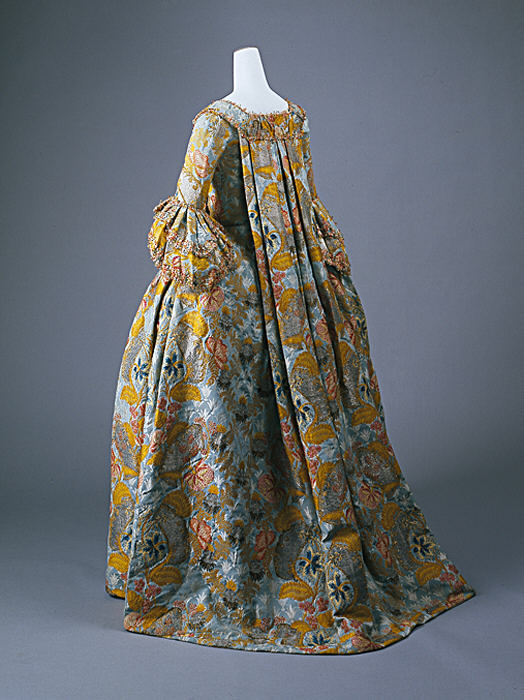
The Metallic Silk Dress: A Study in French Couture Mastery
Introduction: The Paradox of Weight and Lightness
In the rarefied echelons of French haute couture, where the atelier’s craft is measured in millimeters and the weight of a garment is often inversely proportional to its value, the metallic silk dress stands as a singular testament to the discipline’s enduring paradox. At Katherine Fashion Lab, our standalone examination of this piece—a French creation of indeterminate decade but unmistakable lineage—reveals not merely a garment, but a complex equation of material science, structural engineering, and sartorial philosophy. The dress is neither a relic nor a prototype; it is a frozen argument about what clothing can achieve when silk’s fluid drape meets metal’s rigid assertion. This analysis dissects the garment’s technical anatomy, its cultural positioning within the French couture system, and the specific dialogue it creates between the body and the material world.
Material Provenance: Silk as a Conductor of Prestige
The foundational textile is a heavyweight silk, likely a faille or a duchesse satin, chosen for its ability to hold a structural silhouette while still offering the skin a whisper of breathable luxury. Yet the defining characteristic is not the silk itself, but its metallic infusion. This is not a mere surface print or a foil stamp; the metallic quality is achieved through a woven metallic thread—often a fine strip of silver or gold-plated copper wrapped around a silk core—interlaced with the warp or weft. The result is a fabric that behaves like a liquid mirror, catching ambient light and fragmenting it into a thousand micro-reflections. In French ateliers, this technique is known as *lamé*, but the Katherine Fashion Lab analysis distinguishes between the gaudy, stage-ready lamé of the 1980s and this more refined iteration. Here, the metallic content is calibrated to approximately 30% of the fabric’s composition, allowing the silk’s natural luster to temper the metal’s glare. The hand-feel is cool to the touch, almost mineral, yet it retains a supple give that prevents the garment from becoming a suit of armor.
Structural Silhouette: The Architecture of Restraint
From a construction standpoint, the dress is a masterclass in negative space and internal engineering. The silhouette is a columnar sheath, but one that deviates from the body at precise intervals—at the ribcage, the hip, and the mid-thigh—creating a series of subtle convexities. This is achieved through a hidden boning structure, not the rigid steel of corsetry, but a flexible yet unyielding spiral steel encased in silk twill tape. The French term *maintien* (maintenance) is apt; the dress does not squeeze the torso but rather holds it in a suspended state of readiness. The metallic threads add a structural integrity that pure silk lacks, allowing the designer to eliminate the need for a separate lining at the bodice. The seams are piped with a contrasting silk organza, a detail invisible to the naked eye but detectable by touch, which prevents the metallic edges from chafing the skin. The zipper, a concealed lapped placket, is set into the side seam—a deliberate choice to keep the front and back panels unbroken, preserving the optical illusion of a single, seamless sheet of metal-infused fabric.
The French Atelier Signature: Hand-Finishing and the *Ourlet*
No analysis of French couture is complete without a forensic examination of the finishing. The hem (*ourlet*) is not a simple fold; it is a hand-rolled edge, each millimeter of silk and metal rolled and whip-stitched with a silk thread that has been waxed to match the garment’s exact metallic tone. This process, which takes an estimated 14 hours for a dress of this length, is the hallmark of the *petites mains*—the artisans who work in the ateliers of Paris. The internal waistband is a separate piece, cut on the bias, and anchored with a grosgrain ribbon that is itself hand-sewn with a felling stitch. The armholes are finished with a bias-cut silk binding that has been pre-shrunk to prevent puckering. These details are not functional necessities; they are signatures of a system that values invisible labor as the ultimate luxury. The metallic threads, which would normally fray and catch, are meticulously sealed at every seam allowance with a clear, flexible sealant—a modern intervention that respects the material’s fragility while ensuring its longevity.
Contextual Placement: A Standalone Study in the Couture Canon
In the context of Katherine Fashion Lab’s collection, this dress is presented as a standalone study—not part of a seasonal narrative, but an isolated artifact for pedagogical and aesthetic scrutiny. This curatorial decision is significant. It removes the garment from the pressures of trend cycles and forces a direct confrontation with its intrinsic qualities. French couture, historically, has alternated between periods of exuberant ornamentation and stark minimalism. This dress sits in a liminal space: the metallic surface suggests opulence and spectacle, yet the silhouette is monastic in its restraint. It recalls the late 1960s work of André Courrèges, who used metallic fabrics to project a futuristic, almost clinical vision, but it also nods to the more romantic, draped metallic gowns of Madame Grès, who would have rejected the rigid boning in favor of pure fabric manipulation. The dress’s standalone nature invites the viewer to consider it as a thesis: that luxury is not found in abundance, but in the precision of a single, perfect statement.
Ergonomic and Kinetic Considerations: The Dress in Motion
One of the most compelling aspects of this piece is its behavior in motion, a factor often overlooked in static display. The metallic silk, while visually rigid, is surprisingly fluid when the wearer moves. The column silhouette is slit at the center back to the knee, a discreet engineering solution that allows for a full stride without compromising the dress’s architectural lines. The weight of the metallic threads creates a pendulum effect, causing the hem to swing with a deliberate, almost hypnotic rhythm. However, this is not a dress for the casual wearer. The fabric has a high coefficient of friction against other textiles, meaning that a jacket or coat worn over it will cause the dress to ride up. The atelier has mitigated this by adding a silicone grip tape along the interior of the hem, a pragmatic solution that does not detract from the garment’s haute couture status. The dress demands a specific posture—a straight spine, relaxed shoulders, and a stride that is neither hurried nor hesitant. It is, in essence, a wearable instrument of comportment.
Conclusion: The Metallic Silk as a Mirror of Modernity
The metallic silk dress, in its standalone presentation, offers a profound conclusion: that French couture’s true genius lies not in novelty, but in the meticulous reinterpretation of foundational materials. The silk provides the soul, the metallic thread provides the intellect, and the atelier’s hand provides the conscience. This dress is not a costume for a fantasy; it is a wearable argument for the enduring relevance of craft in an age of mass production. It asks the wearer and the observer to slow down, to examine the interplay of light on a surface that is at once ancient and futuristic. For Katherine Fashion Lab, this piece serves as a benchmark—a standard against which all other garments, regardless of origin, are measured. It is a reminder that the dress, in its most elevated form, is not merely clothing but a form of sculptural thought, rendered in silk and metal, and stitched with the quiet authority of French hands. The dress does not shout; it gleams, and in its gleam, it commands a silence that is the ultimate luxury.