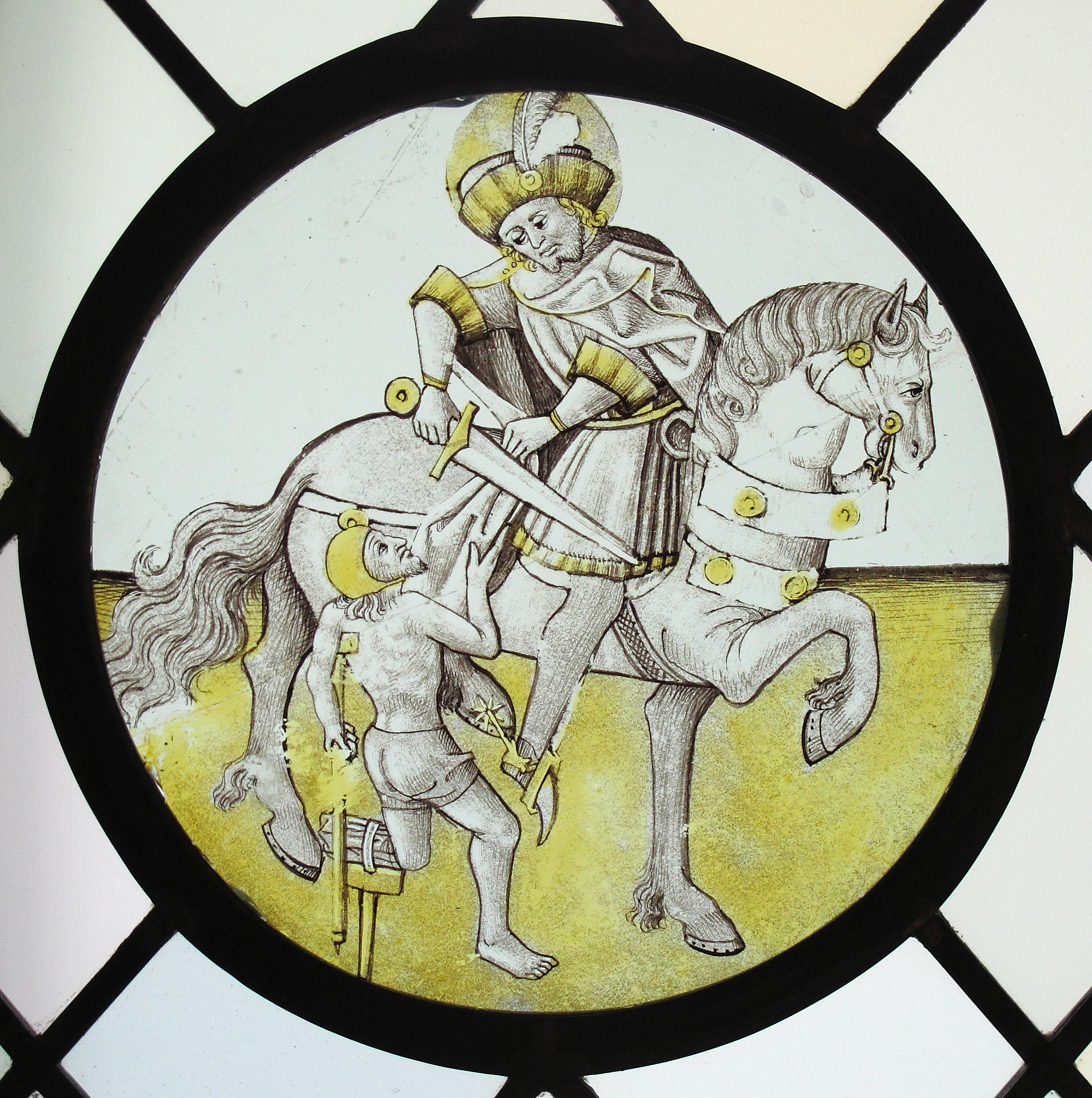
A Study in Contrasts: The Roundel of Saint Martin and the Beggar
At Katherine Fashion Lab, our curatorial lens extends beyond the ephemeral drape of fabric to the enduring narrative of material culture. In this analysis, we turn our gaze from the runway to the reliquary, examining a singular artifact: the German roundel depicting Saint Martin and the Beggar. Crafted from colorless glass, adorned with vitreous paint and silver stain, this standalone study offers a profound meditation on the intersection of medieval piety, nascent artistic technique, and the sartorial semiotics of status and sacrifice. It is not merely a window; it is a manifesto of humility rendered in light.
Technical Mastery and the Alchemy of Light
The roundel’s primary innovation lies in its material execution. The use of colorless glass as a canvas is a deliberate choice, eschewing the jewel-toned saturation of contemporaneous stained-glass windows for a more subtle, almost monochromatic palette. This allows the vitreous paint—a mixture of ground glass, metallic oxides, and a binding medium—to assume absolute authority. The artist has applied this pigment with a draftsman’s precision, building form through layered washes and incised lines. The result is a grisaille effect, a sophisticated play of light and shadow that imbues the figures with a sculptural, almost volumetric presence.
Yet, it is the silver stain that elevates this piece from mere illustration to alchemical wonder. Applied to the reverse side of the glass and fired in a kiln, this compound of silver sulfide and clay transforms into a translucent, golden yellow. In the roundel, this stain is deployed with strategic economy. It gilds the edges of Saint Martin’s cloak, the halo that crowns his head, and the hem of the beggar’s tattered garment. This is not decorative flourish; it is theological illumination. The silver stain becomes the physical manifestation of divine grace, a warm, internal light that emanates from the holy figures and their actions, contrasting with the cooler, more neutral tones of the surrounding glass. The artist has effectively created a painting in light, where the colorless ground is the void and the stain is the spark of the divine.
Deconstructing the Iconography: A Sartorial Reading
Our analysis at Katherine Fashion Lab is inherently drawn to the language of dress. Here, the roundel becomes a silent but eloquent treatise on the social and spiritual functions of clothing. The scene is iconic: Saint Martin, a Roman soldier, encounters a naked beggar at the city gate of Amiens. The pivotal moment, frozen in glass, is the severing of the officer’s military cloak—the chlamys—with his sword.
Consider the sartorial dichotomy. Saint Martin is clad in the regalia of earthly power: a plumed helmet, a fitted cuirass over a tunic, and the voluminous, flowing cloak. His attire speaks of rank, discipline, and the authority of the Roman Empire. The fabric is depicted with crisp, linear folds that suggest a heavy, luxurious wool, perhaps dyed with costly Tyrian purple or a deep red, though in grisaille we read it through tonal value. The beggar, in stark contrast, is rendered nearly nude, his emaciated frame a testament to his destitution. His only covering is a loincloth, the fabric barely clinging to his form. He is the anti-fashion figure, stripped of all markers of identity and social standing.
The act of cutting the cloak is, therefore, a radical act of deconstruction. It is a violent, decisive severing of the signifiers of status. Martin does not simply give alms; he dismantles his own identity, rending the very garment that defines his public persona. This is not a donation of surplus; it is a sacrifice of the self. The cloak, once a symbol of imperial might, is transformed into a symbol of radical charity. The fragment he retains is now a relic, a reminder of the moment when material possession was subordinated to spiritual imperative.
Narrative and Composition: The Economy of Gesture
The composition of the roundel is a masterclass in narrative economy. The circular format, a tondo, forces a concentrated, almost intimate viewing experience. There is no extraneous landscape, no architectural backdrop to distract the eye. The figures fill the frame, creating a powerful psychological tension. The artist has chosen the precise moment of the sword’s descent, the blade poised mid-air, the cloak beginning to give way under its edge. This frozen gesture is the fulcrum of the entire narrative.
The postures are eloquent. Saint Martin is depicted with a slight forward lean, his gaze directed not at the beggar’s eyes but at the point of contact between his sword and his garment. This is an expression of focused, purposeful action, devoid of theatrical sentimentality. The beggar, in turn, is shown in a state of grateful anticipation, his hands raised in a gesture of prayer or acceptance. The dynamic between them is one of profound connection, a momentary bond forged through a single, decisive act.
The artist’s use of line is essential to this effect. The drapery of Martin’s cloak is articulated with bold, rhythmic arcs that convey its weight and volume. The beggar’s ribs are delineated with fine, almost ethereal strokes, emphasizing his fragility. These contrasting linear languages—one forceful, the other delicate—reinforce the thematic opposition of power and vulnerability, abundance and need.
Context and Function: The Standalone Devotional Object
The designation of this roundel as a standalone study is significant. Unlike the vast narrative cycles found in church windows, this piece was likely intended for private devotion. It may have been set into a small wooden frame or a portable altar, serving as a focal point for personal meditation. The intimate scale encourages a close, contemplative engagement with the subject matter. The viewer is not a passive observer in a grand cathedral but an active participant in a private dialogue with the holy.
This context elevates the roundel’s function from mere illustration to a memento mori and a call to action. For a wealthy patron, the image would serve as a potent reminder of the Christian duty of charity. It is a visual sermon on the words of Christ in the Gospel of Matthew: “I was naked and you clothed me.” The roundel is not simply a picture of a past event; it is a perpetual present, a mirror held up to the viewer’s own conscience. The act of looking becomes an act of self-examination. The silver stain, glowing from within, suggests that the divine light of grace is accessible through such acts of selfless giving.
Conclusion: A Legacy of Light and Humility
The Roundel with Saint Martin and the Beggar stands as a testament to the sophisticated artistic culture of medieval Germany. It is a work of remarkable technical achievement, where the painterly manipulation of vitreous paint and the alchemical magic of silver stain converge to create an image of profound spiritual resonance. Through the lens of fashion and material culture, it offers a compelling narrative about the symbolism of dress, the performance of identity, and the transformative power of sacrifice.
In its quiet, monochromatic beauty, the roundel speaks louder than any polychrome spectacle. It reminds us that true elegance lies not in the opulence of the garment but in the grace of the gesture. It is a study in contrasts—between light and shadow, wealth and poverty, power and humility—that remains as relevant today as it was centuries ago. For us at Katherine Fashion Lab, it is a timeless lesson in the art of seeing beyond the fabric to the soul that wears it.